Mastering PLC and Machine Vision Integration on Packaging Conveyors
Master PLC and machine vision integration on packaging lines. Learn how to synchronize high-speed inspection with industrial Ethernet and sub-10ms response times.
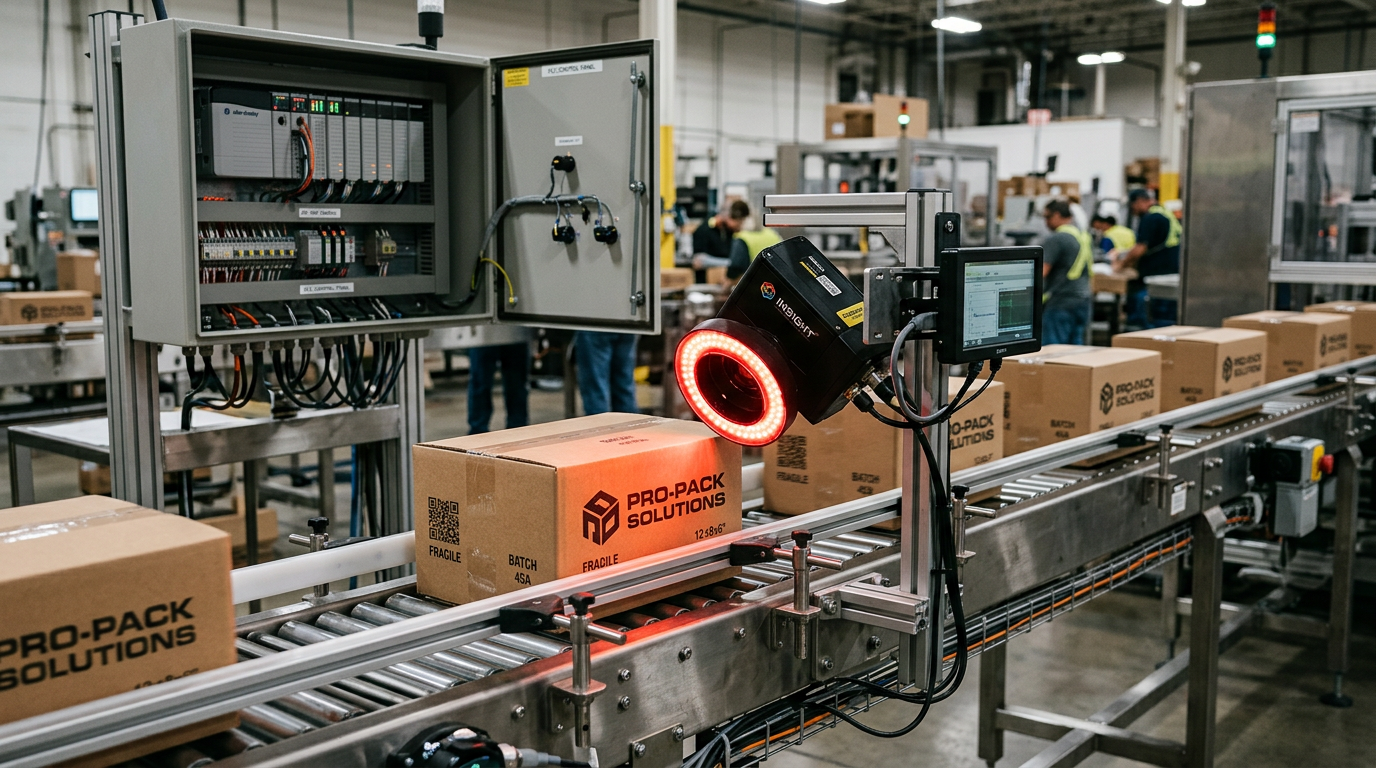
Synchronizing PLC and machine vision integration on packaging conveyor lines requires a high-speed communication protocol (such as PROFINET or EtherNet/IP) that achieves a deterministic response time of less than 10 milliseconds to ensure 100% inspection accuracy at line speeds exceeding 60 meters per minute. This architectural synergy allows the Programmable Logic Controller (PLC) to manage physical motion while the vision system provides real-time quality data, enabling automated rejection or sorting without interrupting throughput.
The Architecture of Synchronized Inspection
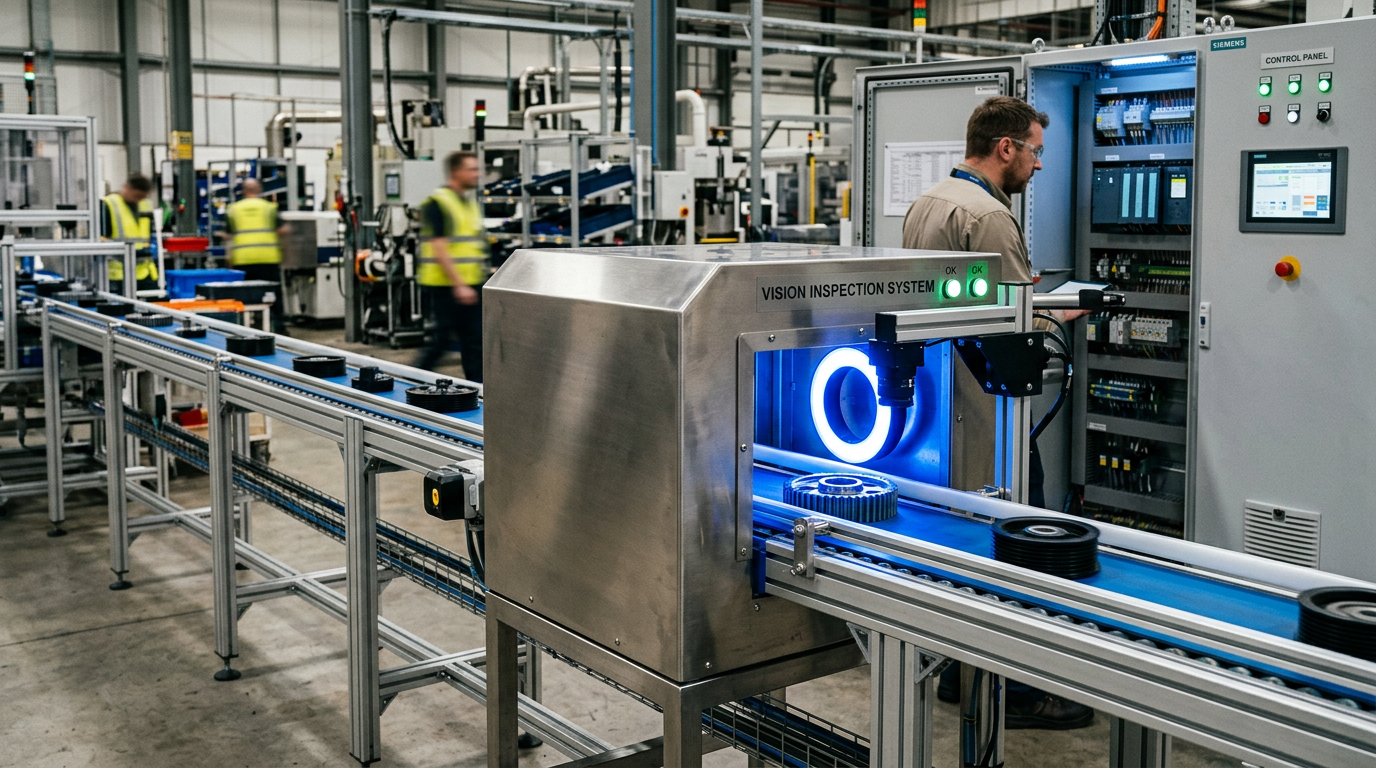
The integration of vision systems into a packaging line is no longer just about mounting a camera; it is about creating a unified control loop. In modern automation, the PLC serves as the "brain" for physical logic—handling motor starters, variable frequency drives (VFDs), and safety circuits—while the machine vision system acts as the "eyes," identifying defects or reading codes.
To achieve seamless integration, the system must handle four critical phases: triggering, acquisition, processing, and action. For high-speed lines, the trigger is often a hardware signal sent from the PLC to the camera via a digital output, synchronized with an encoder pulse. This ensures the camera captures the image exactly when the product is in the field of view, regardless of slight variations in conveyor speed.
Communication Protocols and Latency
The bottleneck in most integrations is data latency. Industrial Ethernet protocols have become the standard for bridging the gap between the vision processor and the PLC.
- PROFINET: Widely used in European manufacturing, it allows for real-time cyclic data exchange.
- EtherNet/IP: Common in North American plants, utilizing the Common Industrial Protocol (CIP) for seamless device integration.
- OPC UA: Often used for vertical integration, sending inspection results to SCADA or ERP systems for long-term data logging.
According to IEC 61158 standards, industrial communication must maintain determinism to prevent "jitter" in the inspection timing. If a PLC receives a "fail" signal 50ms too late, the reject actuator might strike the wrong package or miss it entirely.
Comparison of Integration Methods
| Feature | Discrete I/O | Industrial Ethernet (PROFINET/EIP) | PC-Based Vision |
|---|---|---|---|
| Complexity | Low | Medium | High |
| Data Depth | Pass/Fail only | Results, Strings, Coordinates | Full Image Data |
| Response Time | < 1 ms | 2–10 ms | 10–50 ms |
| Scalability | Poor | Excellent | Good |
| Standard | NEMA ICS | IEC 61158 | GigE Vision |
Precision Hardware Integration
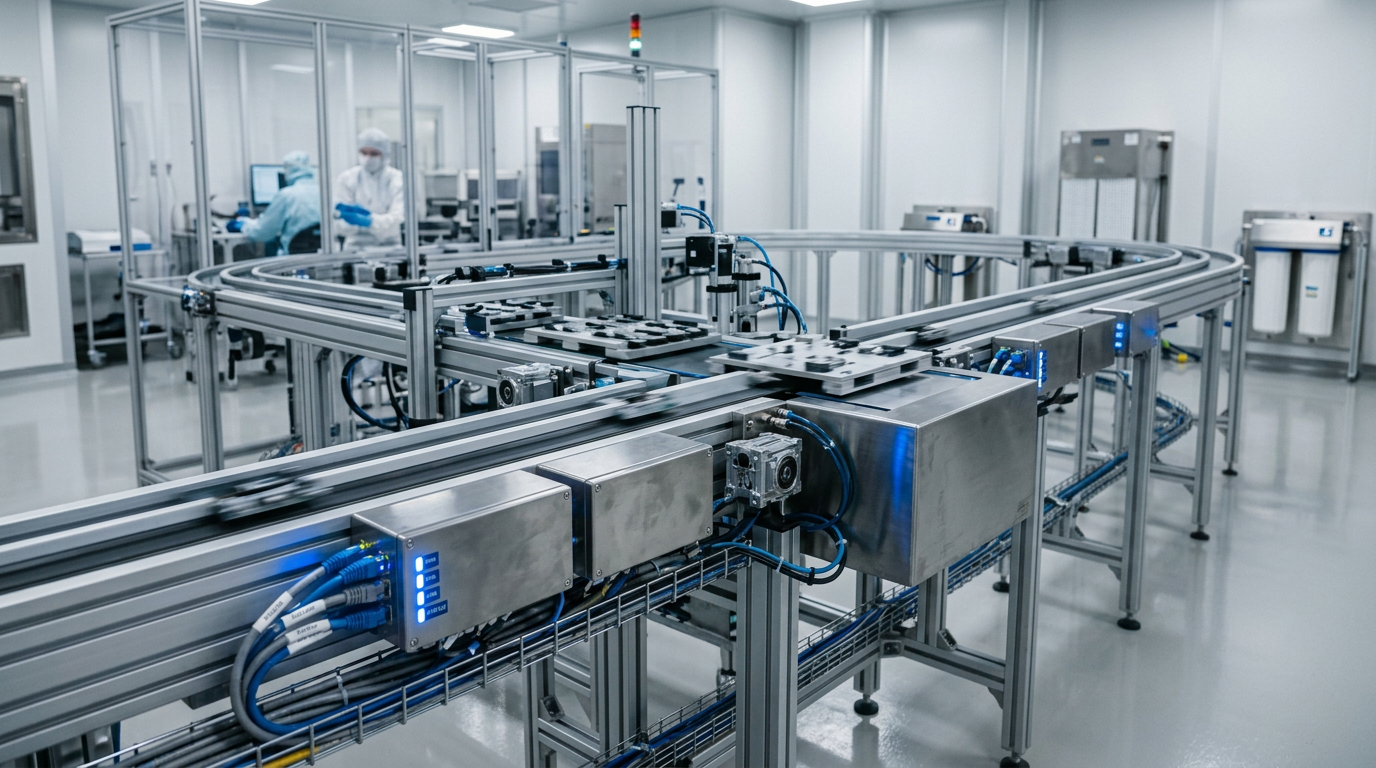
For vision systems to function correctly, the mechanical foundation must be stable. Vibration is the enemy of high-resolution inspection. This is where the choice of conveyor frame and belt material becomes critical. Easy Conveyors provides modular conveyor systems designed with high-stability aluminum or stainless steel profiles that minimize high-frequency oscillations, ensuring the camera’s focal point remains consistent.
Furthermore, the conveyor's drive system must support the precision required. Using an IE3 efficiency class motor (IEC 60034-30-1) paired with a high-resolution encoder allows the PLC to track the position of a package within ±1mm as it moves from the inspection point to the rejection station.
Easy Conveyors stocks the industrial automation discussed here — ready to ship across Europe.
Key Vision Tasks in Packaging
- Label Verification: Ensuring the correct label is applied and is legible (OCR/OCV).
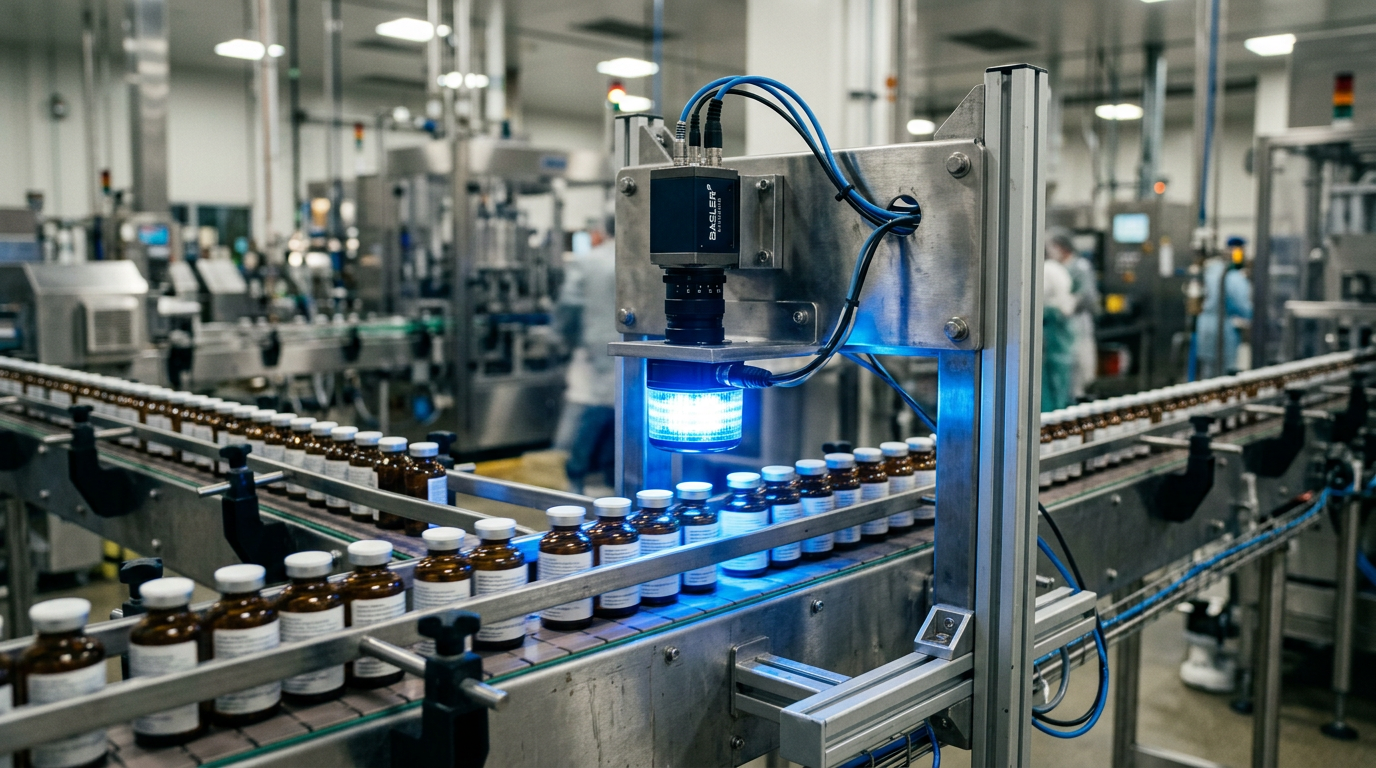
- Fill Level Inspection: Especially critical in beverage and pharma to meet FDA regulations regarding product volume.
- Cap and Seal Integrity: Detecting skewed caps or broken safety seals.
- Primary Packaging Sorting: Using vision to guide a delta robot or a pneumatic pusher to sort products by SKU.
Handling the Reject Logic
Once the vision system processes an image, it sends a result bit to the PLC. The PLC must then "buffer" this result in a shift register or a FIFO (First-In, First-Out) queue. As the conveyor moves, the PLC tracks the distance using encoder pulses. When the tracked package reaches the reject station (e.g., a blow-off nozzle or a pusher), the PLC triggers the output.
This process, often called "Electronic Gearing" or "Camming" in motion control, ensures that even if the belt stops and starts, the PLC never loses track of which package was marked as a "fail."
Design Considerations for Wash-down Environments
In food and pharmaceutical packaging, hygiene is paramount. Vision systems must be housed in IP69K-rated enclosures to withstand high-pressure, high-temperature cleaning. The integration must also consider the EHEDG guidelines for hygienic design, ensuring that camera mounts and cable glands do not create "dead zones" where bacteria can grow.
Stainless steel conveyors with open-frame designs are preferred here, as they allow for thorough cleaning while providing the rigid mounting surfaces necessary for keeping cameras and lighting calibrated.
Advanced Trends: AI and Edge Computing
The industry is moving toward "Deep Learning" vision systems. Unlike traditional rule-based vision, AI-based systems can identify complex defects like a bruised fruit or a slightly torn plastic film that varies in appearance.
Integrating AI vision with a PLC typically requires a more robust data pipe. The vision system might handle the complex inference at the "edge" and only send a simplified classification code to the PLC. This reduces the processing load on the PLC while maintaining the speed of the packaging line.
Troubleshooting Common Integration Issues
- Trigger Misses: Often caused by sensor bounce or incorrect debounce timers in the PLC.
- Image Blur: Usually a result of mismatched exposure times relative to conveyor speed. Rule of thumb: Exposure time should be less than the time it takes the product to move one pixel.
- Data Mismatch: Occurs when the vision system results are not synchronized with the encoder-tracked position, often due to high network traffic or unscheduled interrupts in the PLC scan cycle.
When designing these systems, referring to Rockwell Automation's Integrated Architecture or Siemens TIA Portal documentation can provide specific function blocks designed to handle vision-to-PLC handshaking, which significantly reduces commissioning time and minimizes the risk of logical errors during high-speed operation.
Frequently Asked Questions
What is the ideal latency for vision-to-PLC communication?
The industry standard for high-speed inspection is sub-10 milliseconds. This includes image acquisition, processing time, and the network communication delay to the PLC.
Should I use a hardware trigger or a software trigger for the camera?
Hardware triggers (24V DC) offer the lowest jitter and are preferred for high-speed lines. Software triggers via Ethernet are acceptable for slower applications where +/- 5ms variation won't impact accuracy.
How does the PLC track a 'failed' item until it reaches the reject station?
A shift register or FIFO (First-In-First-Out) buffer in the PLC tracks the inspection result tied to encoder pulses, ensuring the rejecter activates only when the specific 'failed' item arrives.
Are vision systems compatible with wash-down food environments?
Standard industrial vision systems require IP67 or IP69K rated housings, and the PLC integration must account for cable protection in wash-down environments to meet EHEDG standards.