Mastering Wire Mesh Belts in Heat Treatment and Oven Lines
Wire mesh belts are critical for high-temperature oven lines. Learn how to select alloys like AISI 314, manage thermal expansion, and prevent belt creep failures.
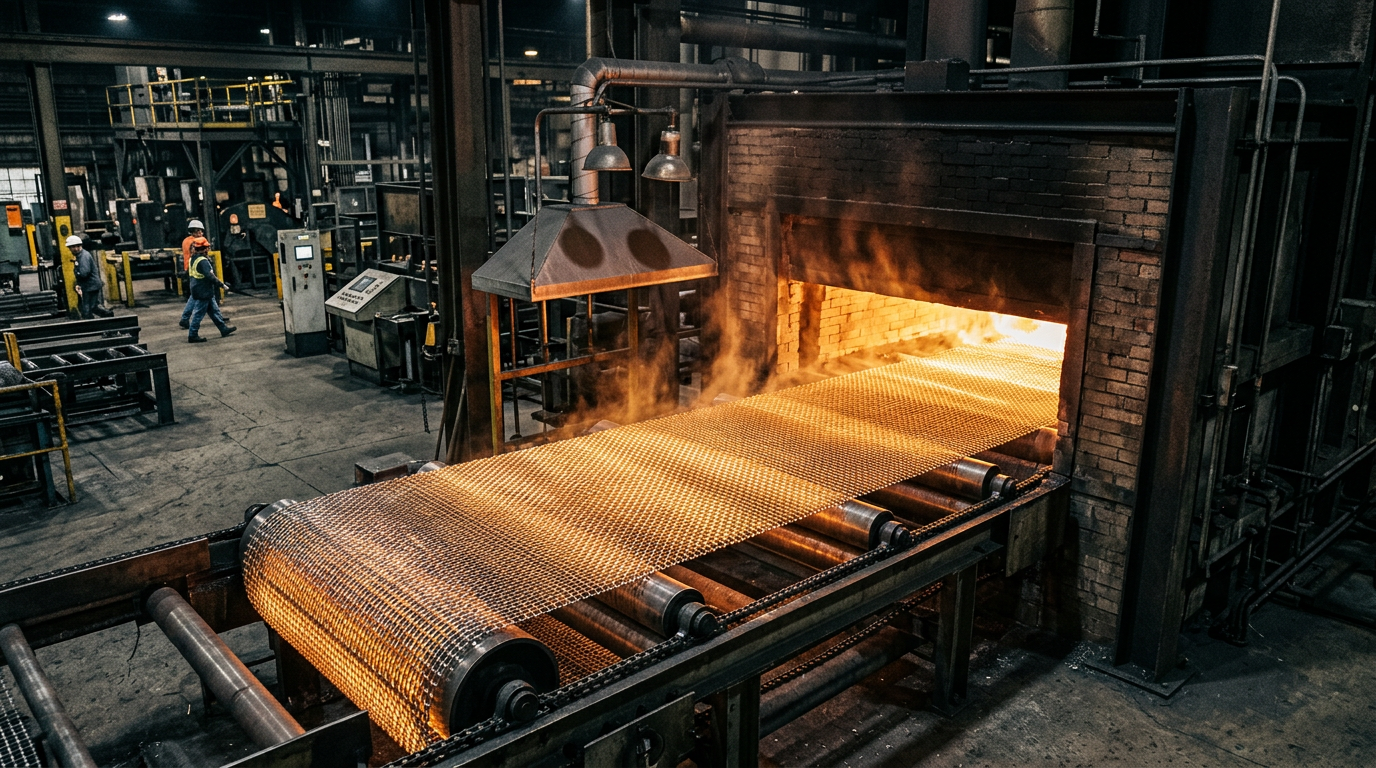
Selecting the correct wire mesh belt for heat treatment and oven lines requires balancing alloy composition with mechanical tension, where a typical rule of thumb is to limit belt load to 50% of the manufacturer’s rated tensile strength when operating at temperatures exceeding 600°C. These specialized conveying components must withstand extreme thermal cycling, oxidative atmospheres, and abrasive environments while maintaining dimensional stability to prevent tracking failures and product damage.
Key Takeaways
- Operating wire mesh belts above 600°C requires high-nickel alloys like AISI 314 or Inconel to prevent rapid oxidation and creep.
- The "Rule of 50" suggests reducing maximum allowable working tension by 50-70% as operating temperatures approach the material's melting point.
- Proper tracking in oven lines is best achieved through active guiding systems or edge-reinforced knuckled borders to resist heat-induced deformation.
- Correct drive sprocket alignment is critical; a mismatch of just 2mm can lead to premature belt fatigue and wire breakage in high-heat zones.
The Role of Wire Mesh Belts in Thermal Processing
Wire mesh belts serve as the backbone of modern industrial ovens, brazing furnaces, and powder metal sintering lines. Unlike standard modular plastic belts which melt at relatively low temperatures, metallic mesh allows for continuous airflow and heat penetration—essential for uniform baking and heat treatment.
In the context of industrial automation, these belts must integrate seamlessly with drive systems. While modular systems often focus on flexibility, high-heat applications require a rigid adherence to material science. Engineering partners like Easy Conveyors provide the structural frameworks and modular subunits that support these heavy-duty belts, ensuring the transition from high-heat zones to cooling sections is fluid and vibration-free.
Material Selection: The Science of High-Temperature Alloys
The primary failure mode in oven belts is not wear, but metallurgical degradation. Choosing the wrong alloy can lead to "green rot," carburization, or excessive scaling according to NEMA standards for industrial heating equipment.
| Material Grade | Max Operating Temp | Oxidation Resistance | Best Use Case |
|---|---|---|---|
| AISI 304 Stainless | 400°C - 650°C | Moderate | Food processing, low-temp drying |
| AISI 314 Stainless | 800°C - 1150°C | High | Annealing, brazing, hardening |
| Inconel 601 | 1100°C - 1250°C | Excellent | Sintering, chemical processing |
| Chrome-Silicon Steel | 300°C - 500°C | Low | High-load mechanical quenching |
Understanding Thermal Expansion
One of the most overlooked factors in wire mesh belts in heat treatment and oven lines is the coefficient of thermal expansion. A 50-meter belt can lengthen by several hundred millimeters when heated from ambient temperature to 1000°C. Design engineers must incorporate gravity take-up units or pneumatic tensioners to compensate for this growth, preventing the belt from sagging and catching on the furnace floor.
Common Weave Types and Their Applications
The geometry of the mesh determines both the belt’s strength and its ability to carry specific product types.
- Balanced Weave: The most common design, featuring alternating left and right-hand spirals. This construction minimizes tracking issues by neutralizing the "pull" of the spirals.
- Compound Balanced Weave (CB): A very tight mesh with multiple spirals and cross-rods. It is ideal for small parts like fasteners or electronic components that might fall through standard gaps.
- Rod Reinforced Weave: Cross-rods are inserted through the spirals to provide higher tensile strength. This is the gold standard for heavy loads in metal quenching operations.
Easy Conveyors stocks the conveyor components discussed here — ready to ship across Europe.
Engineering Challenges: Creep and Fatigue
In high-temperature environments, metals undergo "creep"—the slow, permanent deformation under mechanical stress. According to ISO 204:2023, creep testing is essential for determining the lifespan of components in tension at high heats.
To maximize belt life, operators should focus on VFD soft-start tuning. Abrupt starts exert massive torque on the heated, and therefore weakened, wire mesh. By ramping up speed gradually, the mechanical strain is distributed evenly across the cross-rods, preventing the "necking" effect where the belt narrows and eventually snaps.
The Importance of Airflow and Drainage
In industrial baking and drying, the percentage of open area is a critical KPI. A belt with 70% open area allows for rapid convective heat transfer, reducing the energy consumption of the oven. Conversely, in wash-down environments before the oven, this open area ensures chemicals and water drain away, preventing "spotting" on charred or heat-treated products. This aligns with EHEDG guidelines for hygienic design in food-grade thermal lines.
Maintenance and Failure Prevention
Monitoring wire mesh belts requires a proactive approach. Look for these three warning signs:
- Edge Curving: Usually indicates that one side of the oven is hotter than the other, causing uneven expansion.
- Spiral Elongation: A sign that the belt tension is set too high for the current operating temperature.
- Vibration (Chitter): Often caused by the buildup of "fines" or scale in the drive sprockets, which disrupts the smooth engagement of the mesh.
Proper lubrication of the drive chains (if used) or the high-temperature bearings is vital. However, the mesh itself is usually run dry in heat zones to prevent lubricant combustion or product contamination. For systems requiring precise positioning, integrating drum motor selection strategies designed for high-ambient temperatures can protect the drive electronics from the radiant heat of the furnace.
Sustainability in Heat Treatment
Modern furnace lines are moving toward "green" manufacturing by increasing thermal efficiency. Choosing a wire mesh belt with a lower thermal mass (thinner wire with higher-strength alloys) means the belt itself absorbs less energy as it enters the oven. This reduces the "parasitic heat load," allowing more energy to be directed toward the product itself, a key factor in achieving IE3 or IE4 efficiency benchmarks for the entire conveyor system.
Final considerations for procurement leads should include the ease of field-splicing. A modular mesh design that allows for quick replacement of damaged sections—without replacing the entire 100-meter loop—will significantly reduce the Total Cost of Ownership (TCO) and unplanned downtime in 24/7 manufacturing environments.
Frequently Asked Questions
What is the best material for a furnace belt operating at 1000°C?
For most applications, AISI 314 stainless steel is the standard due to its high silicon content which provides excellent oxidation resistance up to 1150°C. For temperatures exceeding this, nickel-based alloys like Inconel are required.
How do you prevent a wire mesh belt from wandering in a long oven?
Tracking is typically managed using a 'balanced weave' pattern that alternates spiral directions to neutralize side-pull. Additionally, gravity take-up towers and automated edge-sensing guides are used to adjust for thermal expansion.
Why is open area percentage important for mesh belts?
Open mesh allows for maximum air circulation (convection) and radiant heat exposure. This ensures the product is heated uniformly from all sides, including the bottom, which is impossible with solid belts.
What is 'creep' and how does it affect conveyor life?
Creep is the slow, permanent deformation of the metal wires under stress at high temperatures. It is prevented by reducing belt tension (load) and using alloys specifically engineered for high-temperature tensile strength.
Should I lubricate a wire mesh belt in an oven?
While the mesh inside the heat zone is rarely lubricated to avoid contamination, the drive chains and external bearings should use high-temperature synthetic lubricants or graphite-based products rated for the specific ambient heat.