VFD Tuning and Soft-Start Strategies for Modular Conveyors
Master VFD tuning and soft-start strategies to reduce conveyor mechanical stress by 50%. Learn S-curve profiles, PID loop optimization, and IE3/IE4 efficiency standards.
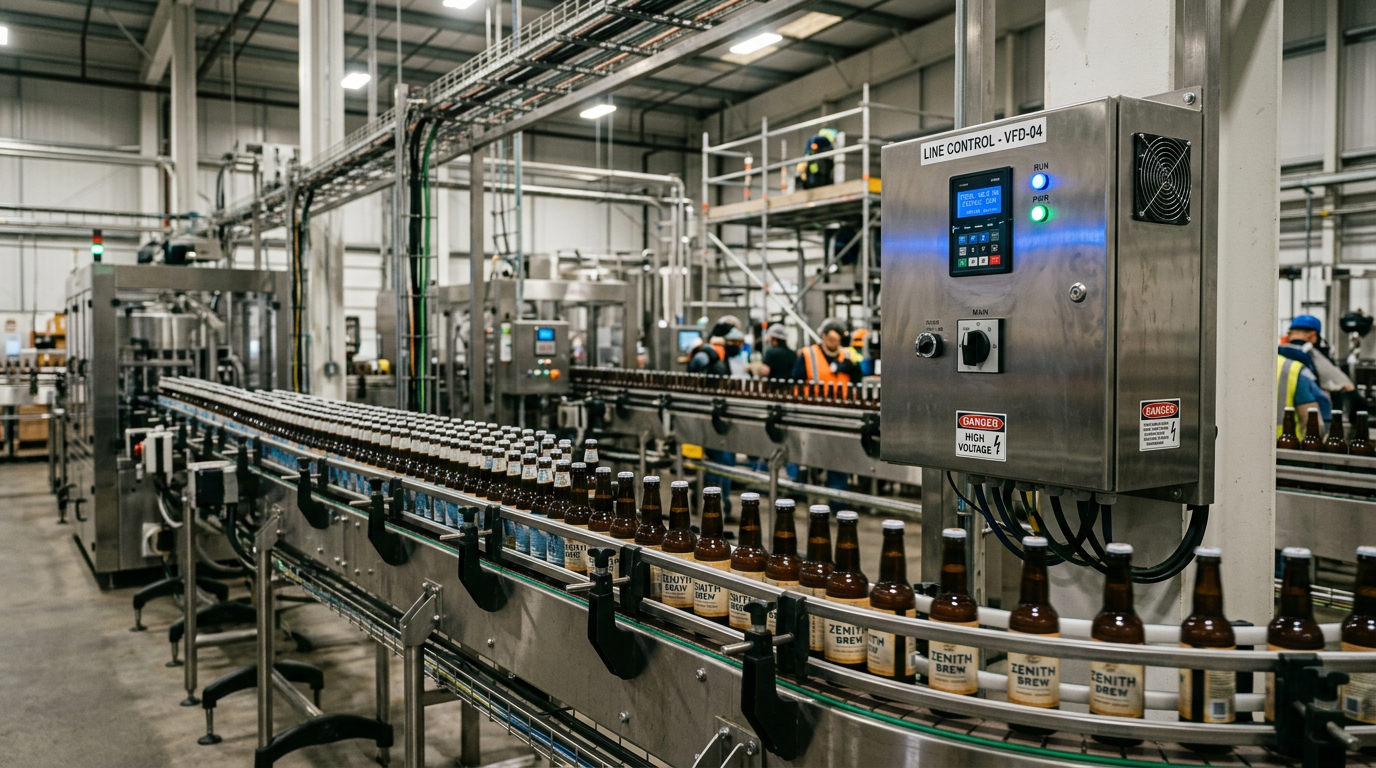
Efficient conveyor operation relies on precise motion control, where VFD tuning and soft-start strategies can reduce mechanical stress by up to 50% and improve energy efficiency through IE3 or IE4 motor optimization. By implementing S-curve acceleration profiles and fine-tuning Proportional-Integral-Derivative (PID) loops, engineers can eliminate package toppling and extend the service life of modular belts and drive components.
The Role of VFDs in Modular Conveyor Systems
In modern material handling, the Variable Frequency Drive (VFD) is more than just a speed controller; it is the central intelligence for motor protection and process optimization. Unlike traditional across-the-line starting, which subjects mechanical components to instantaneous torque spikes, VFDs allow for a controlled ramp-up.
For modular plastic belt conveyors, this control is critical. Modular belts, often made of POM (Polyoxymethylene) or PP (Polypropylene), have specific tensile strength limits. Excessive jerk during startup can lead to hinge fatigue or sprocket jumping. Utilizing Easy Conveyors modular systems alongside properly tuned VFDs ensures that the transition from standstill to operational speed (typically 0.1 to 1.5 m/s) is fluid and stress-free.
Soft-Start Strategies: Beyond the Linear Ramp
While a basic linear ramp (constant acceleration) is an improvement over direct-on-line starting, high-speed modular systems require more sophisticated "soft-start" profiles to maintain product stability and mechanical integrity.
S-Curve Acceleration
The S-curve profile rounds off the beginning and end of the acceleration phase. This prevents the "jerk" (the rate of change of acceleration) that often causes lightweight packages to tip or fragile components to shift. In VFD parameters, this is often defined as a percentage of the total ramp time or a specific jerk limit measured in $m/s^3$.
Torque Boosting and Flux Vector Control
Starting a fully loaded conveyor requires significant breakaway torque. VFDs utilize "torque boost" to provide extra voltage at low frequencies. However, for precision applications, Sensorless Vector Control is preferred over standard V/f (Volts per Hertz) control. Vector control decoupled the magnetizing current from the torque-producing current, allowing for 100% torque even at 0 Hz.
| Strategy | Mechanical Stress | Energy Efficiency | Complexity | Best Use Case |
|---|---|---|---|---|
| Direct-On-Line (DOL) | Very High | Low | Low | Simple fans/pumps only |
| Linear Ramp (V/f) | Medium | Medium | Low | Basic bulk handling |
| S-Curve Profile | Low | High | Medium | Packaging & Bottling lines |
| Closed-Loop Vector | Very Low | Very High | High | Heavy-duty incline/decline |
VFD Tuning: The PID Loop and Beyond
Tuning a VFD for a modular conveyor involves adjusting the internal control loops to match the inertia of the system. If the tuning is too "soft," the conveyor will lag behind its setpoint; if it is too "aggressive," the system may oscillate or trigger over-current faults.
1. Identifying System Inertia
Before tuning, the VFD must undergo an "Auto-tune" procedure. This measures the motor's stator resistance and inductance (IEC 60034-2-1) to build a mathematical model of the load. In modular systems, the inertia of the belt and the total mass of the products must be accounted for.
2. Proportional-Integral (PI) Gains
For most conveyor applications, the Derivative (D) part of a PID loop is omitted to avoid amplifying high-frequency noise.
- Proportional Gain (P): Determines how fast the VFD reacts to the difference between actual speed and setpoint. High P-gain improves response but can cause "hunting."
- Integral Gain (I): Removes the steady-state error, ensuring the conveyor runs at exactly the commanded speed regardless of load changes.
3. Harmonic Mitigation
VFDs generate electrical noise. Ensuring compliance with IEEE 519 standards for total harmonic distortion (THD) is essential to prevent interference with nearby sensors and PLC communication lines. Using shielded cables and proper grounding techniques is non-negotiable in automation environments.
Easy Conveyors stocks the industrial automation discussed here — ready to ship across Europe.
Integration with Industrial Automation
Modern VFDs are rarely standalone units. They communicate via industrial protocols like EtherNet/IP, PROFINET, or EtherCAT. Integrating the drive into the wider automation architecture allows for dynamic "VFD soft-start tuning" based on the specific product being handled.
For example, a PLC can send a different S-curve profile to the VFD when the line switches from heavy crates to lightweight cartons. This level of adaptability is a cornerstone of Industry 4.0 material handling. Engineers should also consider "VFD efficiency optimization" modes, which reduce the motor voltage during periods of light load, potentially saving 5-10% in energy costs according to SEW-Eurodrive technical documentation.
Common Failure Modes and Troubleshooting
Improper tuning often manifests in ways that seem like mechanical failures:
- Belt Surging: Often caused by a PI loop that is too aggressive, causing the motor to speed up and slow down rapidly.
- Overvoltage Faults on Deceleration: Occurs when the VFD tries to stop a high-inertia load faster than the internal DC bus can dissipate the energy. This requires either increasing the deceleration time or installing a braking resistor.
- Motor Overheating: Commonly caused by running motors at very low speeds for extended periods without auxiliary cooling, as the shaft-mounted fan becomes ineffective.
Effective "maintenance and troubleshooting for conveyors" should always include a review of VFD fault logs. Most modern drives will record the current, voltage, and frequency at the time of a trip, providing a "black box" for diagnostic analysis.
Energy Efficiency Standards
Regulated by the IEC 60034-30-1 standard, motor efficiency classes (IE1 through IE4) are significantly impacted by how the VFD is tuned. A drive that is poorly matched to its motor will cause excessive heat loss. By utilizing "automatic energy optimization" (AEO) functions, the VFD can dynamically adjust the flux to the minimum required level, ensuring the system operates at peak efficiency even during partial load conditions.
Sizing and Selection Considerations
When selecting a VFD for modular conveyors, always size for the "Heavy Duty" (HD) rating rather than the "Normal Duty" (ND) rating. Modular belts often have high static friction (stiction), requiring the 150% overload capacity for 60 seconds provided by HD-rated drives to ensure a reliable start every time. High-quality drive selection is as critical as drum motor selection for achieving a compact and efficient conveyor footprint.
Step-by-step
- 1
Perform Motor Auto-Tune
Enter motor nameplate data (kW, RPM, Cos Phi) into the VFD and run a static or dynamic auto-tune to map stator resistance per IEC 60034-2-1.
- 2
Configure S-Curve Percentage
Set the S-curve rounding to 20-30% of the total acceleration time to minimize package jerk while maintaining throughput.
- 3
Set Minimum/Maximum Frequencies
Define a minimum frequency (typically 15-20Hz) to ensure the motor's internal fan provides sufficient cooling, and a max frequency (50/60Hz) to prevent belt overspeed.
- 4
Adjust PI Gains for Load Stability
Increase Proportional gain until the belt follows the ramp without lag, then increase Integral gain to eliminate steady-state speed error under full load.
- 5
Enable Energy Optimization Mode
Activate the VFD's AEO or 'Flux Optimization' setting to reduce voltage during low-load periods, improving IE3/IE4 motor efficiency.
Frequently Asked Questions
Why is an S-curve better than a linear ramp for modular conveyors?
An S-curve profile adds a non-linear transition at the start and end of a ramp. This eliminates the 'jerk' (sudden change in acceleration) that causes products to tip and reduces mechanical wear on conveyor sprockets and hinges.
How does load affect VFD sizing for modular belts?
Modular conveyors often have high breakaway friction. A VFD should be sized for 'Heavy Duty' (HD) applications, typically providing 150% torque for 60 seconds, to ensure the belt starts reliably when fully loaded.
Should I use the Derivative (D) part of the PID loop for conveyor speed control?
The Derivative (D) component is very sensitive to electrical noise. In conveyor applications, the load changes are relatively slow, and a PI (Proportional-Integral) loop is usually sufficient to maintain speed without the risk of instability caused by the D-term.
What causes a VFD to trip on overvoltage when the conveyor stops?
Overvoltage faults during stopping are usually caused by 'regenerative energy' from the motor. To fix this, increase the deceleration ramp time or install a dynamic braking resistor to dissipate the excess energy.