OPC UA Integration for Smart Conveyor Modules: A Technical Guide
Learn how OPC UA integration transforms modular conveyors into smart, decentralized nodes for Industry 4.0, enhancing M2M communication and predictive maintenance.
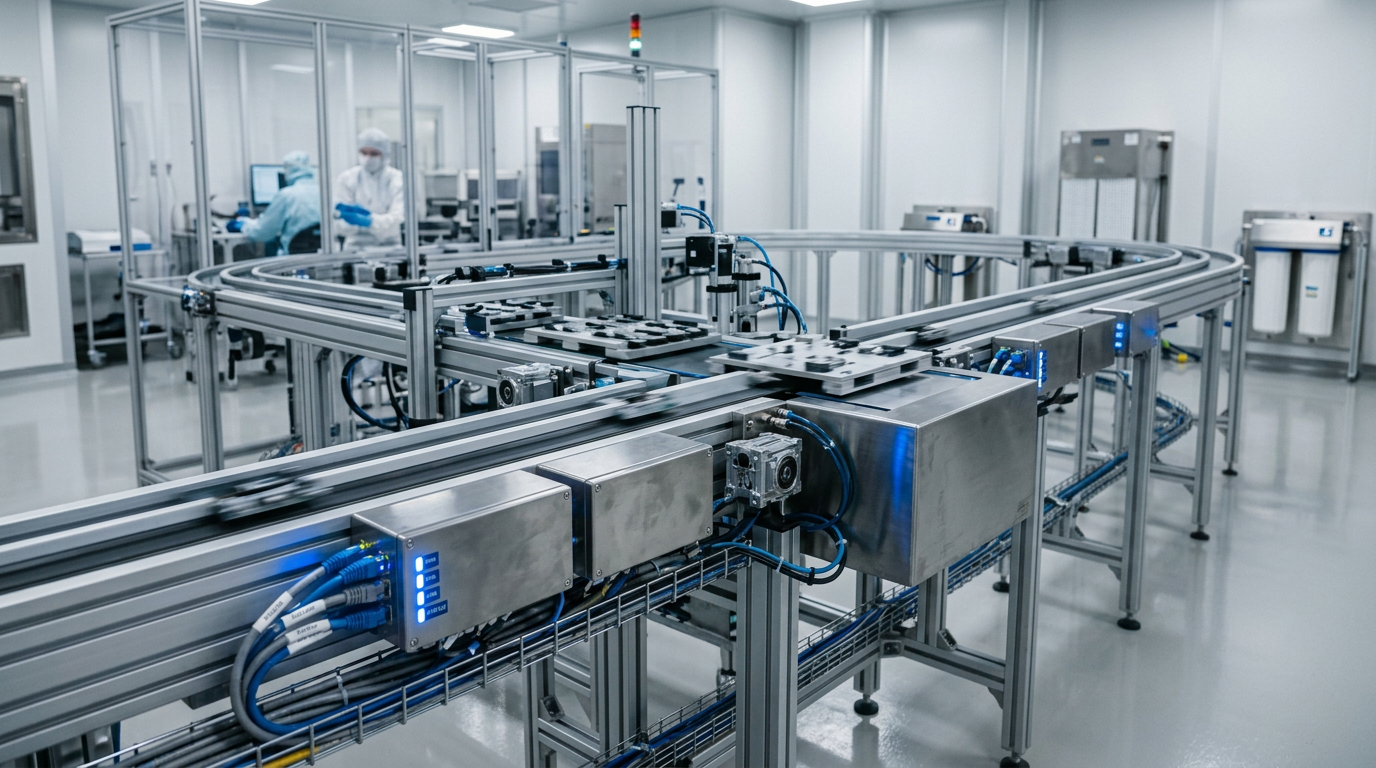
Integrating OPC UA (Open Platform Communications Unified Architecture) into modular conveyor systems enables vendor-neutral, M2M communication with a standard data exchange rate often reaching sub-100ms latency for real-time diagnostics and predictive maintenance. By adopting the IEC 62541 standard, manufacturers can transition from siloed PLC logic to a decentralized, "Smart Factory" architecture where each conveyor module acts as an independent Information Model (IM) node.
The Role of OPC UA in Modern Material Handling
As the industrial landscape shifts toward Industry 4.0, the "dumb" conveyor is being replaced by intelligent modules capable of self-optimization. Traditional Fieldbus systems (like PROFIBUS or DeviceNet) served their purpose for basic motion control, but they often struggle with the semantic interoperability required for cloud integration and cross-platform analytics.
OPC UA provides a service-oriented architecture (SOA) that maps physical hardware—such as drum motors, sensors, and pneumatic diverters—into digital twins. This integration is crucial for modular systems where line configurations may change frequently. Because OPC UA is platform-independent, a modular section utilizing an Easy Conveyors aluminum or stainless steel frame can be swapped or upgraded without rewriting the entire control stack of the warehouse management system (WMS).
Technical Architecture: Information Models and Nodes
The core strength of OPC UA integration lies in its Information Model. Unlike legacy protocols that transmit raw hex strings, OPC UA transmits "Objects" with "Attributes" and "Methods." For a smart conveyor module, the information model typically includes:
- Identity: Serial number, hardware revision, and installation date.
- State: Current velocity (m/s), motor temperature (°C), and vibration levels.
- Methods:
Start(),Stop(),Reverse(), andResetTriage(). - Events: Overcurrent warnings or belt misalignment triggers.
By adhering to the VDMA/OPC Foundation companion specifications for robotics and material handling, engineers ensure that a conveyor from one manufacturer can "talk" to a palletizer from another without custom driver development.
Performance Comparison: OPC UA vs. Legacy Protocols
| Feature | Legacy Fieldbus (e.g., Modbus RTU) | OPC UA (IEC 62541) |
|---|---|---|
| Data Structure | Register-based (flat) | Object-oriented (hierarchical) |
| Security | None (Physical isolation only) | AES-256 Encryption & X.509 Certificates |
| Interoperability | Vendor-specific GSD/EDS files | Universal Discovery Services |
| Scalability | Limited by physical segments | Massive (Client/Server & Pub/Sub) |
| Diagnostics | Basic error codes | Full semantic context |
Implementing OPC UA at the Edge
To achieve true "Smart" functionality, the OPC UA server should ideally reside at the **Edge
Easy Conveyors stocks the industrial automation discussed here — ready to ship across Europe.
**—either within the drive controller or a dedicated IoT gateway mounted on the conveyor module. This allows for edge computing, where the module processes high-frequency sensor data locally and only pushes relevant KPIs (Key Performance Indicators) to the SCADA system.
For example, when integrating VFD soft-start tuning parameters via OPC UA, the system can automatically adjust acceleration ramps based on the weight detected by load cells on the belt. If the module detects a deviation in motor current that matches a "bearing failure" pattern, it triggers an OPC UA Event that alerts maintenance before a breakdown occurs.
Security and Safety Standards
One of the primary concerns with connecting material handling systems to wider networks is cybersecurity. OPC UA addresses this through a multi-layered security model including:
- Authentication: Using X.509 certificates to ensure only authorized clients can control the conveyor.
- Signing & Encryption: Preventing "man-in-the-middle" attacks where a malicious actor could intercept and change conveyor speed commands (IEC 62443).
- Audit Trails: Logging every command sent to the module, essential for pharmaceutical and food-grade compliance where "track and trace" is mandatory.
Furthermore, for safety-critical applications, OPC UA Safety (based on the black channel principle) allows for the transmission of SIL3-rated safety data over the same network cable as standard control data, potentially eliminating the need for separate hard-wired emergency stop circuits across long conveyor runs.
Connectivity Challenges and Solutions
While OPC UA is robust, implementation in high-speed sortation requires careful consideration of network jitter. The introduction of TSN (Time-Sensitive Networking) extensions to OPC UA is solving this by providing deterministic communication over standard Ethernet. For plant engineers, this means the same physical cable can handle high-bandwidth video from quality inspection cameras and time-critical motor synchronization pulses.
When selecting components, ensure that drum motor selection accounts for integrated encoders that support digital communication protocols. A motor that natively supports OPC UA or can be bridged through a smart PLC simplifies the wiring architecture significantly, reducing the total cost of ownership (TCO) by up to 20% through reduced commissioning time.
Future-Proofing with Modular Design
The ultimate goal of OPC UA integration for smart conveyor modules is "Plug-and-Produce." When a new module is added to the line, the central controller should automatically discover the new OPC UA server, browse its capabilities, and integrate it into the workflow. This level of automation is particularly beneficial in e-commerce fulfillment centers where seasonal demands require rapid scaling of conveyor layouts.
By leveraging decentralized intelligence, manufacturers move away from rigid, centralized control toward a flexible, resilient architecture capable of adapting to the shifting demands of the global supply chain.
Frequently Asked Questions
Why is OPC UA preferred over traditional Fieldbus for modular conveyors?
OPC UA provides a standardized Information Model that allows different conveyor components to communicate without custom drivers, enabling 'Plug-and-Produce' functionality.
Can OPC UA handle high-speed conveyor synchronization?
While OPC UA was traditionally slower than EtherCAT, the introduction of OPC UA over TSN (Time-Sensitive Networking) allows for sub-millisecond determinism, suitable for high-speed sortation.
Is OPC UA secure for cloud-connected conveyor systems?
Yes, OPC UA includes built-in security features like X.509 certificate exchange and AES-256 encryption, conforming to IEC 62443 standards for industrial security.
What is an OPC UA Information Model for a conveyor?
An 'Information Model' in this context is a digital representation of the conveyor's physical properties, states (speed, load), and methods (start, stop) organized in a way that any OPC UA client can understand.