Advanced VFD Tuning and Soft-Start Strategies for Modular Conveyors
Master VFD tuning for modular conveyors. Learn how S-curves, V/f patterns, and torque limiting protect modular belts from mechanical shock and the polygon effect.
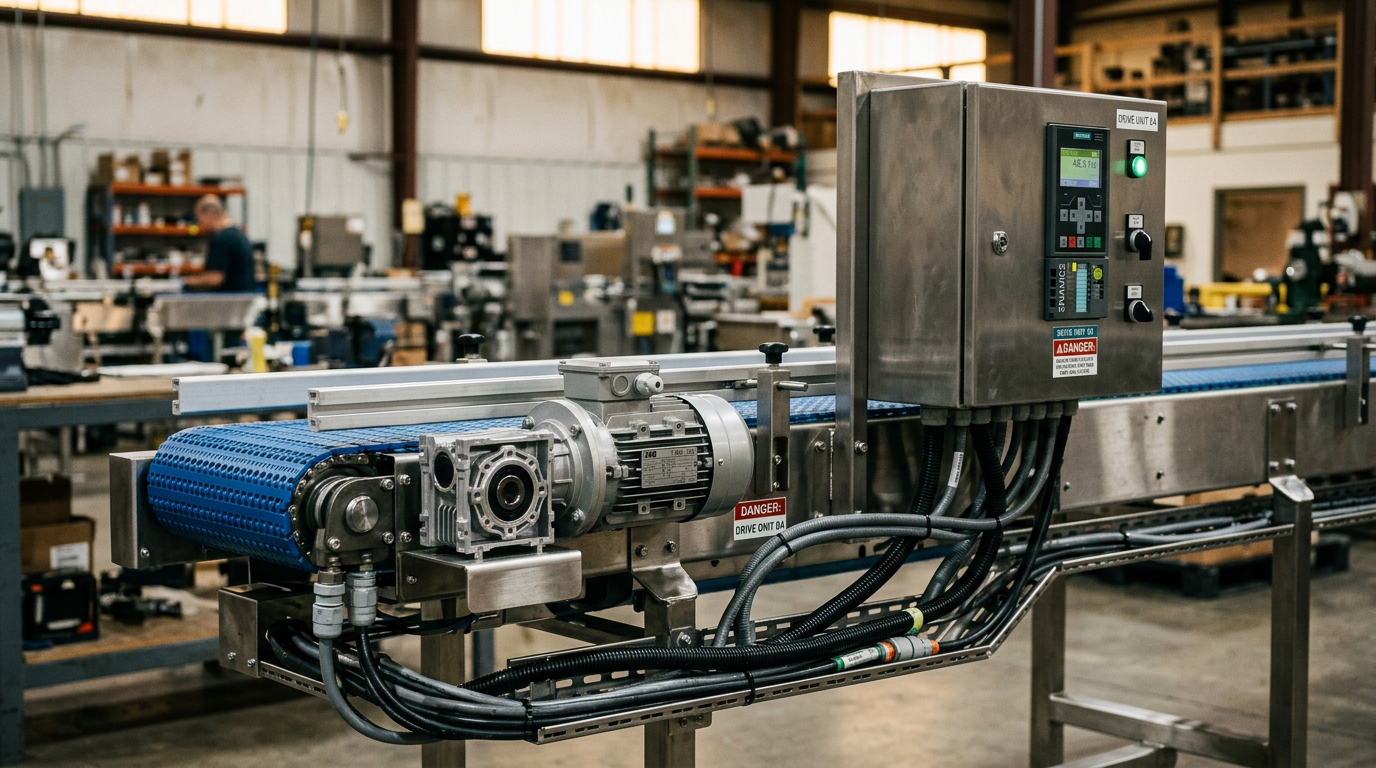
To achieve optimal conveyor performance, VFD tuning should prioritize a linear acceleration ramp between 1.5 and 3.0 seconds, which reduces mechanical shock to modular chain links by up to 40% compared to direct-on-line (DOL) starting. Effective soft-start strategies for modular conveyors involve precise V/f pattern adjustment and S-curve profiling to mitigate the "polygon effect" inherent in sprocket-driven systems, ensuring smooth product handling and extended component life.
The Role of Variable Frequency Drives in Modular Conveying
In modern industrial automation, the Variable Frequency Drive (VFD) has evolved from a simple speed controller into a critical tool for mechanical preservation. Modular conveyors, characterized by their plastic or metal link-style belts driven by sprockets, face unique mechanical stresses during startup. Unlike flat belts, modular systems experience periodic chordal action—often called the "polygon effect"—where the effective radius of the drive sprocket fluctuates.
Without proper VFD tuning and soft-start strategies, the sudden application of torque can lead to pin elongation, sprocket tooth wear, and product tipping. By utilizing VFDs to manage the starting current and torque, engineers can achieve IE3 or IE4 motor efficiency levels (IEC 60034-30-1) while protecting the structural integrity of the conveyor frame.
Fundamental Tuning: V/f Patterns vs. Vector Control
The first step in tuning a VFD for modular conveyors is selecting the control method. Most applications fall into two categories:
- Volts-per-Hertz (V/f) Control: This is the standard for multi-motor conveyor lines. It maintains a constant ratio between voltage and frequency. For modular conveyors, a "Squared V/f" or "Fan/Pump" curve should be avoided; instead, a Linear V/f pattern is required to provide sufficient breakaway torque at low frequencies.
- Sensorless Vector Control (SVC): This method uses complex mathematical models to estimate rotor position, providing much higher torque at near-zero speeds. SVC is ideal for incline conveyors or heavy-duty sortation modules where the belt must start under full load without rolling backward.
| Feature | V/f Control | Sensorless Vector Control |
|---|---|---|
| Start Torque | Moderate (150% for 60s) | High (200% at 0.5Hz) |
| Speed Regulation | 2-3% of base speed | 0.5% of base speed |
| Application | Simple transport, multi-motor | Inclines, precision indexing |
| Efficiency Class | IE2 / IE3 Compatible | IE3 / IE4 Optimized |
| Complexity | Low (Plug & Play) | Moderate (Requires Auto-tuning) |
Soft-Start Strategies: Beyond the Simple Ramp
A simple linear ramp-up is often insufficient for high-speed packaging or fragile food handling. Modern automation engineers employ S-curve acceleration profiles.
The S-Curve Advantage
An S-curve adds a second-order transition at the beginning and end of the acceleration ramp. This "jerk compensation" prevents the sudden snapping of the modular chain. By rounding off the transition from standstill to acceleration, the VFD ensures that the tension in the modular belt increases gradually, preventing the catenary sag
Easy Conveyors stocks the industrial automation discussed here — ready to ship across Europe.
from whipping and causing tracking issues.
Torque Limiting and DC Injection Braking
For systems utilizing Easy Conveyors modules, integrating torque limits within the VFD parameters acts as an electronic shear pin. If a mechanical jam occurs, the VFD senses the spike in current and trips before the modular plastic links reach their tensile breaking point.
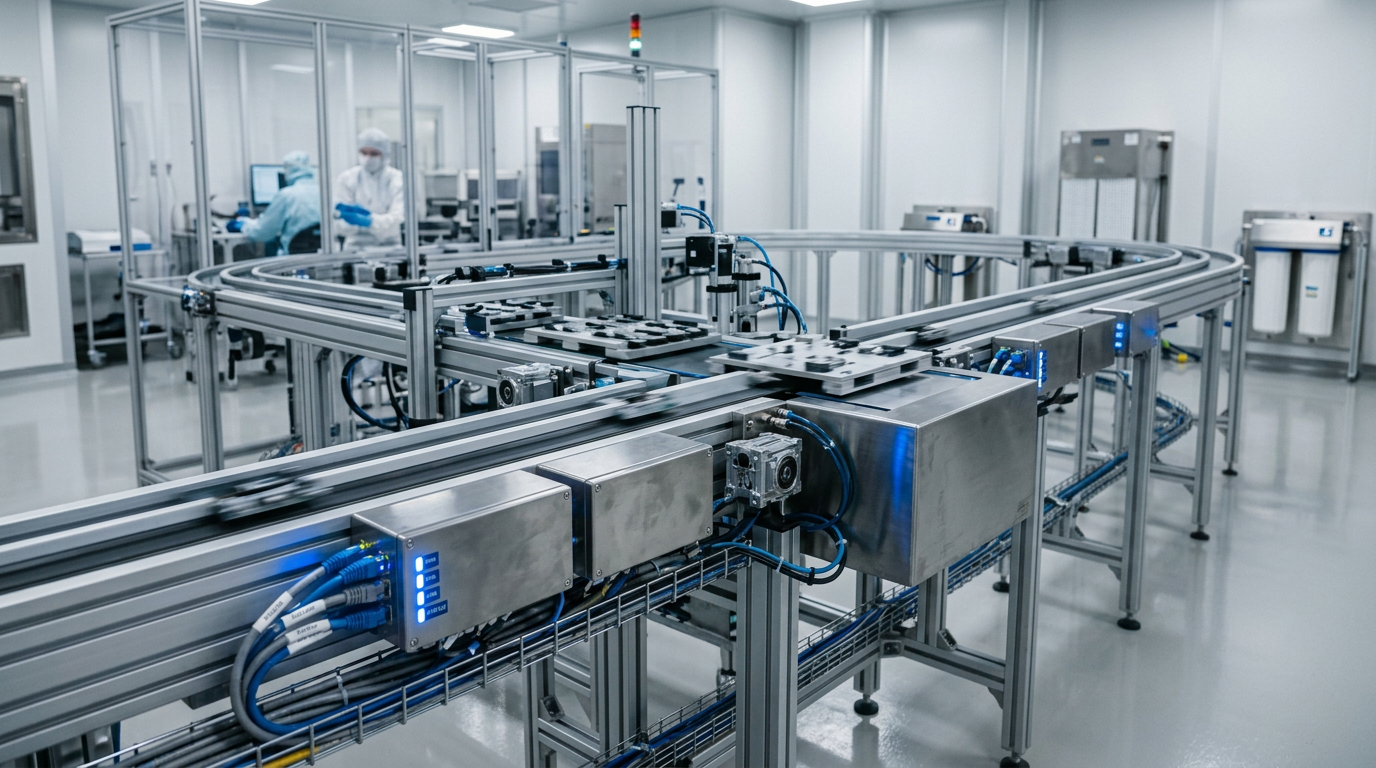
Furthermore, DC Injection Braking can be tuned to provide a holding torque when the motor stops. This is crucial for modular conveyors in pharmaceutical or cleanroom environments where mechanical brakes might shed particulates.
Managing the Polygon Effect via VFD Tuning
Because modular belts wrap around hexagonal or square-ish sprockets, the belt speed is not perfectly constant. This chordal action creates micro-vibrations. Advanced VFD tuning can mitigate this by:
- Slip Compensation: Adjusting the frequency dynamically based on the load to keep the motor RPM stable.
- Carrier Frequency Optimization: Setting the PWM carrier frequency (typically between 4kHz and 16kHz) to reduce audible noise and motor heating. However, higher carrier frequencies increase electromagnetic interference (EMI), requiring shielded cables and proper grounding per NEMA standards.
Practical Commissioning Steps
When commissioning a new modular system, "Auto-tuning" is a mandatory first step. This process allows the VFD to measure the motor’s internal resistance and inductance. Without accurate motor data, the soft-start algorithms will not perform predictably, leading to "hunting" (speed oscillations) or over-current faults during the transition from static to dynamic friction.
For multi-lane systems, synchronization is key. Utilizing a master-follower configuration via industrial Ethernet (Profinet or EtherNet/IP) ensures that all conveyor segments accelerate in unison, preventing product bunching at the transfer points between modules.
Troubleshooting Common VFD Issues
If a conveyor exhibits a "jerky" motion at low speeds, the cause is often an improperly set Torque Boost. While it is tempting to increase the voltage at low frequencies to overcome friction, excessive boost causes the motor to saturate and overheat. A better approach is to refine the acceleration time or switch to a vector control mode that manages flux more efficiently.
Another frequent failure mode is the DC bus overvoltage trip during deceleration. This occurs when the inertia of a loaded modular belt drives the motor, turning it into a generator. To solve this, engineers should either increase the deceleration time or install a dynamic braking resistor to dissipate the regenerated energy.
Energy Efficiency and Regulatory Compliance
Implementing VFDs is the primary method for complying with European Ecodesign requirements (EU 2019/1781). By reducing the motor speed by just 20%, energy consumption can be reduced by nearly 50% due to the affinity laws, although these savings are more pronounced in centrifugal loads than in constant-torque conveyor applications. Nevertheless, the reduction in mechanical wear significantly lowers the Total Cost of Ownership (TCO) by extending the interval between "modular belt replacement" cycles.
Step-by-step
- 1
Perform Motor Auto-tuning
Execute the VFD's static or dynamic auto-tune procedure to measure motor winding resistance and inductance for precise torque control.
- 2
Select Linear V/f Pattern
Configure the VFD to a linear Volts-per-Hertz ratio to ensure consistent torque across the operating speed range, avoiding centrifugal curves.
- 3
Configure S-Curve Acceleration
Set the jerk compensation or S-curve parameter to 20-30% of the total acceleration time (e.g., 0.6s jerk for a 2.0s ramp).
- 4
Set Torque Limits
Adjust the maximum torque limit to 150% of nominal motor current to provide electronic protection against modular belt jams.
- 5
Optimize Carrier Frequency
Set the PWM frequency to 8kHz as a baseline to balance motor noise reduction with EMI management and VFD heat dissipation.
Frequently Asked Questions
Why is an S-curve better than a linear ramp for modular conveyors?
An S-curve adds a transition phase at the start and end of acceleration, preventing 'jerk' and reducing the impact of the polygon effect on modular belts.
Which VFD control mode should I use for modular belts?
For simple transport conveyors, a linear V/f pattern is standard. For inclines or high-torque starts, Sensorless Vector Control (SVC) is preferred.
What is the ideal acceleration time for a modular conveyor?
Typical acceleration times for modular belts range from 1.5 to 3.0 seconds. High-speed sortation may require shorter ramps, while fragile product handling may need 5+ seconds.
Can I use DC injection braking on a modular conveyor?
Excessive DC injection braking can cause motor overheating. It should only be used to hold the belt at a standstill for short durations or to assist in a rapid stop.