VFD Tuning and Soft-Start Strategies for Modular Conveyors
Master VFD tuning for modular conveyors. Learn about S-curve acceleration, sensorless vector control, and soft-start strategies to increase belt life by 40%.
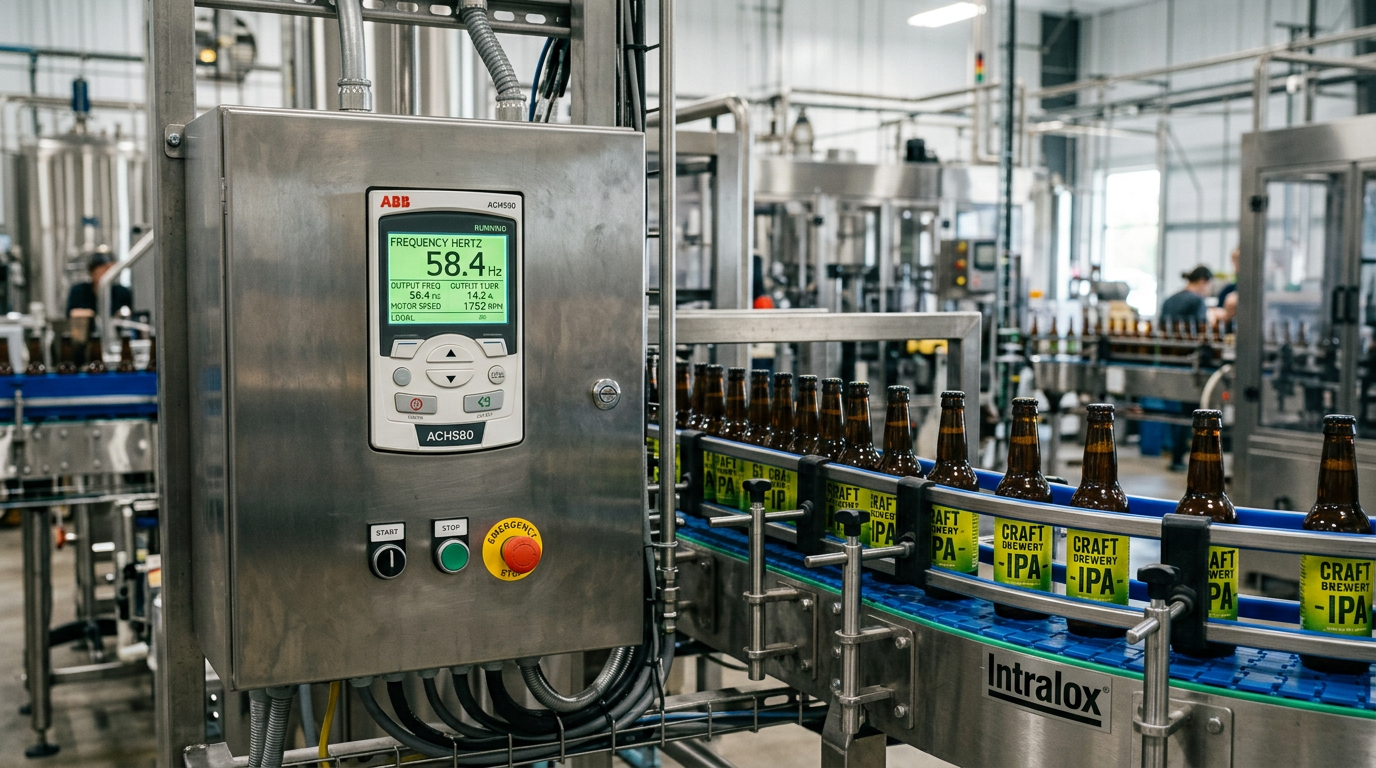
To achieve optimal conveyor performance, VFD tuning for modular conveyors must prioritize a linear acceleration ramp of 1.5 to 3.0 seconds and a S-curve profile (jerk compensation) of 20-30% to prevent mechanical shock and belt surging. Modern Variable Frequency Drives (VFDs) utilizing sensorless vector control can improve starting torque by up to 200% at low frequencies, ensuring smooth initiation of heavy modular belts even under full load conditions.
The Critical Role of VFDs in Modular Conveying
Modular plastic belt conveyors present unique mechanical challenges compared to standard fabric belts. Their polygonal effect—pulsations caused by the belt links wrapping around sprockets—can lead to harmonic vibrations if the motor speed is not precisely controlled. Furthermore, the high mass and friction of modular systems require sophisticated starting strategies to avoid damaging sprocket teeth or stretching the belt.
Implementing a robust VFD (Variable Frequency Drive) strategy is no longer optional for high-throughput lines. By transitioning from across-the-line starting to controlled acceleration, facilities can extend the mechanical life of components by 40% or more, while significantly reducing peak energy demand.
Understanding Soft-Start Strategies: S-Curves vs. Linear Ramps
The most common mistake in conveyor commissioning is relying on a standard linear acceleration ramp. While a linear ramp (a straight line from 0Hz to 50/60Hz) is better than a direct-on-line start, it still creates "jerk" (the rate of change of acceleration) at the start and end of the ramp.
The S-Curve Advantage
For modular conveyors, especially those carrying fragile products like glass or open food containers, the S-Curve profile is essential. An S-Curve rounds off the transition points of the acceleration phase. According to SEW-Eurodrive technical guidelines, using a 20% to 30% S-curve factor minimizes the "whiplash" effect seen in long modular runs where the belt slack is suddenly taken up.
Torque Boosting and Flux Vector Control
Standard Volts-per-Hertz (V/f) control often fails to start a fully loaded modular conveyor because the motor cannot generate enough torque at low frequencies to overcome static friction (stiction).
- Auto-Torque Boost: The drive increases the voltage at low speeds to overcome the IR drop of the motor windings.
- Sensorless Vector Control: The VFD uses a mathematical model of the motor to decouple flux and torque-producing currents. This allows for full rated torque even at speeds as low as 0.5 Hz, which is vital for controlled "inching" during maintenance.
VFD Tuning Parameters for Modular Systems
Successful commissioning requires a systematic approach to parameterization. Below are the key settings recommended for modular belt systems.
| Parameter | Recommended Setting | Purpose |
|---|---|---|
| Control Mode | Sensorless Vector (SVC) | Superior low-speed torque and speed regulation. |
| Accel Time | 2.0 – 4.0 Seconds | Prevents belt surging and sprocket wear. |
| Decel Time | 1.0 – 2.0 Seconds | Avoids product "toppling" while preventing DC bus overvoltage. |
| Stop Mode | Ramp-to-Stop | Prevents the belt from snapping back due to tension. |
| Switching Frequency | 4 kHz – 8 kHz | Balances motor noise vs. heat dissipation in the VFD. |
| Efficiency Class | IE3 or IE4 | Compliance with IEC 60034-30-1 for energy savings. |
Easy Conveyors stocks the industrial automation discussed here — ready to ship across Europe.
Managing Dynamic Loads and Braking
Modular conveyors in e-commerce or bottling often face high-inertia loads. When a conveyor needs to stop quickly—for instance, in a precision indexing application—the motor acts as a generator. This "regenerative energy" can cause the VFD to trip on an Overvoltage (OV) fault.
To mitigate this, engineers should consider:
- Dynamic Braking Resistors: These dissipate excess energy as heat.
- DC Injection Braking: Useful for holding a belt in place once it has stopped, though it should be used sparingly to avoid motor overheating.
- Flux Braking: A software-based method where the drive increases motor losses to dissipate energy without external resistors.
When designing these complex automation layouts, working with an experienced partner is critical. Easy Conveyors provides modular systems designed for seamless integration with modern VFD architectures, ensuring that the mechanical framework can withstand the dynamic forces generated by advanced tuning strategies.
Impact on Component Longevity
The synergy between VFD soft-start tuning and hardware selection directly impacts the Total Cost of Ownership (TCO). In standard modular belts, the highest stress occurs during the first 500 milliseconds of movement.
By utilizing "Catch-on-the-Fly" settings (available in most Rockwell Automation or Siemens drives), a VFD can safely pick up a motor that is already spinning (e.g., due to gravity on a decline or residual momentum). This prevents the massive mechanical shock of trying to force a moving belt to sync with a static frequency output.
Furthermore, integrating VFDs into a wider industrial automation network via EtherNet/IP or PROFINET allows for real-time condition monitoring. Sudden increases in current draw at a constant speed often signal a "vfd soft-start tuning" issue or, more likely, a mechanical failure such as a seized bearing or belt interference.
Energy Efficiency and Standards
Modern drives must align with international standards to ensure sustainability and compatibility. The NEMA MG 1 standard provides critical ratings for motor insulation when used with VFDs, as the high-frequency pulses (PWM) can cause voltage spikes that degrade standard motor windings. Always ensure your conveyor motor is "Inverter Duty" rated to prevent premature insulation breakdown.
Additionally, using VFDs allows for "Eco-modes" where the drive optimizes the flux current during periods of low load, further exceeding the base efficiency requirements of the motor itself. This is particularly effective in modular sortation systems where load levels fluctuate significantly throughout a shift.
Summary of Best Practices
To ensure a successful modular conveyor deployment, always perform a "Static Auto-tune" of the VFD with the motor connected but the belt removed if possible. This allows the drive to measure the motor's internal resistance and inductance precisely. Once the belt is installed, fine-tune the S-curve to eliminate any visible "pulsing" at the head sprocket. By following these technical guidelines, plant engineers can ensure a smooth, efficient, and long-lasting material handling system.
Frequently Asked Questions
What is an S-curve in VFD tuning?
An S-curve rounds the start and end of an acceleration ramp, reducing the 'jerk' or rate of change in acceleration. This prevents modular belts from surging or snapping during startup.
How long should the acceleration ramp be for a modular belt?
Most modular conveyors benefit from an acceleration ramp between 2.0 and 4.0 seconds. Extremely fragile products may require longer ramps, while high-speed indexing may require shorter, more aggressive tuning with braking resistors.
Why choose Sensorless Vector Control over V/f control?
V/f control is a simple linear ratio of voltage to frequency. Sensorless Vector Control (SVC) uses a motor model to provide much higher torque at low speeds, which is necessary for starting heavy modular conveyors.
What causes an overvoltage fault during conveyor stopping?
Overvoltage faults are usually caused by regenerative energy when a heavy conveyor decelerates too quickly. Extending the deceleration time or adding a braking resistor usually solves this.
Do I need an inverter-duty motor for my VFD-controlled conveyor?
Inverter-duty motors (NEMA MG 1 Part 31) feature enhanced insulation and internal cooling to handle the heat and voltage spikes generated by a VFD's pulse-width modulation (PWM) signal.