VFD Tuning and Soft-Start Strategies for Modular Conveyors
Master VFD tuning and soft-start strategies for modular conveyors. Learn how S-curve acceleration and vector control extend belt life and improve energy efficiency.
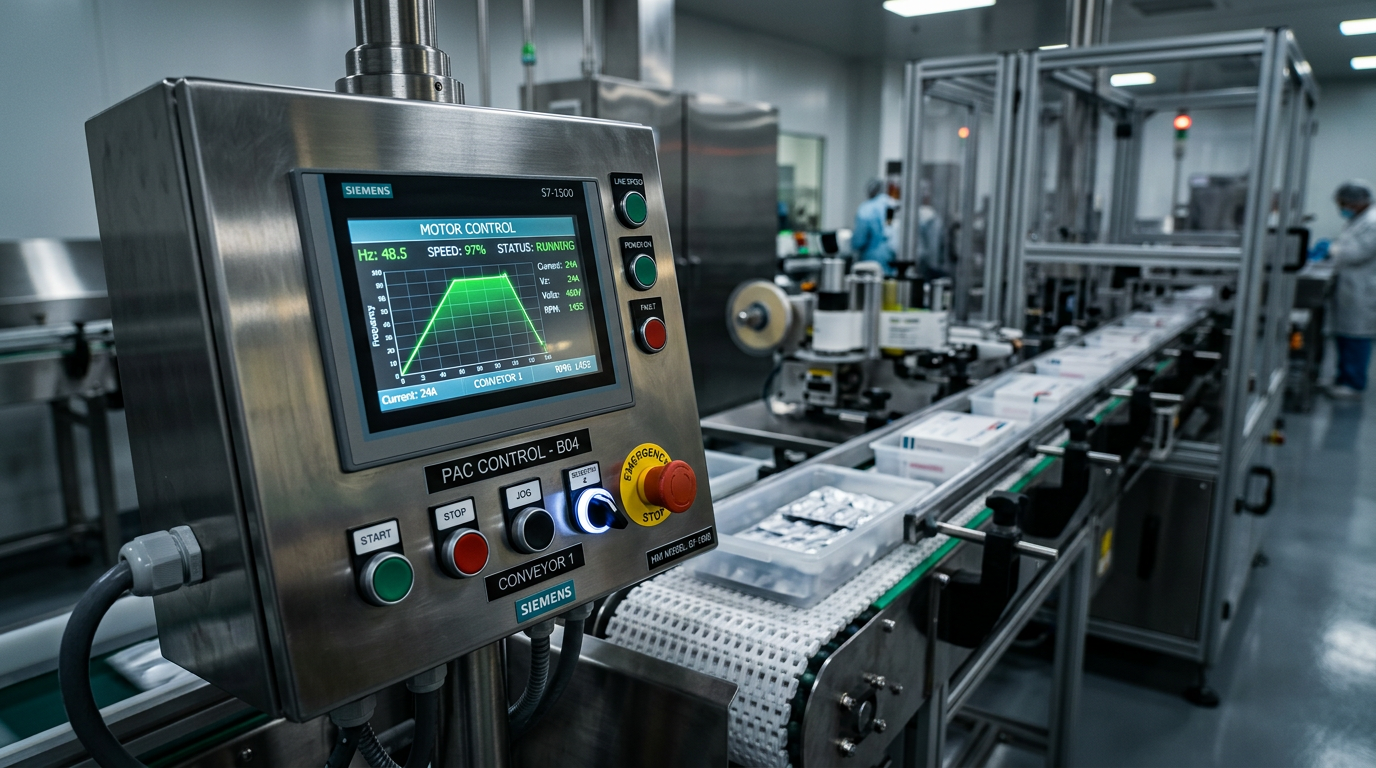
Optimizing modular conveyor systems requires precise Variable Frequency Drive (VFD) tuning, where a standard 1:3 ramp-to-load ratio and an initial S-curve setting of 10-15% of the total acceleration time typically yield the highest mechanical longevity. By implementing strategic soft-start parameters, engineers can reduce mechanical stress on plastic modular belts and drive sprockets by up to 40%, significantly extending the mean time between failures (MTBF).
The Fundamentals of VFD Integration in Modular Systems
Variable Frequency Drives serve as the brain of modern material handling. In modular conveyor applications, which often utilize plastic chains or belts, the VFD does more than just regulate speed; it manages the transition of inertia. Unlike traditional flat-belt systems, modular belts have discrete pitch points and sprocket engagements that can suffer from "chordal action," a phenomenon where the belt velocity fluctuates slightly as it moves around the sprocket radius.
To counteract these nuances, the VFD must be tuned to handle dynamic loads. Most industrial motors used in these systems fall under the IE3 Premium Efficiency class (IEC 60034-30-1). These motors have specific torque-to-current characteristics that require precise VFD parameterization to avoid over-fluxing or "hunting" at low frequencies.
Soft-Start Strategies: Beyond Simple Ramping
A "soft-start" is not merely a slow ramp-up from 0Hz to 50Hz. Effective soft-start strategies involve the manipulation of the voltage-to-frequency (V/f) curve and the application of S-curve acceleration.
S-Curve Acceleration vs. Linear Ramping
Linear ramping increases speed at a constant rate, which creates a "jerk" (the derivative of acceleration) at the start and end of the ramp. For modular conveyors carrying fragile goods or heavy bulk loads, this jerk can cause product topple or belt fatigue.
- Linear Ramp: Simple, but creates high mechanical shock.
- S-Curve (Sigmoid): Smoothens the transitions. We recommend setting the S-curve rounding to approximately 0.5 to 1.5 seconds, depending on the belt length. This ensures that the motor torque builds up gradually, allowing the slack in the modular belt to be taken up before full acceleration begins.
Torque Boosting and IR Compensation
At low speeds, the internal resistance (IR) of the motor windings leads to a voltage drop that can prevent the motor from generating enough starting torque. While "Auto-tuning" functions on modern VFDs are excellent, manual adjustment of the "Torque Boost" parameter is often necessary for conveyors that start under full load. However, excessive boost leads to motor overheating and energy waste.
Technical Comparison: Soft Starter vs. VFD for Modular Conveyors
| Feature | Electronic Soft Starter | Variable Frequency Drive (VFD) |
|---|---|---|
| Speed Control | Limited (Start/Stop only) | Full Range (0 - 120Hz+) |
| Starting Torque | Reduced | High (via Vector Control) |
| Mechanical Stress | Moderate | Minimal (with S-Curve) |
| Efficiency Class Support | IE2/IE3 | IE3/IE4/IE5 |
| Footprint | Compact | Larger (requires Heat Sink) |
| Cost Tier | Low to Medium | Medium to High |
Easy Conveyors stocks the industrial automation discussed here — ready to ship across Europe.
Advanced Tuning: Sensorless Vector Control
For high-performance modular conveyors, such as those used in high-speed sortation or pharmaceutical packaging, Easy Conveyors recommends utilizing Sensorless Vector Control (SVC) rather than standard V/f control.
SVC calculates the optimal magnetic flux by monitoring the motor’s current and voltage feedback without requiring an external encoder. This allows for:
- Full Torque at Zero Speed: Essential for incline conveyors.
- Precise Speed Regulation: Maintains <0.5% speed deviation even as the load changes.
- Active Braking: Using DC injection or dynamic braking resistors to stop the belt precisely at a sensor position, preventing "coast-to-stop" errors.
Common Failure Modes and Troubleshooting
When tuning VFDs for modular systems, engineers frequently encounter three specific issues:
1. DC Bus Overvoltage on Deceleration
If the conveyor is carrying heavy loads (e.g., automotive parts) and the deceleration ramp is too short, the motor acts as a generator, pumping energy back into the VFD. This triggers an "Overvoltage" fault.
- Solution: Increase the deceleration time or install a dynamic braking resistor to dissipate the excess energy as heat.
2. Resonance and Vibration
Modular belts have a specific frequency at which they vibrate. If the VFD operates the motor at a frequency that matches this mechanical resonance, the system will shake violently.
- Solution: Use the "Frequency Skip" (also known as Skip Band) feature on the VFD to jump over the problematic frequency range (e.g., skip 22Hz to 25Hz).
3. Low-Speed Overheating
Standard TEFC (Totally Enclosed Fan Cooled) motors rely on an internal fan attached to the shaft. When running at low frequencies (below 20Hz), the fan does not spin fast enough to cool the motor.
- Solution: For continuous low-speed operation, specify a motor with an external "force-vent" blower or ensure the VFD is tuned for "Energy Optimization" mode which reduces flux at low loads.
Integration with Automation Logic
The VFD tuning must align with the broader automation architecture. In modern Smart Factories, VFDs are typically integrated via PROFINET or EtherNet/IP. This allows for real-time monitoring of motor current—a vital diagnostic tool. A sudden spike in current at a constant speed often signals a mechanical issue, such as a seized roller or excessive belt tension, before a total system failure occurs.
For professionals designing these systems, understanding VFD soft-start tuning is as critical as the mechanical belt selection itself. Proper parameterization ensures that the modular system operates within the safe working limits defined by standards like ISO 21100 for conveyor safety.
For more information on optimizing your drive train, consider exploring our guides on [drum motor selection] and [material handling]. Proper commissioning, including a thorough VFD auto-tune with the belt uncoupled followed by a fine-tune under load, is the industry gold standard for commissioning modern modular conveyors.
Frequently Asked Questions
Why is S-curve acceleration better than linear ramping for modular belts?
S-curve acceleration rounds the corners of the speed ramp, providing a gradual transition from standstill to movement. This prevents 'jerk', which protects modular belt sprockets and fragile products from mechanical shock.
What causes an overvoltage fault during conveyor deceleration?
If a conveyor is running at high speed and carries significant weight, stopping it quickly turns the motor into a generator. This energy flows back to the VFD, causing a DC bus overvoltage. You need to increase the decel ramp or use a braking resistor.
How does Vector Control differ from standard V/f control in material handling?
Sensorless Vector Control (SVC) provides much higher starting torque and tighter speed regulation without needing an encoder. V/f is simpler and cheaper but can struggle with heavy starting loads or very low speeds.
Is it safe to run a modular conveyor at very low speeds indefinitely?
Standard motors have fans that slow down with the motor. If running below 20-25Hz for long periods, the motor will overheat. Solutions include using a 'force-vent' (independent) cooling fan or an inverter-rated motor.
Can VFD tuning reduce the noise level of my conveyor?
Yes, by skipping frequencies that cause mechanical resonance and using energy-optimization modes that reduce motor flux during light-load conditions, a VFD can save 10-30% in energy compared to fixed-speed operation.