ESD-Safe Conveyor Automation for Electronics Assembly
Learn the requirements for ESD-safe conveyor automation in electronics assembly, including surface resistivity standards, material selection, and grounding protocols.
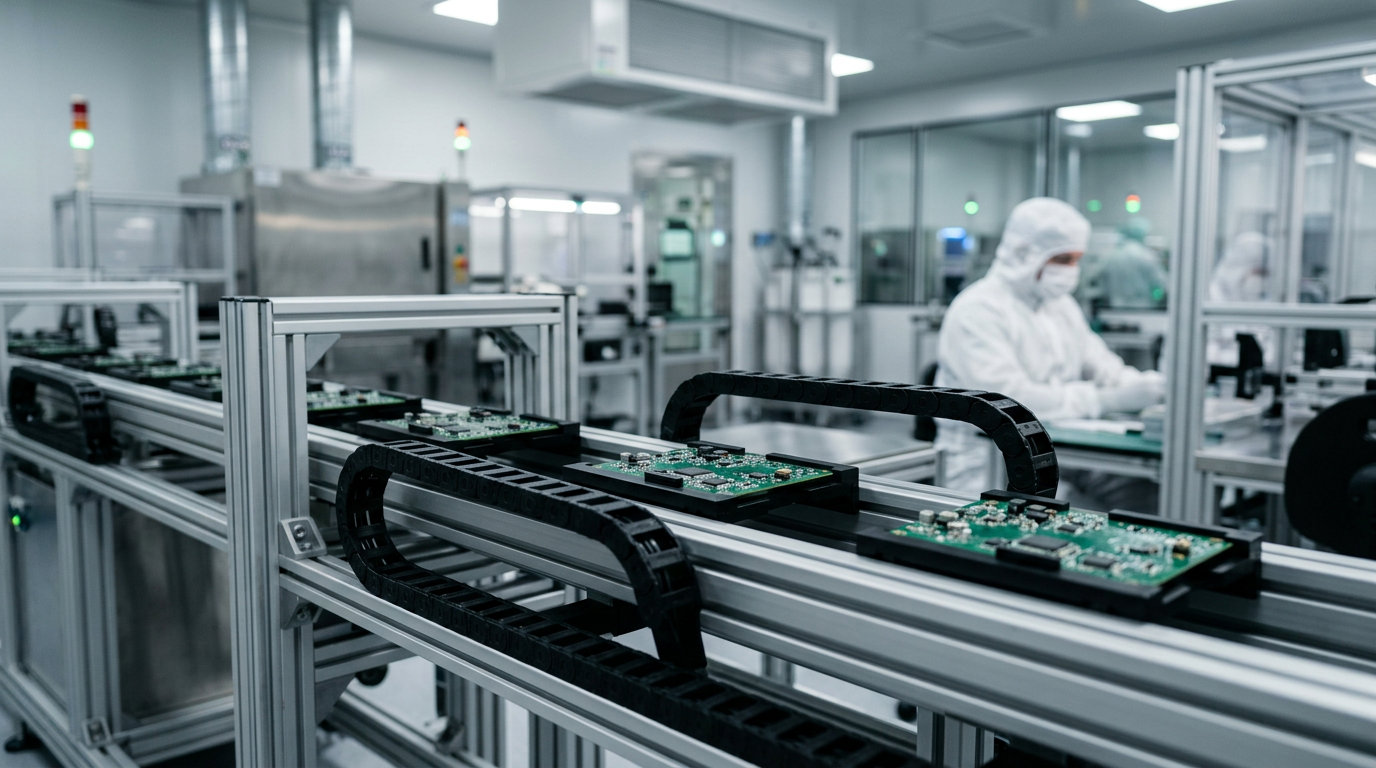
In modern electronics manufacturing, ESD-safe conveyor automation must maintain a surface resistance between $10^4$ and $10^9$ ohms per square to prevent the catastrophic failure of sensitive semiconductor components. Achieving this level of protection requires an integrated approach where every modular component—from the plastic chain links to the wear strips and drive units—is engineered to bleed off static charges to a common earth ground before potential differences can exceed the 100V threshold typical of Human Body Model (HBM) sensitivity.
The Physics of ESD in Conveyor Systems
Electrostatic Discharge (ESD) is the sudden flow of electricity between two electrically charged objects caused by contact, an electrical short, or dielectric breakdown. In the context of conveyor automation, the primary culprit is triboelectric charging. This occurs when the conveyor belt or chain moves across support rails, creating friction that strips electrons from one surface and accumulates them on another.
According to the IEC 61340-5-1 standard, electronic components are increasingly sensitive as node sizes shrink. Modern microchips can be damaged by discharges as low as 10V to 30V. Therefore, a "standard" conveyor is a liability; high-insulation materials like standard Polyethylene (PE) or Polypropylene (PP) can accumulate charges exceeding 10,000V.
Resistance Tiers for Conveyor Materials
Materials used in electronics assembly conveyors are classified by their surface resistivity:
- Conductive: $< 10^5 \Omega/sq$ (Rapid discharge, potentially dangerous if high current flows).
- Static Dissipative: $10^6 \Omega/sq$ to $10^{11} \Omega/sq$ (The "sweet spot" for controlled discharge).
- Insulative: $> 10^{12} \Omega/sq$ (Dangerous; retains charge indefinitely).
Engineering ESD-Safe Modular Systems
To build an effective ESD-safe line, engineers must look beyond the belt. A truly grounded system requires continuity across the entire mechanical assembly.
Chain and Belt Materials
Traditional modular belts are made of acetal or polypropylene. For electronics, these polymers are impregnated with carbon black or specialized metallic fibers. This modification lowers the resistivity into the dissipative range. However, carbon-loaded materials can be more brittle than their standard counterparts, necessitating careful load calculations during the design phase.
Wear Strips and Guides
The interface between the moving chain and the static frame is where most static is generated. Using ESD-safe UHMW-PE (Ultra-High Molecular Weight Polyethylene) wear strips ensures that any charge generated is immediately conducted into the aluminum or stainless steel frame. If using anodized aluminum profiles, engineers must ensure that the anodized layer—which is an insulator—is breached at connection points to maintain electrical continuity to the floor.
The Role of Modular Flexibility
In highly agile electronics assembly environments, the ability to reconfigure lines is paramount. Easy Conveyors provides modular systems that integrate these conductive properties into standard aluminum profile frames, allowing for rapid deployment of ESD-protected work cells without sacrificing the flexibility of modular automation.
Comparative Specifications for ESD Conveyor Components
| Feature | Standard Modular Conveyor | ESD-Safe Modular Conveyor | Requirement/Standard |
|---|---|---|---|
| Surface Resistivity | $> 10^{13} \Omega/sq$ (Insulative) | $10^6$ to $10^9 \Omega/sq$ | IEC 61340-5-1 |
| Chain Material | POM / PP | Carbon-Filled Acetal / PE | ESD-Safe Grade |
| Frame Grounding | Optional / Mechanical Only | Mandatory Copper Grounding Lugs | ANSI/ESD S20.20 |
| Drive System | Standard IE3 Motor | Shielded VFD Cables + Grounding | IEC 60034-30-1 |
| Typical Application | General Packaging | PCBA / SMT / Semiconductor | High Sensitivity |
Easy Conveyors stocks the industrial automation discussed here — ready to ship across Europe.
Automation Integration and VFD Tuning
In automated electronics lines, the movement is rarely constant. Frequent starts, stops, and indexing are common. This intermittent motion can spike static generation if not managed.
Using sophisticated Variable Frequency Drives (VFDs) with dedicated soft-start profiles helps reduce the friction peaks during acceleration. Furthermore, it is critical to address electromagnetic interference (EMI) which can mimic ESD failures. Motors should meet IE3 efficiency classes to ensure thermal stability, and cabling must be shielded and grounded at both ends to prevent the conveyor frame from acting as an antenna for high-frequency noise.
Sensor and Actuator Placement
Automated gates, divert modules, and stoppers must also be grounded. When an electronic assembly on a pallet hits a mechanical stopper, a "Charged Device Model" (CDM) discharge can occur. Using dissipative bumpers and ensuring the stopper assembly is electrically bonded to the main conveyor frame prevents this.
Maintenance Protocols for ESD Integrity
An ESD-safe conveyor is not a "set and forget" system. Over time, environmental factors and wear can degrade its protective properties.
- Carbon Migration: In some low-quality dissipative plastics, the conductive additives can migrate to the surface or wear away, increasing resistivity.
- Dust Accumulation: Standard industrial dust is often insulative. A layer of dust on a dissipative belt can insulate the component from the ground path.
- Humidity Control: Static generation increases as humidity drops. Automation cells should ideally operate between 40% and 60% relative humidity.
Verification and Testing
Regular testing with a surface resistance meter (megohmmeter) is required by ANSI/ESD S20.20. Engineers should measure the resistance from the belt surface to the equipment's primary ground point at intervals of no less than six months. If the resistance exceeds $1.0 \times 10^9 \Omega$, the chain or wear strips likely require replacement.
Advanced Control: Integrating Robotics
As electronics assembly moves toward "Lights Out" manufacturing, the integration between the ESD-safe conveyor and robotic arms (SCARA or 6-axis) becomes critical. The robot's end-of-arm tooling (EOAT) must be at the same electrical potential as the conveyor. If the conveyor is isolated from the robot's ground, a discharge can occur the moment the robot touches the component. Direct electrical bonding between the conveyor frame and the robotic controller's central ground bar is the industry best practice.
For high-speed pallet systems, consider "Twin-Track" designs where the pallet itself is made of dissipative materials. This ensures that even during high-speed transfers or lift-and-rotate maneuvers, the PCB remains "clamped" to a known ground potential. This synergy between modular mechanical design and electrical engineering defines the cutting edge of industrial automation today.
Conclusion
Selection of an ESD-safe conveyor system is a fundamental decision in electronics manufacturing that dictates the yield and reliability of the final product. By adhering to international standards like IEC 61340 and ensuring total system continuity—from the specialized polymers provided by partners like Easy Conveyors to the precision tuning of VFDs—manufacturers can virtually eliminate ESD-related losses. In the era of miniaturization, your conveyor is no longer just a transport tool; it is a critical component of your factory's electrical environment.
Frequently Asked Questions
What is the ideal surface resistance for an electronics conveyor?
Surface resistivity for ESD-safe conveyors should be in the dissipative range, typically between 10^6 and 10^9 ohms per square, following IEC 61340 standards.
Which materials are best for ESD-safe modular belts?
Carbon-filled acetal or polyethylene are the preferred choices because they provide permanent dissipative properties without the shedding issues of topical coatings.
Can I use standard aluminum profiles for an ESD-safe frame?
While aluminum is conductive, the anodized coating is an insulator. You must use grounding washers or remove the coating at connection points to ensure electrical continuity.
How does a VFD help with ESD control?
VFDs manage acceleration and deceleration, preventing jerky movements that increase friction and triboelectric charging between the belt and the product.
How often should I test the resistance of my ESD conveyor?
Testing should be conducted every 6 to 12 months using a megohmmeter to ensure the system still falls within the dissipative range of 10^4 to 10^9 ohms.