Optimizing Safety: Integrating Safety PLCs and Light Curtains on Conveyor Lines
Learn how to integrate safety PLCs and light curtains into conveyor lines to meet SIL 3/PLe standards while maintaining high operational throughput and data-rich diagnostics.
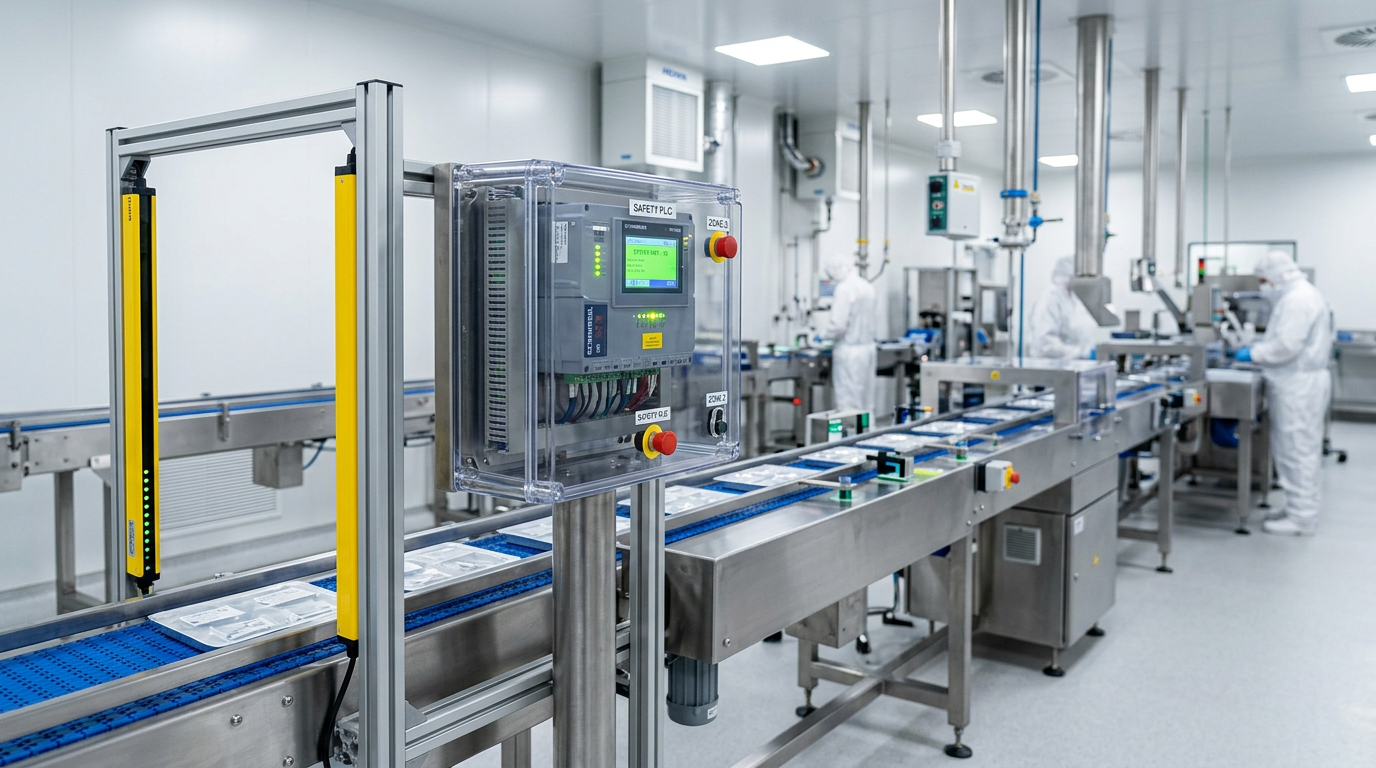
Integrating safety PLCs and light curtains into automated conveyor lines ensures systematic risk reduction to SIL 3 or PLe levels by monitoring emergency stops and entry points with a response time typically under 100ms. Modern safety protocols, such as CIP Safety over EtherNet/IP or PROFIsafe, allow for the seamless integration of distributed I/O, reducing wiring complexity by up to 50% compared to traditional hard-wired safety relays.
The Architecture of Conveyor Safety
In high-throughput environments—ranging from e-commerce sortation to automotive assembly—the conveyor system is the central nervous system of the plant. However, its expansive nature creates numerous "points of operation" and "nip points" that require rigorous safeguarding. The transition from traditional hard-wired safety relays to safety PLCs (Programmable Logic Controllers) represents a shift toward software-defined safety, offering greater flexibility and diagnostic depth.
Standard conveyor safety relies on the "Safety Chain" principle: Input, Logic, and Output.
- Input: Devices like light curtains, E-stop buttons, and interlock switches.
- Logic: The Safety PLC or dedicated safety controller.
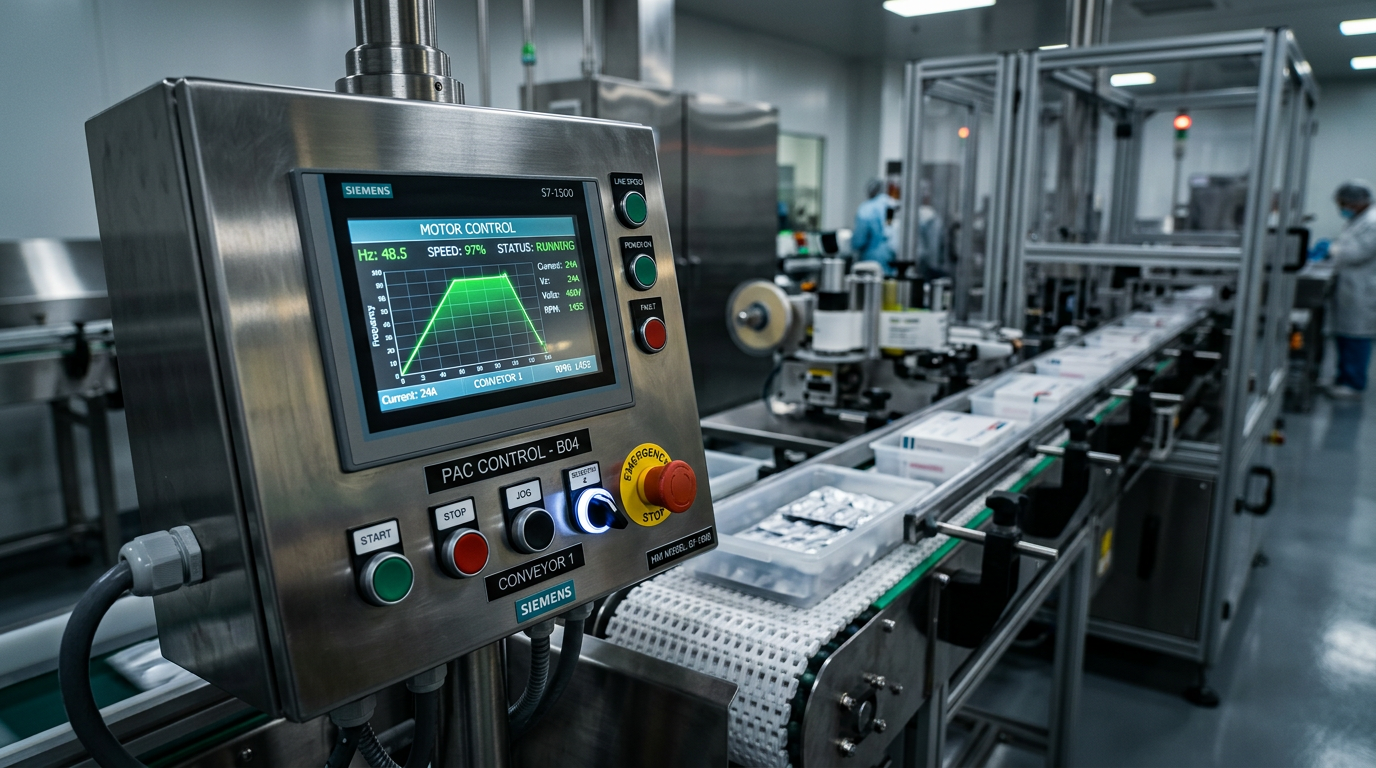
- Output: Safe Torque Off (STO) functions on Variable Frequency Drives (VFDs) or safety contactors that disconnect motor power.
Understanding SIL and PL Ratings
When designing a conveyor line, engineers must adhere to international standards such as ISO 13849-1 (Performance Levels) and IEC 62061 (Safety Integrity Levels). These frameworks quantify the reliability of a safety function.
| Feature | Performance Level (PL) | Safety Integrity Level (SIL) | Typical Conveyor Application |
|---|---|---|---|
| Risk Level | Low to Medium | SIL 1 | Simple transport in restricted areas |
| Risk Level | High | SIL 2 / PLe | Specialized palletizers / high-speed sorting |
| Risk Level | Very High | SIL 3 / PLe | Robtotic interface / human-machine interaction |
| Standard | ISO 13849-1 | IEC 62061 / IEC 61508 | Unified Global Framework |
For most high-speed modular conveyor systems, achieving PLd/SIL 2 is the minimum baseline, while systems involving robotic palletizing or AGV interfaces often require PLe/SIL 3.
Light Curtains: Selection and Placement
Light curtains (Opto-electronic protective devices) provide "point of entry" protection without the physical footprint of hard fencing. On conveyor lines, they are most frequently used at the entry and exit points of tunnels or inside pick-and-place cells.
Mutting and Blanking
A critical challenge in conveyor safety is allowing the product (a box or pallet) to pass through the light curtain without triggering a system-wide E-stop. This is handled through two primary methods:
- Muting: The temporary automatic suspension of a safety function. This is achieved using sensors that "identify" the incoming load, allowing it to pass while still being able to detect a human following the load.
- Blanking: Disabling a specific set of beams within the light curtain. Fixed blanking is used for permanent obstacles (like a conveyor rail), while floating blanking allows a product of a specific size to move through the field.
When designing these systems, Easy Conveyors provides modular frameworks that can easily accommo
Easy Conveyors stocks the industrial automation discussed here — ready to ship across Europe.
date the brackets and mounting hardware required for precise light curtain alignment, which is essential to prevent nuisance tripping in high-vibration industrial environments.
The Role of Safety PLCs
The Safety PLC is the intelligence behind the curtain. Unlike a standard PLC, a safety PLC uses "redundancy and self-checking." It features dual processors that execute the same safety logic and compare results. If a discrepancy is detected (a "cross-fault"), the system defaults to a safe state (Safe State: OFF).
Key advantages of Safety PLCs on conveyors include:
- Zonal Control: Instead of stopping a 100-meter conveyor line because one person opened a gate, the Safety PLC can trigger a localized stop or "Safe Speed" mode in just the affected segment.
- Reduced Wiring: Using safety-rated fieldbus protocols like PROFIsafe (PI/IEC 61784-3-3) or CIP Safety (ODVA), safety signals travel over the same Ethernet cable as standard control data.
- Enhanced Diagnostics: Operations managers can see exactly which E-stop was pressed or which light curtain beam was obscured via the HMI, drastically reducing downtime for "mystery trips."
Design Best Practices for Conveyor Integration
Integration begins with a comprehensive Risk Assessment (ISO 12100). You must identify the "Stopping Distance" of your conveyor. A light curtain is useless if the conveyor takes 2 seconds to coast to a stop while the human hand can reach the hazard in 0.5 seconds.
- Calculate Safety Distance: Use the formula $S = (K \times T) + C$, where $S$ is the safety distance, $K$ is the approach speed of the human body, $T$ is the total system response time (curtain + PLC + VFD brake time), and $C$ is the penetration factor.
- Logic Separation: Even if using a combined PLC, keep safety code in specialized "Safety Tasks" that cannot be overwritten by standard logic.
- VFD Selection: Ensure your motor controllers support Safe Torque Off (STO). This hardware-level input bypasses the microprocessor to ensure the motor cannot produce torque, a requirement for VFD soft-start tuning when safety is involved.
- Environmental Factors: In wash-down environments (pharma/food), ensure light curtains have an IP69K rating and that safety PLC cabinets are properly sealed to prevent logic failures due to moisture ingress.
Common Failure Modes
- Optical Misalignment: Conveyor vibrations can knock light curtains out of alignment. Using heavy-duty mounting pillars is a standard "best practice."
- Muting Sensor Fouling: In dusty environments (distribution centers), muting sensors can become clouded, leading to "False Muting" failures where the system refuses to allow a pallet through.
- Inadequate Monitoring: Failing to monitor the "reset" button. Per OSHA 1910.212, a safety system should never automatically restart just because a light curtain is cleared; a manual, monitored reset is required.
By treating safety as an integrated part of the automation stack—rather than an afterthought—manufacturers can achieve both high productivity and a zero-incident workplace. Integrating hygienic wash-down design with these electronic safeguards creates a robust system capable of meeting the strictest regulatory demands.
Frequently Asked Questions
What is the difference between SIL and PL ratings?
SIL (Safety Integrity Level) is defined by IEC 61508/62061, while PL (Performance Level) is defined by ISO 13849. Both measure the reliability of safety functions, but PL is more common in mechanical machinery like conveyors, whereas SIL is often used in the process industry. SIL 3 is generally equivalent to PLe.
How does muting differ from blanking in light curtains?
Muting temporarily disables the light curtain while a pallet passes, using external sensors to confirm it is a product and not a human. Blanking permanently or dynamically ignores certain beams in the curtain to allow for fixed objects like conveyor rails.
Can I run safety signals over a standard Ethernet network?
Yes, modern safety protocols like PROFIsafe and CIP Safety allow you to run safety-rated signals over standard industrial Ethernet (EtherCAT, EtherNet/IP, PROFINET) provided the hardware is safety-rated.
Why can't I use a standard PLC for safety functions?
A safety PLC features internal redundancy (dual processors) and performs continuous hardware self-checks. If any internal component fails, it defaults to a 'Safe State', whereas a standard PLC might fail with its outputs still 'On'.