VFD Tuning and Soft-Start Strategies for Modular Conveyors
Master VFD tuning for modular conveyors. Learn soft-start strategies, S-curve acceleration, and IE3 motor optimization to extend belt life and reduce energy.
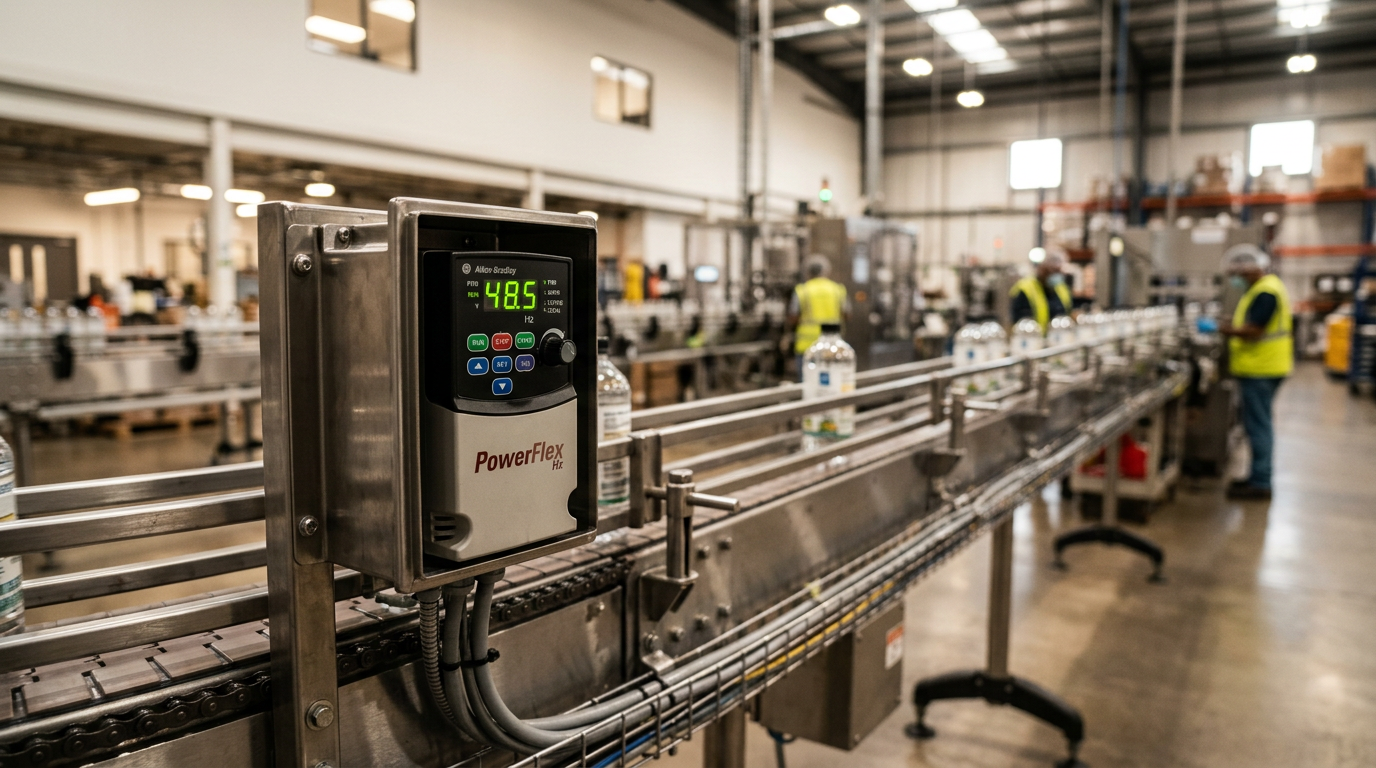
Optimizing modular conveyor performance requires a precise balance of ramp-up acceleration and motor torque control, typically achieved by setting a linear acceleration ramp between 1.5 and 3.0 seconds to prevent belt slipping while maintaining motor thermal stability. Effective VFD tuning reduces mechanical shock loads by up to 40%, significantly extending the lifecycle of plastic modular chains and drive sprockets.
The Physics of Conveyor Startup: Why VFDs are Essential
In modern material handling, the transition from static friction to kinetic friction is the most critical moment for a conveyor’s structural integrity. Unlike traditional direct-on-line (DOL) starts, which subject the drive train to 600% to 800% of the rated current and nearly 200% of the rated torque instantly, a Variable Frequency Drive (VFD) allows for controlled power delivery.
The primary goal of VFD tuning for modular conveyors—whether they are using acetal (POM) or polypropylene (PP) belts—is to manage the "catenary sag" and belt elongation. According to standards for electrical rotating machinery (IEC 60034-1), controlled acceleration minimizes winding stress and heat buildup. Without a soft-start strategy, the high starting torque of an induction motor can cause the sprocket teeth to jump or "cog" against the modular belt, leading to premature wear or catastrophic failure of the hinge pins.
Core Tuning Parameters for Modular Systems
The commissioning of a conveyor drive involves more than just setting the maximum frequency. To achieve peak efficiency, engineers must focus on four critical VFD parameters:
1. Acceleration and Deceleration Ramps
For modular conveyors, a linear ramp is the standard starting point. However, systems carrying fragile goods or high-profile products benefit from an S-Curve (Jerk Limitation).
- Linear Ramp: 1.5s to 2.5s is ideal for empty or lightly loaded belts.
- S-Curve: Adding a 10% to 20% "round-off" at the beginning and end of the ramp prevents the sudden "whiplash" effect that can tip light products like empty plastic bottles or pharmaceutical vials.
2. V/f Control vs. Sensorless Vector Control
Most modular conveyor applications can run effectively on a simple Volts-per-Hertz (V/f) pattern. However, if the conveyor operates at very low speeds (below 10% of rated frequency) or requires high starting torque for heavy loads, Sensorless Vector Control (SVC) is superior. SVC calculates the exact rotor position and magnetizing current, providing maximum torque even at 0.5 Hz without the need for an encoder.
3. Automatic Torque Boost
Modular belts have higher internal friction than fabric belts due to the hinge-and-pin construction. When starting a fully loaded system, the VFD may need a "Voltage Boost" at low frequencies to overcome static friction. Use this sparingly; excessive boost can lead to motor over-heating at low speeds.
4. DC Injection Braking
For incline conveyors or systems requiring precise positioning (e.g., feeding a robotic palletizer), DC injection braking can be tuned to hold the motor shaft still after the ramp-down is complete, preventing back-sliding.
| Parameter | V/f Control (Standard) | Sensorless Vector (Advanced) | DC Injection Braking |
|---|---|---|---|
| Primary Benefit | Simple setup, runs multiple motors | High torque at low speed | Precise stopping / holding |
| Typical Efficiency | 95-97% | 96-98% | N/A (Stopping phase) |
| Best For | Parallel long-run conveyors | Heavy-duty pallet handling | Incline/Decline modules |
| Complexity | Low | Medium | High |
Strategic Soft-Start Implementation
Different modular layouts require distinct soft-start approaches. A long-distance transport conveyor has higher inertia than a small 90
Easy Conveyors stocks the industrial automation discussed here — ready to ship across Europe.
-degree curve module.
When designing complex layouts, Easy Conveyors offers modular systems that are specifically engineered to interface with modern drive electronics, ensuring that the mechanical tolerances of the sprockets match the torque curves provided by high-performance VFDs.
The Role of IE3 and IE4 Motors
With the global shift toward energy efficiency, most new systems utilize IE3 (Premium Efficiency) or IE4 (Super Premium Efficiency) motors as defined by IEC 60034-30-1. These motors have lower internal resistance and higher inertia rotors. When tuning a VFD for an IE3 motor, the "Auto-tune" function is mandatory. The VFD must measure the stator resistance ($R_s$) and leakage inductance ($L_{\sigma}$) to ensure the pulse-width modulation (PWM) frequency is optimized for the motor’s specific winding characteristics.
Advanced Strategies: Multi-Drive Synchronization
In e-commerce sortation or large-scale food processing, several conveyor sections may need to "hand off" products seamlessly.
- Master-Slave Configuration: The master VFD sends its actual speed or torque reference to the slave units via a fieldbus (Profinet, EtherCAT, or Ethernet/IP). This ensures that if the master slows down due to a jam, the slave units follow suit immediately, preventing product pile-ups.
- Load Sharing: On very long modular conveyors driven by multiple motors, torque-based load sharing is critical. If one motor pulls harder than the others, it will wear out the belt sections unevenly. Tuning the VFDs to share the torque load within a 5% margin is a best practice recommended by industry leaders like SEW-Eurodrive.
Common Failure Modes in VFD Tuning
Failure to properly tune the drive leads to several identifiable issues:
- Overvoltage (OV) Trips during Deceleration: This occurs when the load inertia "pushes" the motor faster than the command speed, turning the motor into a generator. Solution: Extend the deceleration ramp or install a braking resistor.
- Motor "Growling" at Low Speeds: Usually caused by a carrier frequency that is too low. Increasing the PWM frequency (e.g., from 4kHz to 8kHz) can steady the motor, but be aware of increased electromagnetic interference (EMI).
- Belt Slippage: If the acceleration ramp is too aggressive ($<1.0s$), the sprockets may skip. Even with a VFD, the mechanical limits of the plastic modules must be respected.
Maintenance and Monitoring
VFDs are powerful diagnostic tools. Modern drives can monitor the "Torque Current" ($I_q$). An upward trend in $I_q$ over several months—while the load remains constant—is a leading indicator of mechanical wear, such as failing bearings or increased friction in the conveyor wear strips. By integrating VFD data into a PLC-based "Condition Monitoring" system, plants can transition from reactive to predictive maintenance.
Using standardized protocols like VDMA 24582 for fieldbus communication allows for the seamless integration of these diagnostic parameters into higher-level SCADA systems. This ensures that the tuning performed during commissioning continues to provide value throughout the system's operational life.
Conclusion
Tuning a VFD for modular conveyors is not a "set and forget" task. It requires an understanding of both the electrical properties of the motor and the mechanical properties of the plastic modular chain. By utilizing soft-start S-curves, performing motor auto-tuning, and implementing smart load-sharing, operations can achieve a significant reduction in energy consumption and a marked increase in the Mean Time Between Failures (MTBF) for their conveyor components.
Frequently Asked Questions
What is the benefit of an S-curve over a linear ramp?
An S-curve adds a non-linear transition at the start and end of the acceleration ramp, reducing 'jerk'. This is essential for preventing fragile or top-heavy products from tipping over during starts and stops.
What is the ideal acceleration time for a modular conveyor?
For standard modular transport, 1.5 to 3.0 seconds is the recommended range. Heavily loaded or long-distance conveyors may require up to 5.0 seconds to prevent mechanical shock.
Should I use V/f control or Sensorless Vector control?
V/f (Volts-per-Hertz) is suitable for 80% of applications. Sensorless Vector Control is needed only if you require high torque at very low speeds (under 5Hz) or precise speed holding under varying loads.
Why is my conveyor motor overheating at low speeds?
If the motor is hot, check the 'Torque Boost' settings. Excessive voltage at low frequencies is a common cause of motor overheating in conveyor applications. ensure the motor fan is effective if running at low speeds for long periods.
What causes modular belt 'cogging' or jumping even with a VFD?
Common causes include an acceleration ramp that is too short, incorrect sprocket alignment, or excessive thermal expansion of the modular belt in high-temperature environments.