VFD Tuning and Soft-Start Strategies for Modular Conveyors: A Design Guide
Master VFD tuning and soft-start strategies for modular conveyors to reduce mechanical wear, prevent product damage, and improve energy efficiency.
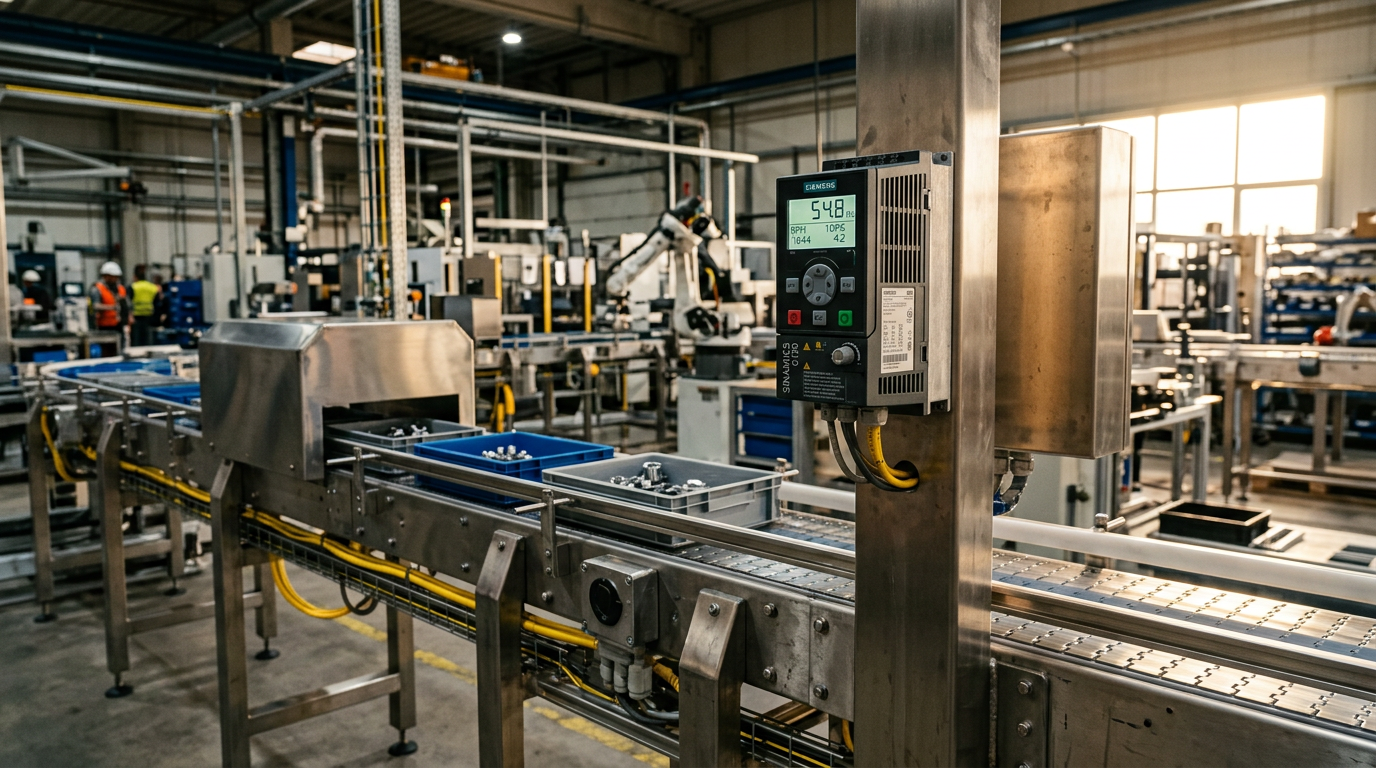
Optimizing modular conveyor performance requires precise VFD (Variable Frequency Drive) tuning, specifically utilizing an S-curve ramp profile with a jerk compensation factor between 20% and 40% to prevent mechanical fatigue and product toppling. Modern industrial automation relies on these soft-start strategies to extend the lifespan of drive chains and belts by reducing the peak starting torque which can otherwise exceed 150% of the nominal motor rating.
The Role of VFDs in Modular Conveyor Systems
In modern material handling, the Variable Frequency Drive (VFD) has transitioned from a luxury component to a fundamental requirement. It manages the electrical current provided to the motor, allowing for precise control over acceleration, deceleration, and running speed. For modular conveyors, where the inertia of the belt and the fluctuating weight of the product vary significantly, a "one-size-fits-all" factory setting is rarely sufficient.
Effective VFD tuning ensures that the motor operates within its optimal efficiency range (often targeting IE3 or IE4 efficiency standards). By modulating the frequency (Hz), the VFD controls the synchronous speed of the induction motor, allowing for synchronized throughput across multiple conveyor segments.
Essential Soft-Start Strategies
The "soft-start" refers to the controlled ramp-up of motor speed. Without this, an AC motor connected directly to the line (Across-the-line starting) draws a massive inrush current and applies instantaneous torque. This "hammer effect" is particularly damaging to modular plastic belts, where the pins and hinges can be stretched or sheared.
1. Linear vs. S-Curve Ramping
While a linear ramp increases speed at a constant rate, it creates "jerks" at the start and end of the transition. An S-curve ramp adds a second-order derivative to the acceleration, smoothing out the transition.
- Linear Ramp: Best for simple, robust systems with high friction.
- S-Curve: Essential for high-speed sortation or unstable product handling (e.g., tall bottles, vials).
2. Torque Boost and V/f Control
At low speeds, induction motors struggle with internal resistance. To overcome the static friction of a fully loaded modular belt, engineers often apply a "Torque Boost." This increases the voltage at low frequencies. However, over-application can lead to motor saturation and overheating.
3. Current Limiting
Setting the current limit to approximately 110% to 125% of the motor’s rated current (FLA) acts as an electronic shear pin. If a jam occurs on the modular line, the VFD trips before the mechanical components fail.
Advanced VFD Tuning Parameters
To reach peak performance, automation specialists must look beyond the basic ramp times.
Carrier Frequency (PWM Tuning)
The carrier frequency (measured in kHz) determines how often the VFD "switches." A higher frequency makes the motor quieter but generates more heat in the VFD and can cause electromagnetic interference (EMI). For most modular conveyor applications, a setting of 4kHz to 8kHz is the "sweet spot" for balancing noise and thermal efficiency.
DC Injection Braking vs. Dynamic Braking
When stopping a heavy modular belt, the kinetic energy must go somewhere.
- DC Injection Braking: Injects DC current into the windings to lock the motor. Good for holding a belt on an incline.
- Dynamic Braking: Uses a braking resistor to dissipate energy. Necessary for high-inertia loads that need to stop in under 1.0 seconds.
Vector Control vs. Scalar (V/Hz)
Scalar control (V/Hz) is sufficient for most standard transport conveyors. However, for applications requiring high torque at near-zero speeds or precise positioning, Sensorless Vector Control is preferred. It uses a mathematical model of the motor to estimate and control the magnetic flux and torque independently.
Easy Conveyors stocks the industrial automation discussed here — ready to ship across Europe.
Integration with Modular Hardware
The hardware design of the conveyor dictates the tuning limits. For instance, Easy Conveyors provides modular systems designed for high-efficiency operation, which allows for more aggressive deceleration profiles due to their low-friction plastic chain designs. When pairing these high-quality modules with a VFD, you can often achieve shorter cycle times without risking belt elongation.
| Feature | Scalar Control (V/Hz) | Sensorless Vector | Closed-loop Vector |
|---|---|---|---|
| Speed Accuracy | 2-3% of base speed | 0.5% of base speed | 0.01% of base speed |
| Starting Torque | 150% at 3Hz | 200% at 0.5Hz | 200% at 0Hz |
| Cost Tier | Low | Moderate | High (requires encoder) |
| Ideal Application | General Transport | Inclines/Heavy Loads | Precision Indexing |
| Complexity | Simple Setup | Auto-tuning required | Advanced Integration |
Troubleshooting Common Tuning Issues
Overvoltage (OV) Trips During Deceleration
If the VFD trips with an "OV" fault as the belt slows down, the deceleration ramp is likely too short. The motor is acting as a generator and pumping power back into the VFD’s DC bus. Increase the deceleration time or install a braking resistor.
Motor "Chirp" or Noise
High-pitched whining is usually caused by the carrier frequency. Try adjusting the parameter in 1kHz increments. If the noise persists, check for resonance in the conveyor frame.
"Sticking" at Start-up
If the motor hums but doesn't move when first energized under load, increase the "Starting Torque" or "Voltage Boost" parameter. Ensure you are not exceeding the motor’s thermal limits if it spends significant time at low RPMs.
Energy Efficiency and the VFD
One of the secondary benefits of VFD tuning is the reduction in energy consumption. Because power consumption is proportional to the cube of the speed (in centrifugal loads) and linear in constant-torque conveyor loads, reducing the speed by just 10% can result in significant energy savings over a 24/7 production schedule. Implementing a "sleep mode" or "auto-stop" via the VFD when the upstream photo-eye detects no product can further reduce the total cost of ownership.
When considering "vfd soft-start tuning", always refer to the motor's nameplate data for accurate input of the pole count and nominal slip. Proper "hygienic wash-down design" should also be considered when mounting VFDs; either use IP66/69K rated drives mounted locally or house standard IP20 drives in a centralized, climate-controlled stainless steel cabinet. This protects the sensitive electronics from the moisture and chemicals prevalent in food and pharma environments.
By mastering these VFD tuning strategies, operations managers can ensure their modular conveyor systems operate with the highest possible reliability, lowest maintenance requirements, and maximum energy efficiency.
Frequently Asked Questions
What is the 'Jerk' setting in VFD tuning?
The Jerk setting (often part of S-curve tuning) controls the rate of change of acceleration. For modular conveyors, a 20-40% jerk factor prevents the sharp "snap" that causes belt pins to wear or product to tip over.
Should I use DC braking or Dynamic braking for my conveyor?
Use Dynamic Braking with a resistor for fast stops ( <1 sec). For holding a load on an incline after it has stopped, DC Injection Braking is more effective.
Can I run my conveyor motor at very low speeds indefinitely?
Standard TEFC motors can overheat at low speeds (below 20Hz) because their internal fan spins too slowly. For continuous low-speed operation, use an 'Inverter Duty' motor with an independent blower cooling fan.
How does Carrier Frequency affect conveyor performance?
The Carrier Frequency is the switching speed of the VFD's transistors. Higher frequencies (8-16kHz) reduce motor noise but increase electrical interference and VFD heat. 4-8kHz is standard for industrial conveyors.
What should the maximum current limit be set at for a modular belt?
Typically, set the current limit to 110% of the motor's Full Load Amps (FLA) for continuous operation and 150% for short-term (60s) starting peaks.
Sources & references
- [1]ISO 13849-1:2023 Safety of machinery - Safety-related parts of control systems
- [2]VFD Frequency Inverters for Conveyor Applications
- [3]Variable-frequency drive (VFD) - Principles and Operation
- [4]PowerFlex 750-Series AC Drives for Industrial Automation
- [5]SMC-3 and SMC-Flex Smart Motor Controllers (Soft Starters)