How Tool-less Belt Change Designs Boost OEE on Modular Conveyors
Discover how tool-less belt change designs can reduce MTTR by 85% and significantly boost OEE on modular conveyors in food, pharma, and packaging industries.
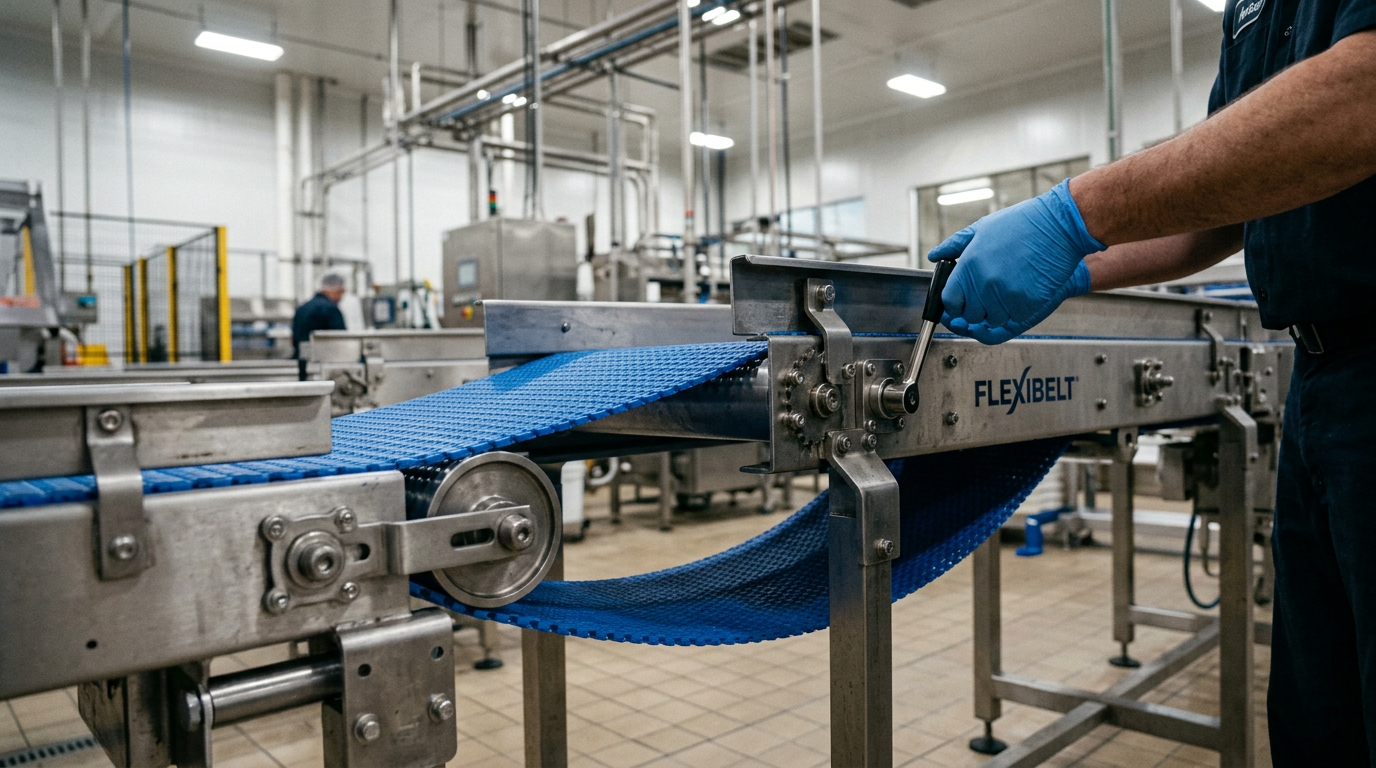
Tool-less belt change designs on modular conveyors can reduce Mean Time to Repair (MTTR) by up to 85%, directly increasing Overall Equipment Effectiveness (OEE) by minimizing planned and unplanned downtime. In high-velocity packaging and food processing environments, these systems allow a single operator to perform a full belt swap in under 15 minutes without specialized mechanical tools, ensuring that sanitation and maintenance windows do not compromise production availability.
The Relationship Between Maintenance Speed and OEE
Overall Equipment Effectiveness (OEE) is calculated as the product of Availability, Performance, and Quality. In modular conveyor applications, Availability is the variable most susceptible to mechanical design. Conventional modular belts often require the removal of side guards, the loosening of take-up units with wrenches, and the manual extraction of hinge pins using drifts and hammers.
By implementing tool-less designs, facilities shift from "mechanical repair" to "component exchange." This transition is critical in industries following FDA 21 CFR Part 110 guidelines, where hygiene-related belt removals are frequent. When a belt change is reduced from two hours to 15 minutes, the gained 105 minutes of production time directly boosts the Availability score, often resulting in a 2-4% net increase in total plant OEE.
Core Mechanisms of Tool-less Modular Designs
Modern tool-less systems focus on three primary engineering challenges: tension release, guard access, and pin extraction.
1. Quick-Release Tensioning Units
Standard conveyors require threading a take-up screw to slacken the belt. Tool-less modules utilize cam-lever or pneumatic tensioners. By flipping a lever, the tail sprocket assembly moves inward by a fixed distance (typically 50–100mm), providing immediate slack. This eliminates the need to recalibrate belt tracking upon re-tensioning, as the lever returns the sprocket to a precision-stopped home position.
2. Snap-In Hinge Pins (Headless Pins)
Traditional modular belts use pins with headed ends that must be cut or pried out. Advanced modular belts utilize "active" link retention or snap-fit end plugs. These allow the operator to press a recessed button on the link or use a simple thumb-slide to eject the pin.
3. Tool-free Side Guards and Guides
If an operator must spend ten minutes unscrewing 12 bolts to reach the belt, the "tool-less" nature of the belt itself is negated. Integrated systems, such as those provided by Easy Conveyors, utilize spring-loaded plunger pins or quarter-turn fasteners for all peripheral hardware, ensuring the entire maintenance path is accessible by hand.
Technical Comparison: Traditional vs. Tool-less Modular Belts
| Feature | Standard Modular Belt | Tool-less Modular Design |
|---|---|---|
| Tool Requirement | Wrench, Hammer, Drift, Pliers | None (Manual Operation) |
| Avg. MTTR (10m Belt) | 60 - 120 Minutes | 10 - 20 Minutes |
| Skill Level | Maintenance Technician | Trained Operator |
| Sanitation Rating | Standard | High (No threads/crevices) |
| Tracking Recovery | Manual Adjustment Required | Automatic (Fixed Home Position) |
| Spare Parts Loss | High (Pins often damaged) | Low (Retained components) |
Impact on Food Safety and Hygienic Design
Tool-less designs are not merely about speed; they are a cornerstone of hygienic design. According to EHEDG Doc 8, equipment should be designed to prevent the accumulation of soil and allow for easy cleaning.
Traditional bolted assemblies create "dead zones" where bacteria can proliferate. Threaded fasteners are notorious for harboring Listeria or Salmonella. A tool-less design typically utilizes smooth, rounded surfaces and eliminates exposed threads near the product zone. Furthermore, because the belt is so easy to remove, sanitation teams are more likely to perform "belt-off" cleaning, ensuring the conveyor frame and slider beds are fully sanitized, rather than just cleaning the visible top surface of the belt.
Easy Conveyors stocks the modular systems discussed here — ready to ship across Europe.
Engineering Trade-offs: When to Choose Tool-less
While the OEE benefits are clear, engineers must consider the mechanical limitations of tool-less systems:
- Load Capacity: Quick-release tensioners must be robustly engineered to handle the start-stop torque of high-inertia loads. For heavy automotive parts, traditional bolted take-ups may still be preferred for sheer clamping force.
- Environmental Factors: In extreme heat or chemical washdown environments, plastic snap-fit components must be made of chemically resistant polymers like PVDF or reinforced Polypropylene to prevent brittleness.
- Initial Capex: Tool-less systems typically carry a 15-25% premium in initial hardware costs. However, the ROI is usually realized within the first 6-12 months through labor savings and increased uptime.
Integration with Automation and VFDs
For a tool-less system to truly boost OEE, it must be paired with intelligent controls. When the tension is released, safety interlocks (PL-d or PL-e rated according to ISO 13849-1) should prevent the motor from engaging. Integrating the quick-release lever with a safety limit switch ensures that the conveyor cannot be restarted while the belt is slack or the guards are removed.
Furthermore, proper VFD soft-start tuning is essential. Because tool-less belts often use specific pin-retention geometries, high-impact starts can cause premature wear on the retention clips. A ramped acceleration profile protects the tool-less mechanism from mechanical shock during the 300+ starts per hour common in e-commerce sortation.
Maintenance Strategies for Tool-less Systems
Transitioning to tool-less designs requires a shift in the preventive maintenance (PM) schedule. Instead of checking bolt tightness, technicians focus on:
- Pivot Point Lubrication: Ensuring cam-levers move freely without binding.
- Spring Tension Verification: Measuring the compression of quick-release springs to ensure they still meet the manufacturer’s Newtons-of-force specification.
- Link Inspection: Checking for elongation in the "active" retention holes of the modular links.
By reducing the complexity of the belt change, facilities can move toward a "Total Productive Maintenance" (TPM) model where operators, not just specialized mechanics, take ownership of the equipment's health. This democratization of maintenance is often the final hurdle in achieving world-class OEE levels. For those designing new lines, consulting with an engineering partner like Easy Conveyors allows for the selection of sub-components that are purpose-built for these high-availability requirements.
Troubleshooting Common Issues
Even the best tool-less designs can encounter issues if improperly handled. If a pin becomes difficult to eject by hand, it is often a sign of belt tenting or debris build-up in the hinge. Regular high-pressure washdowns (IP69K rated) are recommended to keep the tool-less mechanisms clear of particulates that could lead to jamming. Additionally, ensure that the conveyor frame is level; a twisted frame can put lateral pressure on the pins, making tool-free extraction nearly impossible. Proper modular conveyor frame alignment remains the foundation upon which all quick-change features are built.
Frequently Asked Questions
How much time can tool-less designs actually save?
A tool-less design typically reduces the time required for a belt swap by 70% to 85%, allowing a 60-minute task to be completed in roughly 10-15 minutes.
Are tool-less belts suitable for washdown environments?
Yes, most tool-less modular belts are designed to meet FDA and EHEDG standards, often providing better hygiene than bolted systems because they eliminate bacteria-harboring threads.
Does a tool-less design sacrifice belt strength?
No, when properly engaged, tool-less pins and tensioners are designed to handle standard operational loads. However, they may have lower peak tension limits than heavy-duty bolted systems.
Can I retrofit my existing conveyor to be tool-less?
Most tool-less systems are proprietary to the conveyor manufacturer, so you usually need to retrofit the entire tail section or frame to support the quick-release mechanisms.