Maximizing Floor Space: Spiral Modular Conveyors for Vertical Accumulation
Vertical spiral modular conveyors provide high-density buffer zones in minimal floor space. Learn how to calculate buffer time, choose materials, and optimize FIFO/LIFO flow.
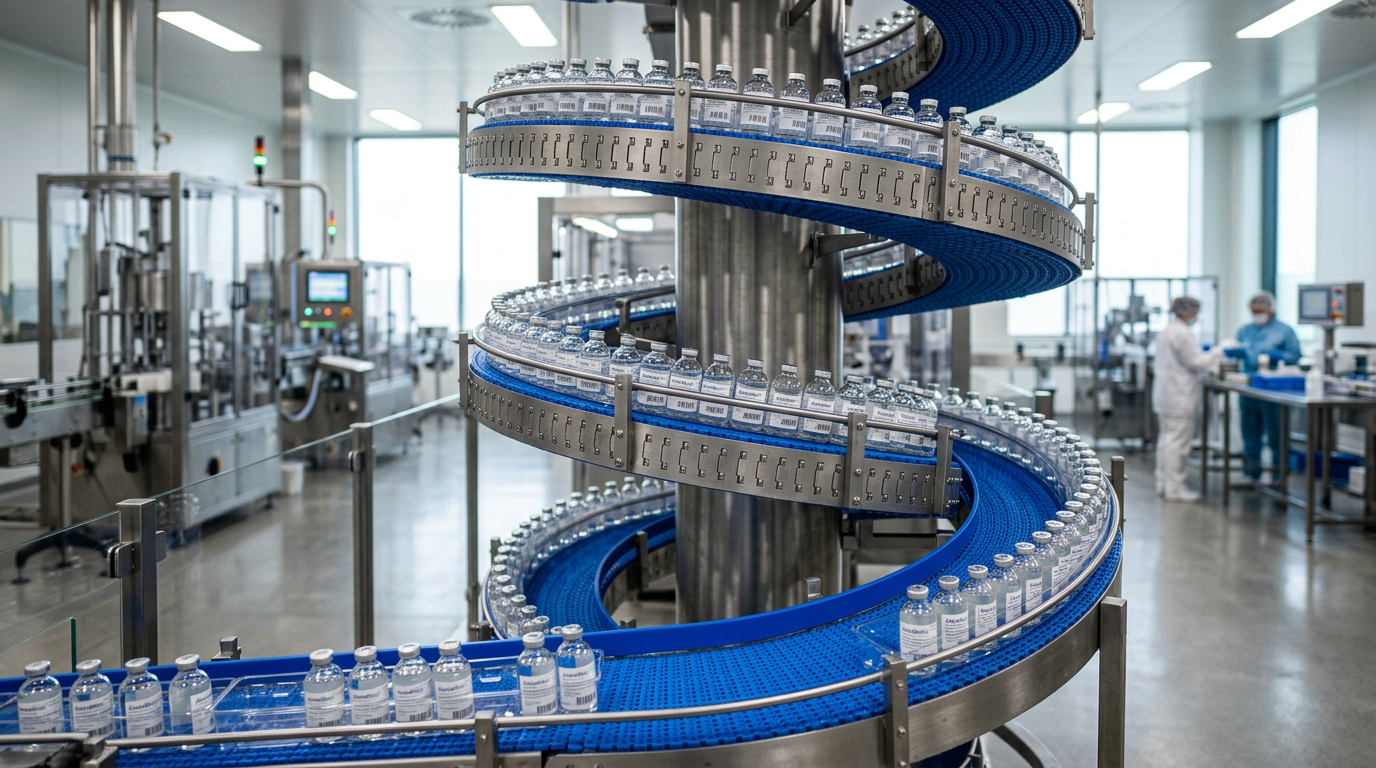
Spiral modular conveyors for vertical accumulation utilize a continuous helical path to provide up to 50 meters of buffer length within a footprint as small as 5 square meters, making them the most space-efficient solution for balancing production speeds between machines. By decoupling upstream and downstream processes, these systems eliminate micro-stops and ensure a 100% flow consistency even during brief downstream interruptions.
The Architecture of Vertical Accumulation
In modern high-speed manufacturing, process synchronization is the difference between a profitable shift and an operational nightmare. Vertical accumulation systems, specifically spiral modular conveyors, address the "pendulum effect" in production lines—where a 30-second fault at a labeler causes a full shutdown of the upstream filler.
Unlike traditional horizontal accumulation tables that consume massive amounts of floor space, a spiral accumulator builds "up." By utilizing a modular plastic belt wrapped around a central drum (the "solenoid" design), these systems create a buffer zone that stores products vertically. This is particularly critical in facilities handling food, beverage, or pharmaceutical products where 1:1 floor space utilization is at a premium.
Sizing the Buffer: The 300-Second Rule
When engineering an accumulation zone, the primary metric is "buffer time." For most FMCG (Fast-Moving Consumer Goods) lines, an accumulation window of 180 to 300 seconds is the industry standard. This allows operators to clear a minor jam or replace a label roll without stopping the entire line. To calculate the required belt length, engineers use the formula:
L = (C / 60) * t * d
Where L is belt length (m), C is line capacity (units/min), t is required buffer time (min), and d is product pitch or diameter (m).
Advantages of Modular Belt vs. Traditional Spiral Designs
The choice of a modular belt—typically made of Polyoxymethylene (POM) or Polypropylene (PP)—over a solid PVC or rubber belt is what makes vertical accumulation viable for high-speed automation.
| Feature | Modular Spiral Accumulator | Traditional Friction Spiral |
|---|---|---|
| Drive System | Positive drive (sprockets) | Friction-driven |
| Speed Range | Up to 60 m/min | Up to 35 m/min |
| Tension Level | Low (positive engagement) | High (belt stretch common) |
| Max Load | High (distributed across chain) | Moderate |
| Maintenance | Snap-in link replacement | Full belt vulcanization |
| Efficiency Class | IE3/IE4 Compatible | Standard AC |
The positive drive mechanism ensures there is zero slippage, a critical factor when tracking individual product positions (serialization) for pharmaceutical packaging or high-end electronics.
Integration Strategies: First-In-First-Out (FIFO) vs. LIFO
When selecting a spiral modular conveyor for vertical accumulation, the logic of product retrieval is as important as the physics of the move.
FIFO (First-In-First-Out) Configuration
In a FIFO spiral, the product enters at the bottom and exits at the top (or vice versa) after traveling the full length of the helix. This is the gold standard for temperature-sensitive goods or products with strict batch tracking. It ensures that the first product packaged is the first product palletized, maintaining a strict chronological flow.
LIFO (Last-In-First-Out) Dynamic Buffering
For non-perishable goods, dynamic LIFO spirals act as a "surge tank." When the downstream line slows, the spiral begins to fill. When the downstream line resumes at a higher speed, the spiral "discharges" back onto the main line. This requires sophisticated VFD soft-start tuning to ensure that the transition between horizontal and vertical motion doesn't cause product toppling, especially for tall, slim containers like wine bottles or aerosol cans.
Easy Conveyors stocks the modular systems discussed here — ready to ship across Europe.
Technical Requirements for High-Density Stacking
Building a reliable vertical accumulator requires a deep understanding of friction coefficients and centrifugal forces. As a product travels the spiral, centrifugal force pushes it toward the outer guardrail. If the belt speed is high (above 40 m/min), the transition curves must be engineered with integrated side rollers to reduce friction and heat buildup.
For manufacturers seeking a balance between high-throughput and modular flexibility, working with an experienced European specialist is essential. Easy Conveyors provides the modular building blocks necessary to construct these complex helix structures, ensuring that the interface between the horizontal feed and the vertical climb is seamless and low-maintenance.
Materials and Environment (ISO & EHEDG)
The environment dictates the material selection for the modular belt:
- Dry/Ambient: POM (Acetal) is preferred for its high strength and low coefficient of friction.
- Wet/Washdown: Polypropylene (PP) offers superior chemical resistance to caustic cleaning agents.
- Hygienic Design: For food-grade applications, the spiral must adhere to hygienic wash-down design principles, featuring "open-hinge" belt links that allow water and debris to pass through rather than accumulating in the track.
Controlling the Helix: Sensors and Logic
A spiral accumulator is only as smart as its control system. To manage vertical accumulation effectively, three zones of sensing are required:
- Infeed Detection: Laser sensors monitor product gaps. If the downstream is "Full," the spiral engages.
- Saturation Monitoring: Multiple sensors along the helix track identify how "full" the accumulator is (25%, 50%, 75%, 90%).
- Discharge Timing: As the downstream bottleneck clears, the spiral must accelerate (often using a 10-20% over-speed ratio) to purge the accumulated stock without creating a new "wave" of congestion.
Proper drum motor selection is vital here; the motor must provide high starting torque to move a "dead load" of several hundred kilograms of accumulated product from a standstill on a 15-degree incline.
Maintenance and Longevity
Vertical spirals are mechanical "batteries"—they store potential energy. Regular inspection of the wear strips (usually UHMW-PE) on the spiral curves is mandatory. If the wear strips thin out, the friction increases, leading to higher amperage draw on the motor and potential belt fatigue.
Key Maintenance Metric: Monitor the motor's current draw (Amps) during a full-load climb. A 15% increase over the baseline "as-commissioned" amperage typically indicates that the side guides or wear strips require lubrication or replacement. Using food-grade dry lubricants can extend the life of a POM belt by up to 40% in high-cycle environments.
Frequently Asked Questions
What is the maximum incline angle for a spiral modular conveyor?
A typical spiral modular conveyor can handle inclines/declines up to 15 degrees, though this depends on the friction coefficient of the product and the belt material.
How much floor space can I save with vertical accumulation?
A spiral modular conveyor typically saves 60-80% of floor space compared to a traditional horizontal accumulation table with the same linear belt length.
Can spiral conveyors act as dynamic buffers for non-perishable goods?
Yes, they can. LIFO (Last-In-First-Out) dynamic buffers allow for bidirectional movement to absorb surges without requiring the product to travel the full helix length every time.
What belt materials are best for high-speed vertical accumulation?
Low-friction POM (Acetal) is the standard for dry goods, while Polypropylene (PP) is used for high-chemical washdown or food-grade environments where EHEDG compliance is required.
What is the expected lifespan of a modular spiral belt?
Modern modular spirals are designed for high-cycle environments, often reaching 50,000 to 80,000 operating hours before requiring major component overhauls, provided wear strips are maintained.