Maximizing Throughput: Spiral Modular Conveyors for Vertical Accumulation
Spiral modular conveyors provide high-density vertical accumulation, increasing dwell time by 500% within the same footprint for food, pharma, and packaging lines.
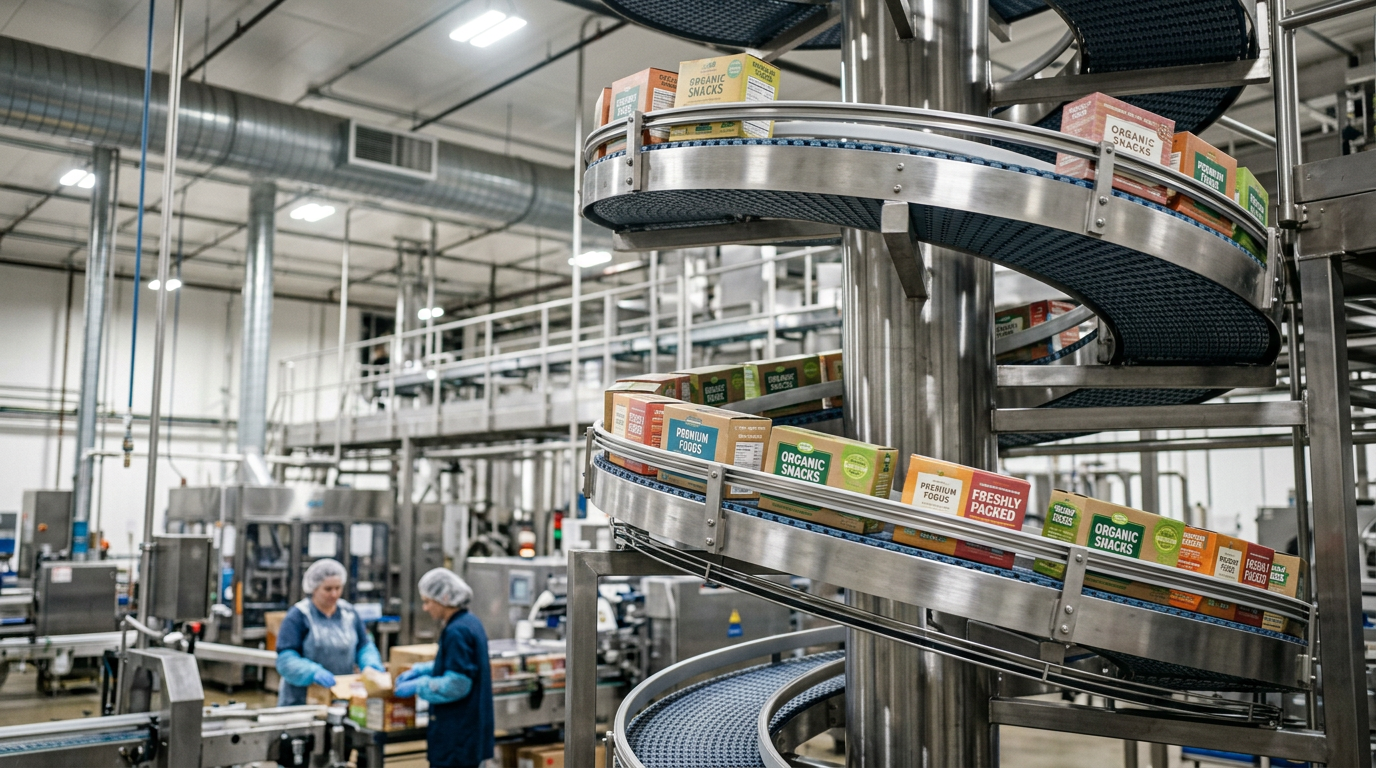
Spiral modular conveyors provide vertical accumulation by utilizing a continuous helical path that increases dwell time by up to 500% compared to linear tracks within the same floor footprint. These systems typically achieve vertical transfer rates of up to 60 meters per minute while maintaining product orientation, serving as a high-density buffer for secondary packaging and cooling lines.
The Role of Vertical Accumulation in Modern Automation
In high-speed production environments, downtime in one segment—such as a labeler or palletizer—can cause an immediate upstream shutdown if buffering is not integrated. Spiral modular conveyors solve this by moving the product vertically, using the "Z-axis" of the factory floor to store products temporarily. Unlike traditional elevator systems that operate in a start-stop fashion, spiral systems offer continuous flow, which is critical for maintaining the high OEE (Overall Equipment Effectiveness) demanded by modern manufacturing standards.
Design Principles of Spiral Modular Systems
The core of a spiral conveyor is its modular plastic belt, designed with high lateral flexibility to navigate tight radii without buckling. Most systems utilize a central column (drum) that provides the structural support for the helical tracks.
- Side-Flexing Chains: The belts are usually made of Polyoxymethylene (POM) or Polypropylene (PP) to withstand high tensile loads.
- Friction Management: Low-friction wear strips (often UHMW-PE) are essential to reduce heat build-up and energy consumption.
- Tension Control: Because the belt travels in a continuous curve, managing side-loading forces is paramount to prevent "tenting" or belt pop-out.
Easy Conveyors specializes in modular conveyor systems that integrate these spiral configurations into existing layouts, ensuring seamless transitions between horizontal and vertical planes.
Comparing Vertical Transport Technologies
When selecting a vertical accumulation method, engineers must weigh the benefits of spirals against alternatives like vertical reciprocating conveyors (VRCs) or wedge conveyors.
| Feature | Spiral Modular Conveyor | Wedge Conveyor | Vertical Reciprocating (VRC) |
|---|---|---|---|
| Flow Type | Continuous | Continuous | Intermittent (Batch) |
| Footprint | Medium (Helical) | Small (Linear) | Small (Elevator) |
| Accumulation Volume | Very High | Low | None (Transfer only) |
| Product Orientation | Maintained | Maintained | Maintained |
| Speed Range | 10–60 m/min | 20–50 m/min | 5–20 m/min |
| Standard Compliance | ISO 4414 | ISO 12100 | OSHA 1910.212 |
Engineering Considerations for Vertical Buffering
Accumulation is not merely about moving products up; it is about managing the logic of the line.
1. Dwell Time and Throughput
The length of the helical path determines the total accumulation time. If a downstream packer is down for 3 minutes, and the line speed is 20 meters per minute, t
Easy Conveyors stocks the modular systems discussed here — ready to ship across Europe.
he spiral must accommodate 60 meters of product. Calculating this involves the spiral's pitch (the vertical distance between tiers) and the radius. A tighter radius saves space but increases the friction coefficient, requiring higher-torque motors.
2. Motor Selection and Efficiency
Vertical transport requires overcoming gravity, meaning energy consumption is higher than horizontal transport. Utilizing IE3 or IE4 class efficiency motors (defined by IEC 60034-30-1) is recommended for 24/7 operations. Variable Frequency Drives (VFDs) are essential for "soft-start" tuning to prevent belt surges when the spiral is fully loaded with product.
3. Hygienic Design and Washdown
In food and pharma applications, spirals must adhere to EHEDG guidelines to prevent bacterial growth in the central drum or under the wear strips. Open-frame stainless steel construction allows for easier cleaning and drainage, which is a common requirement in dairy and meat processing facilities.
Failure Modes and Maintenance
To ensure a long service life, maintenance teams must monitor specific wear indicators:
- Elongation: Modular belts stretch over time. Automatic tensioning take-up units are often required to compensate for this without manual intervention.
- Guide Rail Wear: In high-speed spirals, the outer guide rails experience significant centrifugal force. Replacing these before they wear down to the steel frame is critical.
- Drive Sprocket Alignment: Misaligned sprockets lead to uneven tooth wear and can cause the belt to jump, leading to catastrophic failure during high-load accumulation phases.
Integration with Industrial Automation
Modern spirals are rarely standalone units. They are integrated into the wider factory floor via PLC logic. Sensors at the entry and exit points monitor the "fill level" of the spiral. If the downstream machine slows down, the spiral can decrease its speed or act as a dynamic buffer, absorbing the excess flow until the bottleneck is cleared. This requires sophisticated motor control and real-time data feedback, often utilizing EtherNet/IP or PROFINET protocols for communication with the main controller.
Applications in Secondary Packaging
Spirals are most effective when used for:
- Cooling/Proofing: Giving baked goods or hot-filled bottles time to reach ambient temperature without stopping the line.
- Curing: Allowing adhesives or coatings to set during vertical transit.
- De-elevation: Safely bringing products from high-level palletizing mezzanines down to floor-level shipping docks.
By optimizing the vertical dimension, facilities can increase their throughput without expanding their physical building footprint, a key strategy for brownfield site upgrades. Ensuring proper drum motor selection and VFD soft-start tuning are the final steps in commissioning a system that will run reliably for years. High-density buffering remains the most cost-effective way to decouple machine dependencies and maximize production uptime.
Frequently Asked Questions
What is the difference between a spiral conveyor and a vertical elevator?
A spiral conveyor uses a helical path to provide continuous product flow and accumulation, whereas a vertical elevator (VRC) usually moves products in batches (start-stop) between levels without accumulation capacity.
What is the maximum incline angle for a spiral modular conveyor?
Standard modular spiral conveyors can typically handle inclines and declines between 5 to 15 degrees, depending on the friction coefficient of the product and the belt material.
Can spiral conveyors be used for cooling applications?
Yes, by using open-grid modular belts and stainless steel frames that meet EHEDG and FDA standards, spirals are ideal for cooling baked goods or hot-filled containers.
What belt material is best for high-load vertical accumulation?
For high-load vertical transport, Polyoxymethylene (POM) is preferred due to its high tensile strength and low coefficient of friction, though Polypropylene (PP) is used for chemical resistance.