Spiral Modular Conveyors for Vertical Accumulation: A Design Guide
Spiral modular conveyors reduce floor space by up to 75%. Learn how vertical accumulation buffers production lines, optimizes throughput, and saves facility costs.
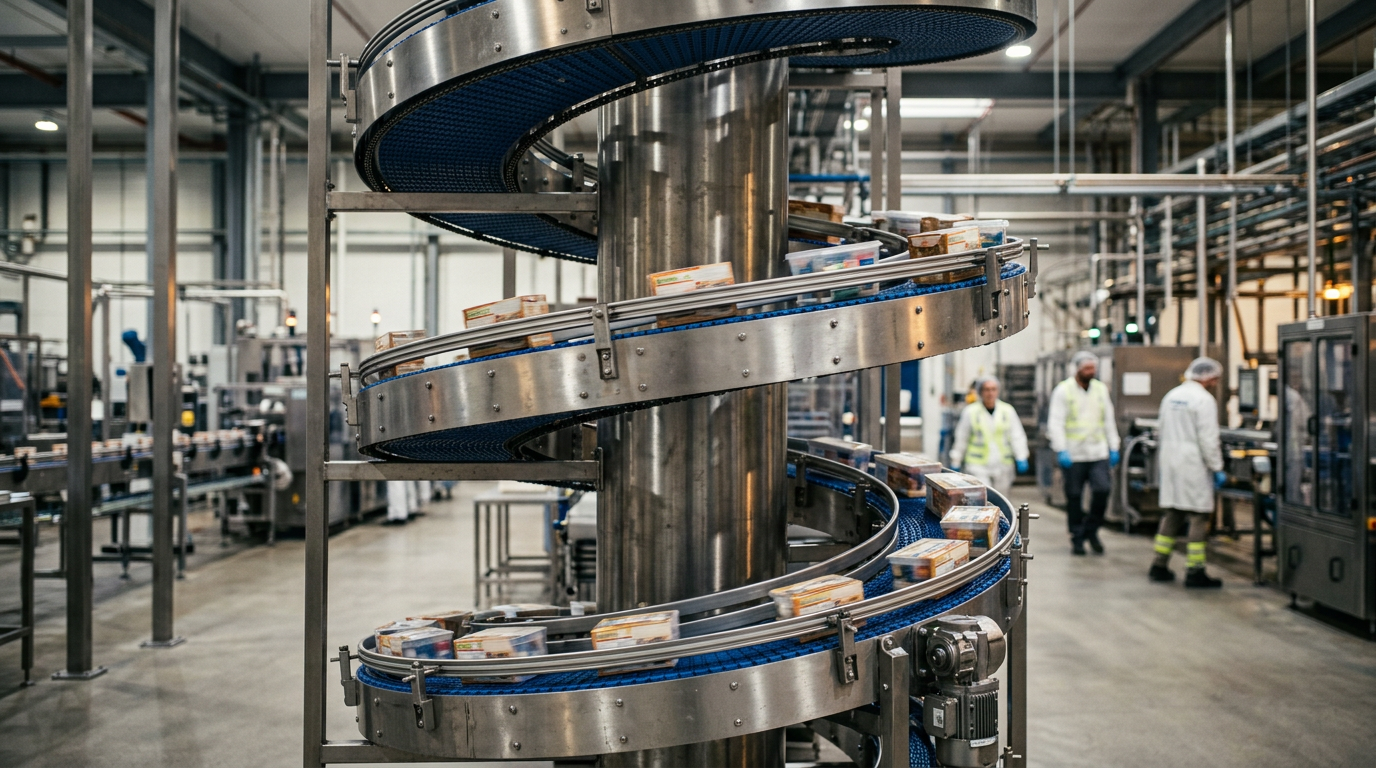
Spiral modular conveyors for vertical accumulation solve the floor-space dilemma by utilizing gravity and vertical height, typically offering a footprint reduction of up to 75% compared to horizontal accumulation tables. These systems rely on high-strength modular plastic chains, such as those made from Polyoxymethylene (POM), to navigate tight-radius curves while maintaining a continuous flow or providing a buffer capacity of several hundred meters in a vertical column.
The Engineering Logic of Vertical Accumulation
In modern high-speed production lines, particularly in beverage and pharmaceutical sectors, downtime on a downstream machine (like a palletizer) can force an immediate stoppage of the upstream filler. Vertical accumulation acts as a dynamic buffer, storing product vertically to keep the line running during minor interruptions.
The core technology behind these systems is the side-flexing modular belt. Unlike traditional fabric belts, modular belts are composed of interlocking links that can withstand the high tensile loads required to pull a chain through multiple spiral tiers. According to standards like ISO 2110:2020, the geometry of these belts must account for the collapsing inner radius and the expanding outer radius during 360-degree turns.
Key Performance Metrics for Spiral Systems
When designing or procuring a spiral modular conveyor, several technical variables dictate the system's reliability:
- Pitch and Diameter: The relationship between the center diameter and the belt width determines the "incline angle." For most packaged goods, an angle of 5° to 12° is optimal to prevent product slippage or toppling.
- Chain Tensile Strength: In vertical spirals, the motor must overcome both the friction of the wear strips and the gravitational force of the accumulated product. High-performance POM chains often reach allowable strengths of 10,000 N/m or more.
- Friction Factors: The interface between the modular belt and the slide rails (often UHMW-PE) is critical. A lower coefficient of friction reduces the "stick-slip" effect, which is vital for maintaining product stability during vertical transit.
Spiral vs. Traditional Accumulation Methods
Choosing the right buffer system requires a comparison of spatial efficiency and mechanical complexity.
| Feature | Spiral Modular Accumulator | Horizontal Alpine Conveyor | Rotary Accumulation Table |
|---|---|---|---|
| Space Utilization | Excellent (Vertical) | Moderate (Z-Pattern) | Poor (Large Circular Footprint) |
| Footprint Reduction | 60% – 85% | 20% – 30% | 0% (Baseline) |
| Throughput (BPM) | Up to 800+ | Up to 400 | Low (manual/semi-auto) |
| Cleaning/Hygiene | High (Open frame) | Moderate | Difficult (Center pivot) |
| Initial Investment | High | Medium | Low |
For manufacturers looking to integrate these systems into existing lines, Easy Conveyors provides modular components that allow for rapid assembly and reconfiguration of spiral loops, ensuring that the system can grow with production demands.
Dynamic vs. Static Accumulation
In vertical accumulation, there are two primary logic modes:
1. First-In-First-Out (FIFO)
The spiral acts as a continuous loop. If the downstream process stops, the spiral continues to fill from the bottom, effectively "stretching" the time it takes for a product to reach the exit. This is essential for products with strictly monitored shelf lives or cooling requirements, such as bakery items.
2. Zero-Pressure Accumulation (ZPA)
Using sensors and segmented drives, ZPA ensures that products do not touch each other during accumulation. This prevents damage to fragile primary packaging (e.g., glass bottles or thin-walled PET). Implementing ZPA often involves advanced VFD soft-start tuning and logic controllers to manage the inertia of a fully loaded spiral.
Easy Conveyors stocks the modular systems discussed here — ready to ship across Europe.
Selecting the Right Drive System
The drive configuration is the heart of a spiral conveyor. Because of the long chain lengths—often exceeding 50 meters in a single spiral—tension management is paramount.
- Top-Drive Systems: The motor is located at the discharge end, pulling the belt up the spiral. This is the most common configuration for elevating spirals.
- Intermediate Drives: For ultra-high spirals (exceeding 10 meters in height), multiple drive points may be required to distribute the chain tension and prevent link elongation.
- Drum Motors vs. Gearmotors: While traditional gearmotors are common, high-IP-rated drum motors (IEC 60034-30-1) are increasingly used in food-grade spirals to eliminate external linkages and reduce the risk of lubricant contamination.
Safety and Compliance Standards
Vertical systems introduce risks related to falling objects and high-torque mechanical parts. Design engineers must adhere to:
- ISO 13849-1: Safety of machinery, particularly regarding the performance levels (PL) of the emergency stop systems on vertical inclines.
- FDA/EHEDG: For food applications, the modular belt must be made of food-safe plastics (FDA 21 CFR), and the spiral structure should allow for "Clean-in-Place" (CIP) procedures to prevent bacterial growth in the belt hinges.
Maintenance and Failure Modes
The most common failure point in spiral modular conveyors is "catenary sag" or excessive chain elongation. As the belt wears, the pitch of the links increases slightly. Without a proper take-up unit, this can lead to the belt jumping the drive sprockets.
Maintenance Checklist:
- Monthly: Inspect the wear strips for signs of uneven friction or melting (common in high-speed applications).
- Quarterly: Check the tensioner/take-up travel. If the take-up is at its limit, a link must be removed from the modular chain.
- Annually: Verify the alignment of the spiral tiers. Building settling or heavy vibration can slightly tilt the spiral, causing the belt to track improperly.
Proper hygienic wash-down design also plays a role in longevity. In wet environments, residual sugars or cleaning chemicals can increase the coefficient of friction if not properly rinsed from the spiral’s internal guide rails, leading to premature motor failure or belt breakage.
Conclusion
Spiral modular conveyors for vertical accumulation represent the pinnacle of space-efficient material handling. By mastering the variables of chain tension, incline geometry, and control logic, manufacturers can create a resilient production environment that maximizes uptime without expanding their facility's physical footprint. Whether for cooling, proofing, or simple buffering, the vertical spiral remains an indispensable tool in the automation engineer's arsenal.
Frequently Asked Questions
What is the maximum incline angle for a spiral conveyor?
The maximum incline angle generally ranges between 5° and 12°, depending on the coefficient of friction of the product packaging and the belt surface. Higher angles may require high-friction inserts or cleats.
How much floor space can a spiral conveyor save?
Spiral conveyors save up to 75-85% of floor space compared to horizontal accumulation tables or long 'alpine' conveyors by utilizing the vertical height of the facility.
Can spiral accumulators handle First-In-First-Out logic?
Yes, spiral modular conveyors are ideal for FIFO (First-In-First-Out) logic, as the products follow a continuous path, ensuring the first product entered is the first to exit.
What materials are typically used for the modular belts in spirals?
Common materials include Polyoxymethylene (POM) for high strength and low friction, or Polypropylene (PP) for chemical resistance in wash-down environments. Both can be FDA-compliant.