Optimization via Spiral Modular Conveyors for Vertical Accumulation
Learn how spiral modular conveyors optimize vertical accumulation, offering up to 40% space savings and FIFO flow for food, pharma, and packaging lines.
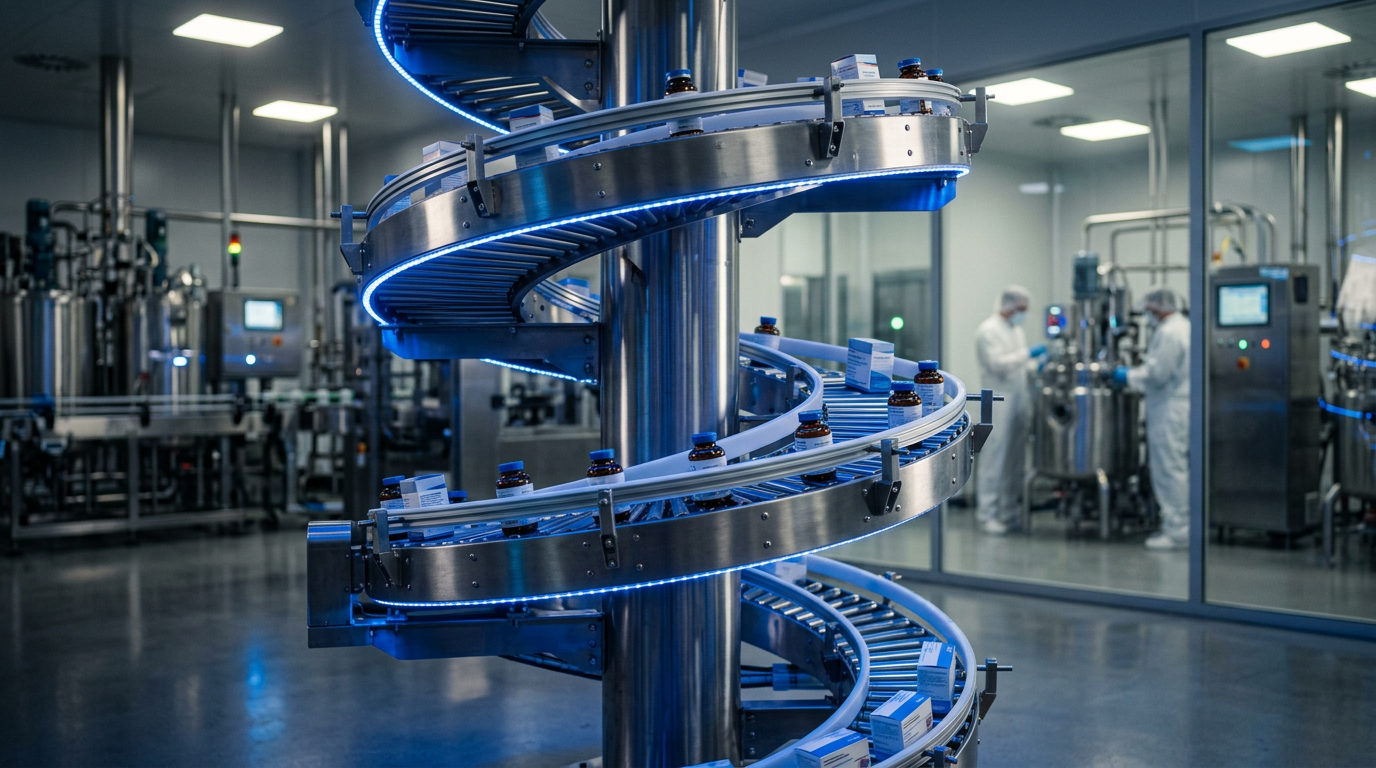
Vertical accumulation via spiral modular conveyors allows for up to 50 meters of product buffer in a footprint as small as 5 square meters by utilizing a continuous helical path. This design provides 30-40% higher space efficiency compared to traditional serpentine or multi-tier accumulating systems while maintaining a First-In-First-Out (FIFO) product flow.
The Engineering Behind Spiral Modular Accumulation
The primary challenge in vertical material handling is balancing mechanical complexity with throughput reliability. Spiral modular conveyors solve this by using high-tension plastic modular belts that navigate a tight radius on a continuous vertical incline or decline. Unlike traditional bucket elevators or simple hoists, a spiral system serves double duty: it moves products vertically and acts as a dynamic storage buffer.
In modern packaging and bottling lines, machine downtime on a downstream labeler or palletizer shouldn't force an immediate shutdown of the upstream filler. By implementing a spiral accumulator, engineers can capture several minutes of production volume within the vertical helix. The belt width, typically ranging from 200mm to 600mm, is selected based on the product footprint and the required pitch of the spiral. The pitch is critical; for instance, according to VDMA standards for conveyor safety and design, the incline angle must be calculated to prevent product "rollback" or sliding, typically kept under 12 degrees for non-gripped modular belts.
Design Principles: The Low-Tension Advantage
Most vertical spirals operate on a low-tension drive principle. The belt is driven by a central drum or a series of peripheral chain drives that interact with the inner radius of the modular belt. This reduces the stress on the belt material—typically Polyoxymethylene (POM) or Polypropylene (PP)—extending the service life of the system.
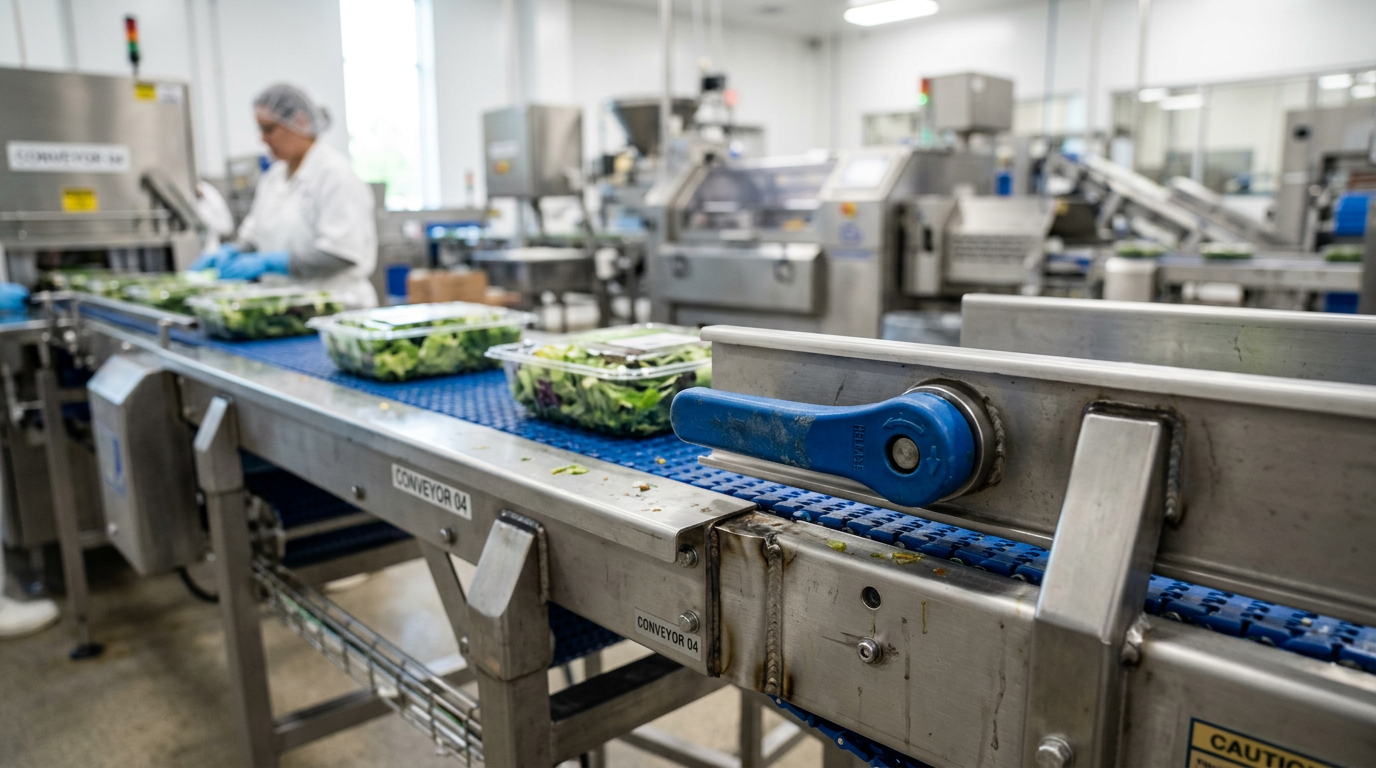
For systems requiring high hygiene, such as food processing or pharmaceutical secondary packaging, stainless steel frames combined with blue modular belts (standard for visibility and food safety per FDA guidelines) are preferred. When integrating these systems into complex layouts, working with a specialist like Easy Conveyors ensures that the modular components are compatible with existing horizontal runs and drive controls.
Technical Comparison: Accumulation Methods
When selecting a vertical accumulation strategy, engineers must weigh footprint against mechanical complexity.
| Feature | Spiral Modular | Serpentine (Alpine) | Vertical Lift (Reciprocating) |
|---|---|---|---|
| Footprint Efficiency | High | Medium | Very High |
| Throughput Speed | Up to 60 m/min | Up to 50 m/min | Low (Cycle dependent) |
| FIFO Capability | Yes | Yes | Often LIFO or complex FIFO |
| Mechanical Stress | Uniform / Low | High (many turns) | High (Start/Stop) |
| Material Handling | Continuous | Continuous | Intermittent |
| Maintenance Class | Low (Modular) | Medium | High |
Optimizing Throughput with VFD Integration
The effectiveness of modular spiral accumulation is largely dependent on its control logic. Variable Frequency Drives (VFDs) are essential for managing the transition between the accumulation phase and the discharge phase. To prevent product damage, the VFD must be tuned for smooth acceleration ramps, often following an S-curve profile.
Modern systems utilize photoelectric sensors at the inlet and outlet to monitor "slug" density. If the downstream sensor detects a blockage, the spiral speed can be modulated to thicken the product density on the belt—effectively increasing the number of units stored per linear meter—without stopping the upstream flow. This is a common application for VFD soft-start tuning in high-speed bottling lines.
Material Selection: POM vs. PP
Modular belts for these spirals are usually made from high-performance polymers:
- POM (Polyoxymethylene): Chosen for its high strength and low coefficient of friction. It is the industry standard for high-load spirals.
- PP (Polypropylene): Used in chemical environments or where extreme washdowns are required, though it has lower tensile strength than POM.
Easy Conveyors stocks the modular systems discussed here — ready to ship across Europe.
Key Maintenance and Failure Modes
While spiral modular conveyors are robust, they are not "fit and forget" systems. The most common failure modes involve belt elongation and guide rail wear. Since the belt travels a helical path, the outer edge travels a significantly longer distance than the inner edge, creating differential stress.
- Belt Elongation: Over time, the pins in the modular belt may wear, leading to belt "stretch." Most modular spirals include a weighted take-up unit or a pneumatic tensioner to compensate for this.
- Guide Rail Wear: The lateral forces in a spiral are significant. High-molecular-weight polyethylene (UHMW-PE) wear strips are used to minimize friction. If these strips wear through, the belt can begin to "chatter," leading to product instability.
- Drive Synchronization: In larger spirals with multiple drive motors, ensuring torque sharing is vital. Misaligned drives can cause the belt to bunch or jump teeth on the drive sprockets.
Integrating Spiral Accumulators into the Factory Floor
In an Industry 4.0 environment, the spiral accumulator is more than a piece of hardware; it is a data point. By monitoring the motor torque and belt speed through a centralized PLC, operations managers can predict maintenance needs before a failure occurs. Integrating this with hygienic wash-down design principles ensures that the system meets the stringent requirements of the EMEA and North American food safety markets.
For applications requiring cooling or drying during transport, the open structure of modular belts is a distinct advantage. Air can circulate around the product as it moves vertically, turning a "dead" transport phase into an active processing phase. This "process-while-moving" approach is a hallmark of efficient material handling systems.
Conclusion
Spiral modular conveyors represent the pinnacle of vertical accumulation technology. They provide a continuous, high-speed, and space-saving solution that protects product integrity through FIFO logic. By specifying the correct belt material, ensuring proper VFD control, and following a rigorous maintenance schedule, manufacturers can significantly increase their line OEE (Overall Equipment Effectiveness). Choosing modular systems allows for future scalability, ensuring that as production demands grow, the conveyor infrastructure can grow alongside it.
Frequently Asked Questions
What is the maximum incline angle for a modular spiral?
Most spirals utilize an incline angle between 8 and 12 degrees. Angles exceeding 15 degrees typically require high-friction belt inserts or 'grippers' to prevent product back-sliding.
Can spiral conveyors be used for product cooling?
Yes. By using perforated modular belts, spirals can be used for ambient cooling or drying while the product moves between floor levels, maximizing process efficiency.
What is the typical throughput capacity of a spiral accumulator?
Standard modular spirals can handle throughputs up to 3,000 units per hour, depending on the product dimensions and the belt speed, which typically tops out at 60 meters per minute.
How does spiral accumulation handle FIFO vs LIFO?
Spiral systems are inherently FIFO (First-In-First-Out), ensuring that the first product that enters the buffer is the first to leave, which is critical for perishable goods.
What are the primary maintenance requirements for modular spirals?
Monthly checks should include inspecting the UHMW-PE wear strips, verifying belt tension at the take-up unit, and checking for debris in the drive sprockets.