Efficient Vertical Accumulation via Spiral Modular Conveyors
Discover how spiral modular conveyors solve floor space issues through vertical accumulation. Learn about FIFO logic, belt tension, and IE3 motor efficiency.
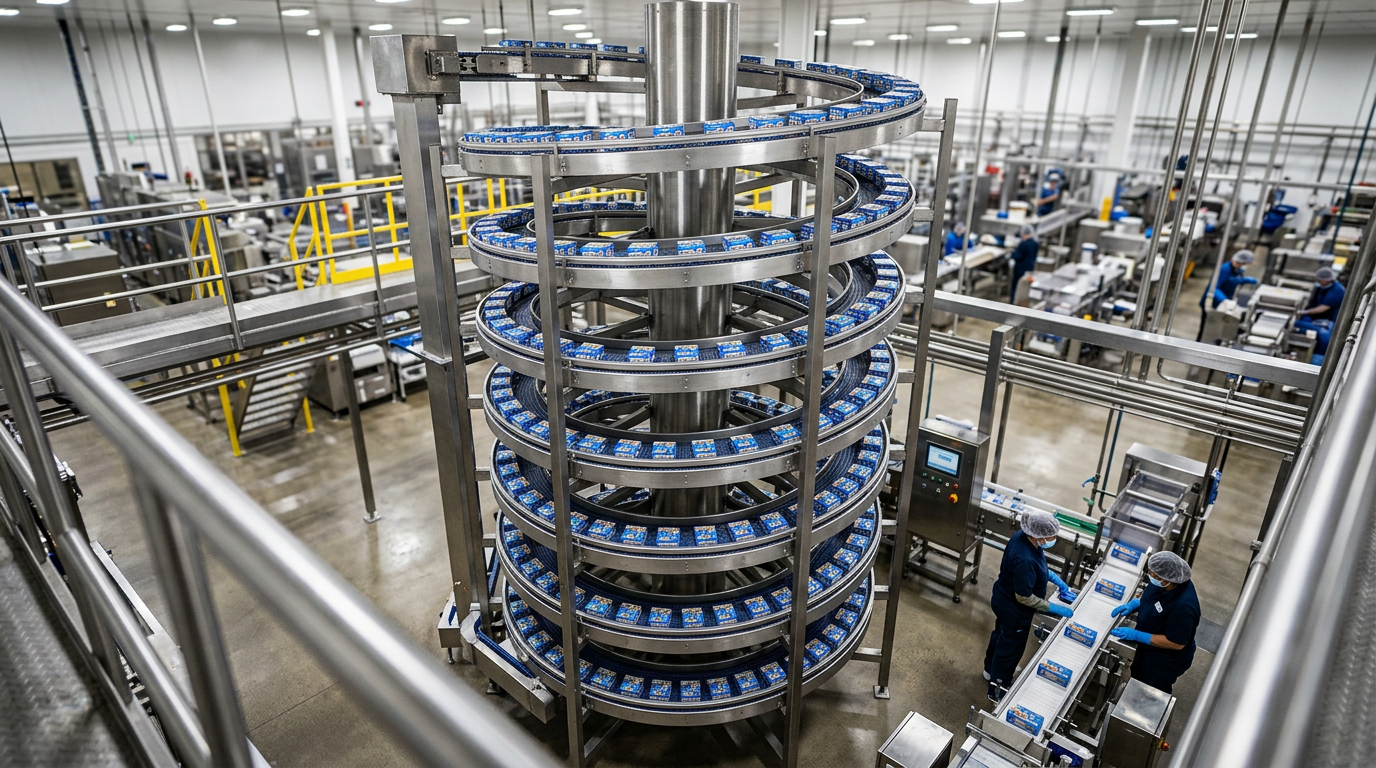
Spiral modular conveyors for vertical accumulation provide a high-density buffer solution that utilizes overhead space, typically offering a 40% to 60% reduction in floor space requirements compared to traditional horizontal accumulation tables. These systems rely on low-friction acetal (POM) modular belts and precise tension control to manage the transition of products between different elevation levels while maintaining a First-In-First-Out (FIFO) or Last-In-First-Out (LIFO) product flow.
Vertical accumulation is the strategic response to the "bottleneck paradox" in modern packaging lines: when a downstream machine (like a palletizer or case sealer) stops briefly, the upstream production must continue to avoid costly restarts. By spiraling the conveyor path upward, facilities can store minutes of production in a footprint only slightly larger than a single conveyor turn.
The Engineering Logic of Spiral Accumulation
The primary challenge in vertical accumulation is managing the radial forces and friction inherent in a continuous curve. Unlike standard straight conveyors, a spiral module must balance the tangential pull of the motor with the inward centripetal force of the belt. Most modern systems utilize a central "drum" or a series of perimeter guides to maintain the belt’s path.
For high-speed applications, the selection of belt material is critical. Acetal (POM) is the industry standard due to its high tensile strength and low coefficient of friction against wear strips. According to ISO 13212, the mechanical properties of these plastics must be accounted for regarding thermal expansion, especially in facilities that fluctuate between ambient and refrigerated temperatures.
FIFO vs. LIFO Accumulation
Depending on the product and the process, engineers must choose between two flow logic systems:
- First-In-First-Out (FIFO): Often called a "Dynamic Buffer," this system ensures that the first product to enter the spiral is the first to leave. This is essential for perishable goods and pharma products with strict lot tracking.
- Last-In-First-Out (LIFO): Simpler to implement via a "reversing" spiral or a "dead-end" stack, LIFO is often used for non-perishables or secondary packaging where sequence is less critical than pure volume.
Technical Specifications and Design Limits
When designing a vertical accumulation spiral, engineers must evaluate the "Incline Angle" and the "Turning Radius." If the incline is too steep, products may slide or tip; if the radius is too tight, the belt life is significantly shortened due to edge stress.
| Feature | Specification Range | Industrial Standard / Reference |
|---|---|---|
| Incline Angle | 2° to 12° | Dependent on product friction |
| Belt Material | POM (Acetal) or PP | FDA/CFR 21 Compliant |
| Motor Efficiency | IE3 or IE4 | IEC 60034-30-1 |
| Load Capacity | 25 – 50 kg/m | Varies by chain pitch |
| Noise Level | < 70 dB(A) | Measured at 1m distance |
| IP Rating | IP66 (Washdown) | IEC 60529 |
Integration with Modular Systems
Vertical spirals are rarely standalone units. They function as the "lungs" of a larger system. For example, Easy Conveyors specializes in modular components that allow these spirals to be integrated seamlessly into aluminum or stainless steel sub-frames. This modularity is vital for "future-proofing" a facility; as production volumes increase, additional tiers can often be added to the spiral stack.
Integration requires sophisticated sensing, typically involving:
- Photoelectric Sensors: Placed at every 90 or 180 degrees of the spiral to monitor "slug" density and prevent jams.
- Encoders: Linked to the VFD to ensure the spiral speed matches the upstream infeed and downstream outfeed exactly.
- Torque Limiters: Both mechanical and software-based (within the VFD) to prevent belt breakage if a product becomes wedged.
Easy Conveyors stocks the modular systems discussed here — ready to ship across Europe.
Friction and Drive Dynamics
The physics of a spiral modular conveyor differs from a standard flat-belt conveyor. Because the belt is traveling in a circle while climbing, the outer edge of the belt travels a significantly longer distance than the inner edge. This is compensated for by "collapsible" side-flexing chains—a design pioneered by manufacturers like Intralox.
To drive these belts effectively, engineers often use a Peripheral Drive System or a Direct Drive Revolution. In a peripheral drive, the friction between the belt edge and the rotating central drum provides the motive force. This reduces the tension on the belt because the "pull" is distributed across the entire length of the spiral rather than just at the head shaft. This design heavily limits "surging"—the jerky movement of a belt that occurs when friction overcomes the motor's initial torque.
Maintenance and Operational Longevity
To ensure the 24/7 reliability required in e-commerce and food processing, maintenance schedules for spiral accumulators focus on three pillars:
- Wear Strip Inspection: The plastic strips (often UHMW-PE) that the belt slides on are sacrificial components. If they wear through, the belt will begin to cut into the metal frame, leading to catastrophic failure.
- Chain Elongation: All modular belts stretch over the first 500 hours of operation. Automated take-up units, often using pneumatic cylinders or gravity-fed rollers, are required to maintain constant tension.
- Hygienic Standards: In food applications, the spiral must meet EHEDG guidelines to ensure there are no "dead zones" where organic matter can accumulate in the central drum or the belt links.
Energy Efficiency in Vertical Transport
Spirals are inherently more energy-efficient than vertical reciprocating conveyors (lifts) for high-frequency small-parcel movement. Because the movement is continuous and rotational, the motor does not need to overcome the massive inertia of "stop-and-start" cycles. By utilizing IE3 premium efficiency motors—as defined by IEC 60034-30-1—and regenerative braking in the VFD, facilities can reclaim energy during the "downward" descent of products in a multi-story sortation center.
Selecting the Right Incline
The rule of thumb for "slick" plastic containers (like LDPE bottles) is an incline of no more than 5 degrees without high-friction inserts. For corrugated cardboard boxes, inclines can reach 10 to 12 degrees. Exceeding these limits requires "rubber-top" or "friction-top" modules, which increase the maintenance burden as the rubber inserts can wear or delaminate over time.
Conclusion
Spiral modular conveyors represent the pinnacle of spatial efficiency in material handling. By mastering the variables of belt tension, friction, and modular integration, plant managers can turn wasted overhead air into a valuable buffer that keeps the production line running even when downstream disruptions occur. As modular technology continues to evolve, the integration of these "vertical lungs" will be a cornerstone of high-speed, automated manufacturing. Areas like "VFD soft-start tuning" and "hygienic wash-down design" remain critical for long-term operational success in these complex vertical environments.
Frequently Asked Questions
What is the maximum incline angle for a spiral conveyor?
For most plastic-on-plastic modular belts, the maximum incline is between 5° and 12°. Beyond this, "friction top" modules are required to prevent product slippage.
Should I choose FIFO or LIFO for vertical accumulation?
FIFO (First-In-First-Out) ensures product rotation and freshness, crucial for food and pharma. LIFO (Last-In-First-Out) is simpler and used when product sequence doesn't matter, often in secondary packaging.
Why is Acetal (POM) the standard for spiral modules?
Low-friction Acetal (POM) is the preferred material for its high tensile strength and dimensional stability, which are critical for the radial forces found in spiral paths.
How does a drum drive improve spiral conveyor longevity?
A central drum drive or peripheral drive distributes the pulling force across the entire length of the spiral, significantly reducing belt tension and wear compared to a traditional head-shaft drive.