Spiral Modular Conveyors for Vertical Accumulation: Engineering Guide
Spiral modular conveyors offer a 75% footprint reduction for vertical accumulation. Learn how to size, select materials, and optimize FIFO buffers for production lines.
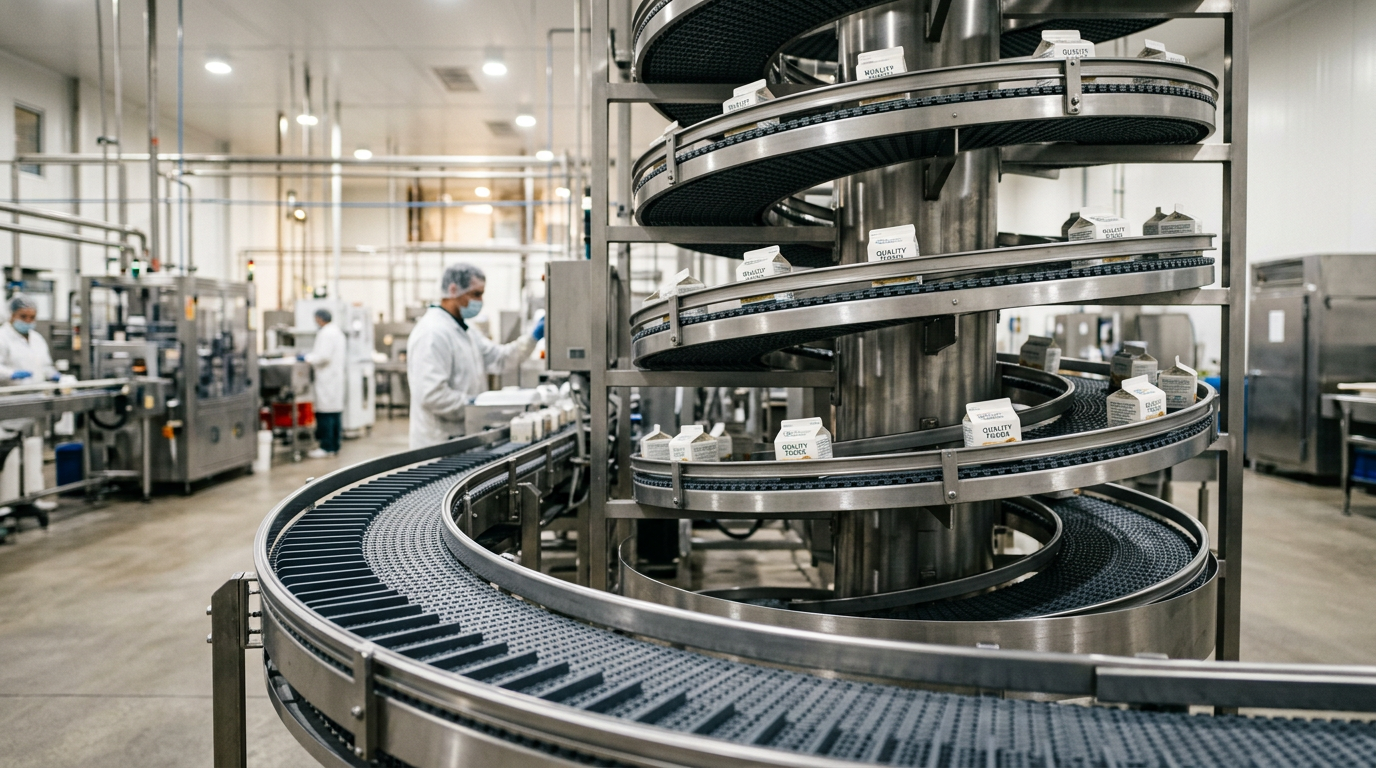
Spiral modular conveyors for vertical accumulation optimize floor space by utilizing vertical height, typically offering up to a 75% reduction in footprint compared to traditional horizontal accumulation tables while maintaining a continuous first-in-first-out (FIFO) product flow. These systems rely on low-friction modular plastic belts and precision-engineered spiral structures to buffer products during downstream interruptions without stopping upstream production.
The Role of Vertical Accumulation in Modern Automation
In high-speed production environments, such as beverage bottling or pharmaceutical packaging, a 60-second downstream stoppage can result in hundreds of wasted units if the entire line is interlocked. Vertical accumulation acts as a physical "buffer" or "surge protector" for the production line. By moving products upward or downward in a tight spiral, the system gains the necessary linear belt length to store products temporarily.
Unlike traditional alpine conveyors, which utilize a simple multi-tier incline, spiral modular conveyors offer a much tighter radius. This is achieved through the use of side-flexing modular belts, often made of Acetal (POM) or Polypropylene (PP), which can handle the high tensile loads required to pull a belt through several hundred degrees of rotation.
Design Principles of Spiral Modular Systems
The core of a spiral accumulator is its central drum or a series of perimeter-driven rails. The engineering challenge lies in managing the "friction factor" and the "radial force."
- Chain Pull and Tension: As the belt travels through multiple 360-degree turns, the cumulative friction increases. Designers must calculate the allowable chain pull based on the belt’s technical data sheets (typically measured in N/m or lbs/ft of width).
- Product Stability: For vertical accumulation, the incline angle is critical. Most modular spiral systems operate at inclines between 5° and 12°. Exceeding these limits without high-friction inserts can cause product "rollback" or toppling.
- Drive Configurations: Modern spirals often use a bottom-drive or top-drive arrangement. However, for long accumulation runs, a "distributed drive" system may be necessary to keep belt tension within the limits defined by ISO 21183-1 for light conveyor belts.
Material Selection: POM vs. PP vs. PE
The choice of modular belt material dictates the system's longevity and its ability to handle vertical loads. Intralox and other industry leaders provide specific resins designed for low-friction operation in spiral cages.
| Feature | Acetal (POM) | Polypropylene (PP) | Polyethylene (PE) |
|---|---|---|---|
| Tensile Strength | High | Medium | Low |
| Friction Coeff. | Very Low | Medium | Low |
| Temp Range | -40°C to +90°C | +5°C to +105°C | -70°C to +45°C |
| Impact Resistance | High | Medium | Very High |
| Best For | Heavy loads/Long runs | Chemical washdown | Cryogenic/Freezing |
Integrating FIFO Accumulation Logic
One of the primary advantages of spiral modular conveyors is their inherent support for First-In-First-Out (FIFO) logic. In industries like food processing, ensuring that the first item onto the buffer is the first item off is critical for shelf-life management and traceability, adhering to FDA standards for food safety.
Easy Conveyors provides
Easy Conveyors stocks the modular systems discussed here — ready to ship across Europe.
modular components that allow for seamless integration of these spiral units into existing layouts, ensuring that the transition from horizontal transport to vertical buffering does not compromise product orientation.
Engineering Considerations for Vertical Buffering
When sizing a spiral accumulator, engineers must consider the "collapse factor" of the side-flexing belt. This is the ratio between the minimum inside turning radius and the belt width. Most high-performance modular belts for spirals have a turn ratio of 1.6 to 2.2 times the belt width.
Key Sizing Variables:
- Throughput (PPH): Products per hour determines the belt speed.
- Buffer Time: How many minutes of accumulation are required? (e.g., 5 minutes of buffer at 100 ppm requires 500 units of linear storage).
- Pitch/Tier Height: The vertical distance between tiers must accommodate the product height plus a safety clearance (typically 50-100mm) for maintenance access.
Energy Efficiency and Drive Systems
Given the vertical lift involved, motor selection is paramount. Using IE3 or IE4 efficiency class motors (IEC 60034-30-1) is now standard in European markets to reduce Total Cost of Ownership (TCO). Variable Frequency Drives (VFDs) are essential for "soft-start" functionality, which prevents sudden tension spikes that could snap the modular links during a fully loaded start-up.
For high-capacity spirals, regenerative braking can be employed if the system is primarily used for lowering products (decline accumulation), feeding energy back into the plant grid.
Maintenance and Wear Life
The primary wear point in a spiral conveyor is the inner edge of the modular belt where it contacts the wear strips of the spiral cage.
- Wear Strips: Often made of UHMW-PE (Ultra-High-Molecular-Weight Polyethylene) to provide a low-friction surface.
- Elongation: Modular belts will naturally "stretch" or seat during the first 100 hours of operation. Automatic take-up units (catenary sags or weighted take-ups) are required to maintain proper engagement with the drive sprockets.
- Hygienic Design: In food environments, the spiral must be designed for washdown. Open-frame stainless steel construction following EHEDG guidelines prevents bacterial harborage in the tiered structure.
Practical Applications
- Cooling Lines: In industrial bakeries, spiral accumulators provide the necessary "dwell time" for bread or pastries to cool before packaging, without occupying half the factory floor.
- Primary Packaging Buffer: Between a filler and a case packer, a spiral can hold 3-5 minutes of production, allowing the operator to clear a minor jam on the packer without stopping the filler.
- Elevator/Lowerator Combo: Using a "dual-spiral" setup, products can be moved to a mezzanine level for accumulation and then brought back down to the main floor for final palletizing.
By focusing on modular components, manufacturers can scale their accumulation capacity. Unlike custom-welded spirals, modular systems allow for the addition of tiers if production demands increase in the future, providing a future-proof investment in material handling infrastructure. Integrating advanced sensors and VFD soft-start tuning further ensures that these complex vertical systems operate with the same reliability as a standard flat-belt conveyor.
Frequently Asked Questions
Which belt material is best for high-tension spiral accumulation?
Acetal (POM) is the preferred material for spiral belts due to its high tensile strength and extremely low coefficient of friction, which reduces the total chain pull required to move through multiple turns.
Why is FIFO logic important in vertical accumulation?
A FIFO (First-In-First-Out) spiral ensures that products do not sit in the buffer longer than necessary, which is critical for maintaining shelf-life in food and beverage industries and ensuring consistent lot tracking.
What is the maximum incline for a modular spiral conveyor?
Standard spiral conveyors typically handle inclines between 5 and 12 degrees. Higher angles may require high-friction rubber-top modules to prevent product slippage.
What is the 'collapse factor' in spiral conveyor design?
The 'collapse factor' is the ratio of the minimum inside turning radius to the belt width. Most side-flexing modular belts require a factor between 1.6 and 2.2 to function without binding.