Maximizing OEE with Spiral Modular Conveyors for Vertical Accumulation
Learn how spiral modular conveyors provide vertical accumulation to maximize OEE, using the Z-axis to buffer up to 50m of product in a 10sqm footprint.
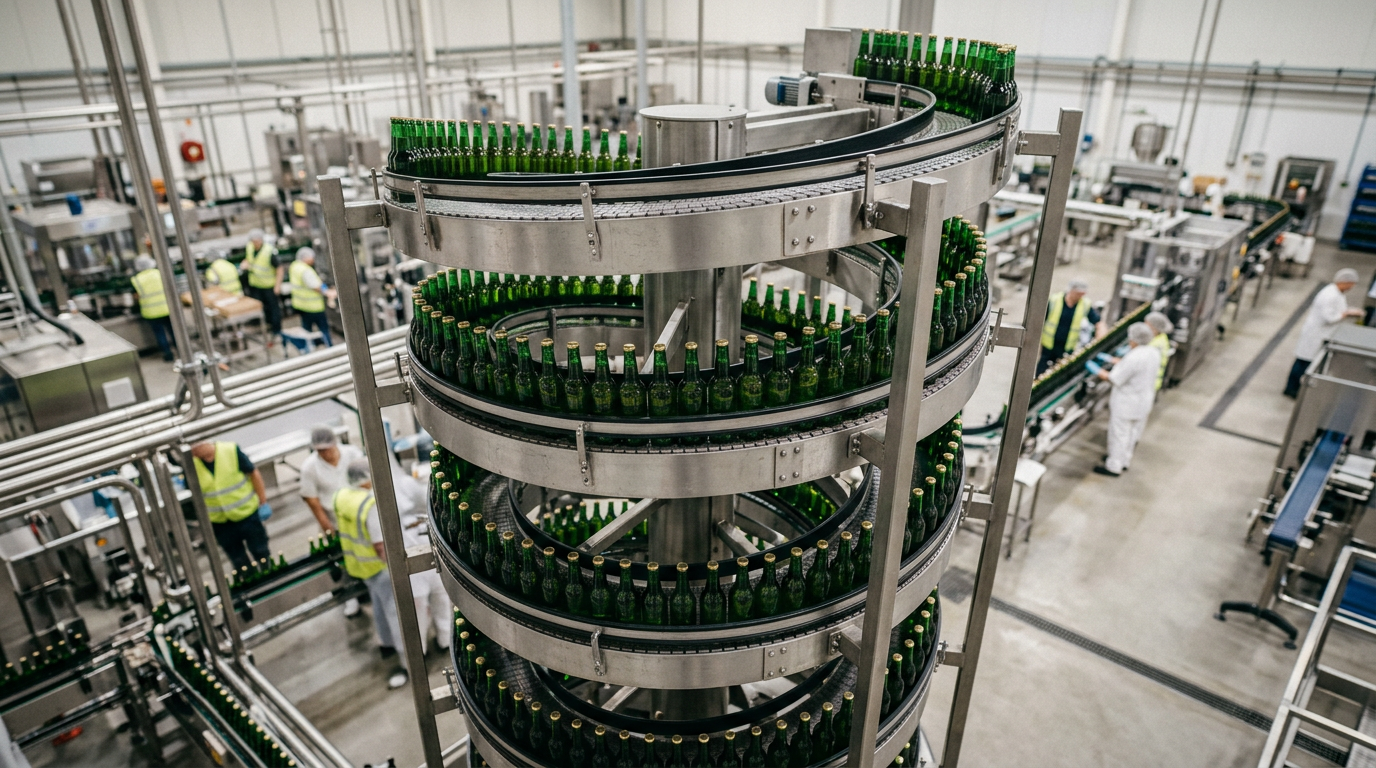
Vertical accumulation via spiral modular conveyors allows for a buffer capacity of up to 50 meters of product length within a footprint of less than 10 square meters, utilizing the Z-axis to decouple production stages. These systems typically employ high-friction modular belts or slat chains to maintain product orientation at inclines or declines of up to 12 degrees.
The Role of Spiral Modular Conveyors in Modern Automation
In high-speed production environments—particularly in food, beverage, and pharmaceutical packaging—the failure of a single downstream machine (like a labeler or case packer) can force an immediate shutdown of the entire upstream process. To prevent this, engineers implement vertical accumulation. Unlike traditional horizontal buffers that consume expensive floor space, spiral modular conveyors utilize vertical height to store product during downstream interruptions.
The core technology relies on a continuous helical path. While standard spiral conveyors are often used for simple floor-to-floor transport, "accumulation spirals" are engineered for variable speed and high-density storage. They provide a "dynamic buffer" that buys operators critical minutes (typically 3 to 10 minutes of surge capacity) to clear a downstream jam without stopping the filler or oven.
Design Principles: Geometry and Mechanics
The efficiency of a spiral modular conveyor is governed by the relationship between the radius of the spiral, the width of the belt, and the friction coefficient of the modular surface.
- The Inner Radius Rule: To prevent belt tenting or premature wear, the inner radius of a spiral conveyor is generally required to be at least 1.5 to 2.2 times the belt width, depending on the material properties of the modular links.
- Friction and Grip: For vertical accumulation, belts are often equipped with high-friction inserts or "rubber tops." This is critical when handling plastic containers or glass bottles that might slide at higher speeds.
- Drive Systems: Most spirals utilize a peripheral drive or a center-drum drive mechanism. In the center-drum configuration, the drum provides a consistent pull along the entire inner edge of the belt, reducing localized tension—a design often seen in Easy Conveyors systems to ensure longevity and smooth transitions.
Material Selection: POM vs. PP vs. Stainless Steel
Choosing the right modular belt material is essential for both the lifespan of the conveyor and the safety of the product. Standard materials include Polyoxymethylene (POM/Acetal) and Polypropylene (PP).
| Feature | POM (Acetal) | PP (Polypropylene) | Stainless Steel (Slat) |
|---|---|---|---|
| Tensile Strength | High (Up to 40kN/m) | Medium | Very High |
| Temp Range | -40°C to +90°C | +5°C to +105°C | -50°C to +400°C |
| Chemical Resistance | Good | Excellent | Superior |
| Friction Coeff. | Low (Standard) | Mediu |
Easy Conveyors stocks the modular systems discussed here — ready to ship across Europe.
m | High (with inserts) | | Food Safety | FDA Approved | FDA Approved | EHEDG/FDA |
Integration with Control Systems
For a spiral to act as a true "vertical accumulator," it must be integrated with a sophisticated control logic, usually managed by a PLC (Programmable Logic Controller).
- Variable Frequency Drives (VFDs): The spiral must speed up or slow down based on sensor data from downstream. If a downstream photo-eye is blocked for more than 2 seconds, the spiral slows to its accumulation speed while the infeed remains constant.
- Tension Management: As the spiral fills with product, the mass increases. Modern systems use load cells or torque monitoring via the VFD to ensure the belt tension remains within the limits specified by Intralox or other belt manufacturers.
- Soft-Start Tuning: Given the high inertia of a loaded spiral, "VFD soft-start tuning" is mandatory to prevent belt "surging" or "whiplash" effects during startup.
Use Case: Food and Beverage Hygiene
In the food industry, hygiene is paramount. Vertical spirals used for cooling bread or buffering milk cartons must comply with EHEDG guidelines for "cleanability." This involves:
- Open-frame stainless steel construction to prevent debris buildup.
- Modular belts with a high "open area" percentage (e.g., 40-60%) to allow airflow and easy wash-down.
- Drive motors with IP69K ratings to withstand high-pressure, high-temperature cleaning.
Maintenance and Wear Life
The most common failure mode in spiral conveyors is uneven belt wear caused by improper tracking or excessive tension. Regular inspection of the "wear strips"—the low-friction plastic (usually UHMW-PE) that the belt slides on—is critical. If the wear strips wear through, the belt will begin to rub against the steel frame, leading to catastrophic failure and metal contamination.
Engineers should also monitor the "catenary sag" at the drive end. Because modular belts stretch slightly over their first 100 hours of operation, manual adjustment of the take-up unit is usually required after the commissioning phase. For more on this, refer to our guide on modular belt tensioning and tracking.
Conclusion: Why Vertical Accumulation?
As production lines become faster and more automated, the "cost of a stop" increases exponentially. A spiral modular conveyor for vertical accumulation is an insurance policy. It protects the OEE (Overall Equipment Effectiveness) of the most expensive machines on the line—the fillers and the ovens—by decoupling them from the instabilities of the packaging area. By leveraging the Z-axis, manufacturers achieve a high-density buffer that maintains product flow and maximizes throughput in constrained facility layouts.
Frequently Asked Questions
How does a spiral accumulator compare to a horizontal buffer?
Spiral accumulators use vertical height to store product, saving up to 80% of floor space compared to horizontal alpine or serpentine conveyors.
What is the maximum incline for a spiral modular conveyor?
Most modular spirals can handle inclines between 5 and 12 degrees. Higher angles require specialized high-friction 'rubber top' modules.
Why is POM commonly used for spiral belt modules?
POM (Acetal) is preferred for its high tensile strength and low friction, which reduces the load on the drive system in long spiral runs.
Can spiral conveyors be used for cooling processes?
Yes, by using open-link modular belts and stainless steel frames, spirals are ideal for cooling or proofing food products while moving vertically.
What is the critical maintenance task for spiral conveyors?
Daily visual checks for belt tracking and monthly measurements of wear-strip thickness are recommended to prevent frame damage.