Maximizing Efficiency with Spiral Modular Conveyors for Vertical Accumulation
Spiral modular conveyors maximize vertical accumulation, offering high-density product buffering in a compact footprint using low-friction POM modular chains.
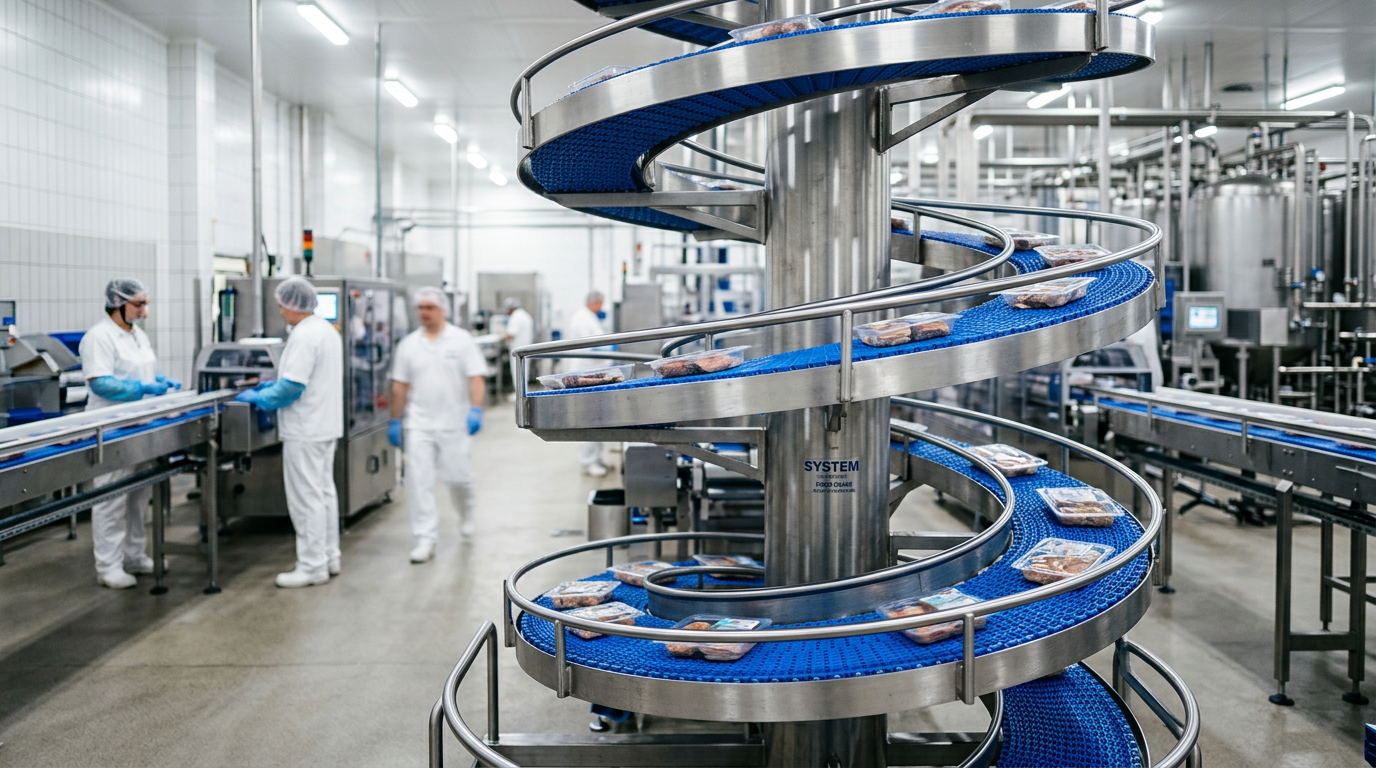
Building an efficient vertical buffer requires maximizing the storage-to-footprint ratio, a metric where spiral modular conveyors excel by offering up to 50 meters of accumulated product path within a 3-meter diameter footprint. These systems leverage the high-tensile strength of modular plastic chains to provide a continuous, first-in-first-out (FIFO) or first-in-last-out (FILO) flow that decouples upstream production from downstream packaging delays.
The Engineering Logic of Spiral Accumulation
Vertical accumulation is the primary defense against "micro-stops" in high-speed manufacturing environments. When a downstream labeler or palletizer halts for a 45-second film change, a spiral accumulator allows the upstream filler or oven to continue running at full capacity, preventing costly thermal cycles or product waste.
Unlike traditional flat-belt incline conveyors, spiral modular systems utilize a constant radius. The core design principle relies on the low-friction interaction between the plastic modular chain and the high-density polyethylene (HDPE) or steel wear strips of the spiral guide. By utilizing modular chains—often made of Polyoxymethylene (POM)—engineers can achieve high load capacities while maintaining the flexibility required for tight-radius turns.
Key Performance Metrics
When sizing a spiral system, three variables dictate the mechanical limits:
- Throughput Velocity: Generally measured in meters per minute (m/min). Most modular plastic spirals operate reliably between 10 and 60 m/min.
- Product Pitch: The center-to-center distance between products, which determines the total buffer capacity (Total Belt Length / Product Pitch).
- Chain Pull: The tension exerted on the modular belt. Exceeding the manufacturer's rated chain pull (often cited in Newtons per meter of width) results in premature elongation or sprocket failure.
Modular Plastic Chains: Materials and Friction
The selection of the belt material is critical for vertical stability. While Polypropylene (PP) is common in standard conveyors, spiral applications almost exclusively use POM (Acetal) due to its superior stiffness and low coefficient of friction. According to Habasit, the low friction properties of POM allow for longer conveyor runs without the need for intermediate drives.
| Feature | Polypropylene (PP) | Polyoxymethylene (POM/Acetal) | Stainless Steel |
|---|---|---|---|
| Tensile Strength | Medium | High | Very High |
| Friction Coeff. | 0.25 - 0.30 | 0.15 - 0.20 | 0.20 - 0.40 |
| Temp Range | 5°C to 105°C | -40°C to 90°C | -50°C to 200°C |
| Cost Tier | Low | Moderate | High |
| Max Chain Pull | Standard | High-Load | Extreme |
For hygiene-sensitive environments like dairy or meat processing, belts must meet FDA (U.S. Food and Drug Administration) standards for food-contact surfaces. In these cases, the modular design allows for "blue belt" configurations that highlight contaminants and facilitate rapid wash-down procedures.
Integrating Spiral Systems into Automation Cells
The intelligence of a spiral accumulator lies in its control logic. Modern systems utilize variable frequency drives (VFDs) and photo-eye sensors located at every 180 or 360 degrees of the spiral.
Dynamic vs. Static Buffering
- Static Buffering: The spiral holds a set number of products. When the downstream line stops, the spiral fills until it reaches capacity, then signals the upstream system to halt.
- Dynamic Buffering: The spiral adjusts its speed based on the gap between products. Using "VFD soft-start tuning" and advanced PLC logic, the system can compress or expand the product flow to ensure a "mass flow" state, minimizing the impact of brief downstream interruptions.
When designing complex layouts, Easy Conveyors provides modular components that allow for seamless integration between standard horizontal lines and these vertical spiral units. Their modular approach ensures that the transition curves—where the belt moves from flat to an incline—are engineered to prevent product toppling, a common failure mode in tall container handling.
Easy Conveyors stocks the modular systems discussed here — ready to ship across Europe.
Maintenance and Failure Modes
The spiral configuration introduces unique stresses, specifically radial forces that pull the belt toward the center drum (or "center mast").
- Wear Strip Degradation: The outermost and innermost wear strips bear the brunt of the radial force. If the HDPE wears through, the modular chain will grind against the steel frame, increasing friction and potentially tripping the motor's thermal overload.
- Sprocket Alignment: High-tension spiral systems require precise sprocket engagement. A 2mm misalignment can lead to "hunting," where the belt oscillates side-to-side, causing edge wear.
- Hygienic Shadowing: In food applications, the overlapping layers of a spiral can create "shadows" where spray balls during a CIP (Clean-In-Place) cycle cannot reach. Designers should refer to EHEDG (European Hygienic Engineering & Design Group) guidelines to ensure adequate spacing for cleaning.
Energy Efficiency and Motor Selection
Because spiral conveyors often operate 24/7 as the "heart" of a production line, energy consumption is a major operational expense. Transitioning from standard induction motors to IE3 or IE4 "Premium Efficiency" motors—as classified by IEC 60034-30-1—can reduce energy consumption by 5-15%.
Furthermore, using localized "drum motor selection" instead of external gearmotors can reduce the system's overall footprint and eliminate external chain guards, which are points of potential contamination and mechanical failure.
Future Trends: Mass Flow and Smart Spirals
The industry is moving toward "Smart Spirals" equipped with IO-Link sensors that monitor belt tension and motor temperature in real-time. By analyzing the torque required to move the spiral at a constant speed, predictive maintenance algorithms can identify when a wear strip needs replacement weeks before a failure occurs. This is particularly vital in e-commerce sortation and automotive parts manufacturing, where a single hour of downtime can cost upwards of €50,000.
In "hygienic wash-down design", modern spirals are increasingly being built with open-frame stainless steel construction, allowing high-pressure water to pass through the entire structure, ensuring no organic matter is trapped in the center column. This design evolution aligns with stricter global food safety standards and the drive for increased automation in primary food packaging.
Frequently Asked Questions
Why is POM preferred over Polypropylene for spiral belts?
POM (Acetal) is the preferred material because it has a significantly lower coefficient of friction (0.15-0.20) compared to PP (0.25-0.30), allowing for longer spiral paths and less motor strain.
What is the maximum incline angle for a spiral modular conveyor?
The maximum incline depends on the product's coefficient of friction and stability, but most modular spirals operate effectively between 5 and 12 degrees to prevent product sliding or toppling.
What is the benefit of FIFO buffering in a spiral?
First-In-First-Out (FIFO) ensures that products exit the spiral in the exact order they entered, which is critical for time-sensitive or perishable goods like dairy or baked products.
How often do spiral conveyor wear strips need inspection?
Maintenance intervals vary by load, but a monthly inspection of the wear strips and a quarterly check of belt tension and sprocket alignment are recommended for 24/7 operations.