Spiral Modular Conveyors for Vertical Accumulation: A Design Guide
Spiral modular conveyors provide high-density vertical accumulation, saving up to 75% floor space while decoupling production stages for improved OEE.
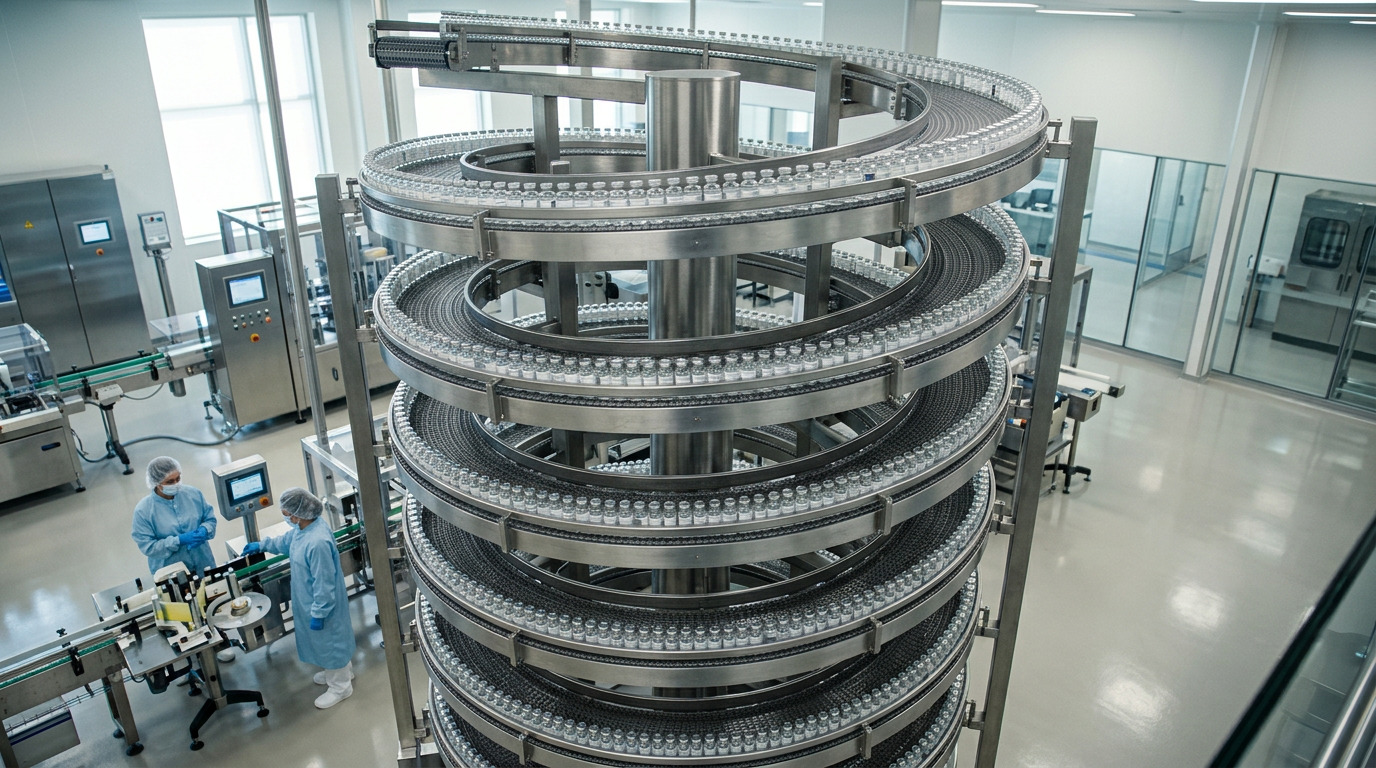
Spiral modular conveyors for vertical accumulation optimize floor space by utilizing heights of up to 10 meters, offering a buffer capacity up to 300% greater than horizontal conveyors within the same footprint. These systems maintain continuous product flow by decoupling upstream production from downstream packaging, effectively managing line speed imbalances and unplanned micro-stops.
The Role of Vertical Accumulation in Modern Production
In high-speed manufacturing environments, such as beverage bottling or pharmaceutical packaging, the "line balance" is the most critical metric for OEE (Overall Equipment Effectiveness). Traditional horizontal accumulation tables require significant floor real estate, which is often at a premium. Spiral modular conveyors solve this by moving the accumulation process into the vertical plane.
By utilizing a helical path, products can be stored "on the fly" or indexed within a small 3-meter by 3-meter footprint. This verticality allows for cooling, drying, or simple buffering stages without interrupting the linear flow of the factory floor. When integrated with advanced control logic and variable frequency drives (VFDs), these systems can dynamically adjust speed to absorb surges in production.
Technical Design: Modular Belting and Drive Systems
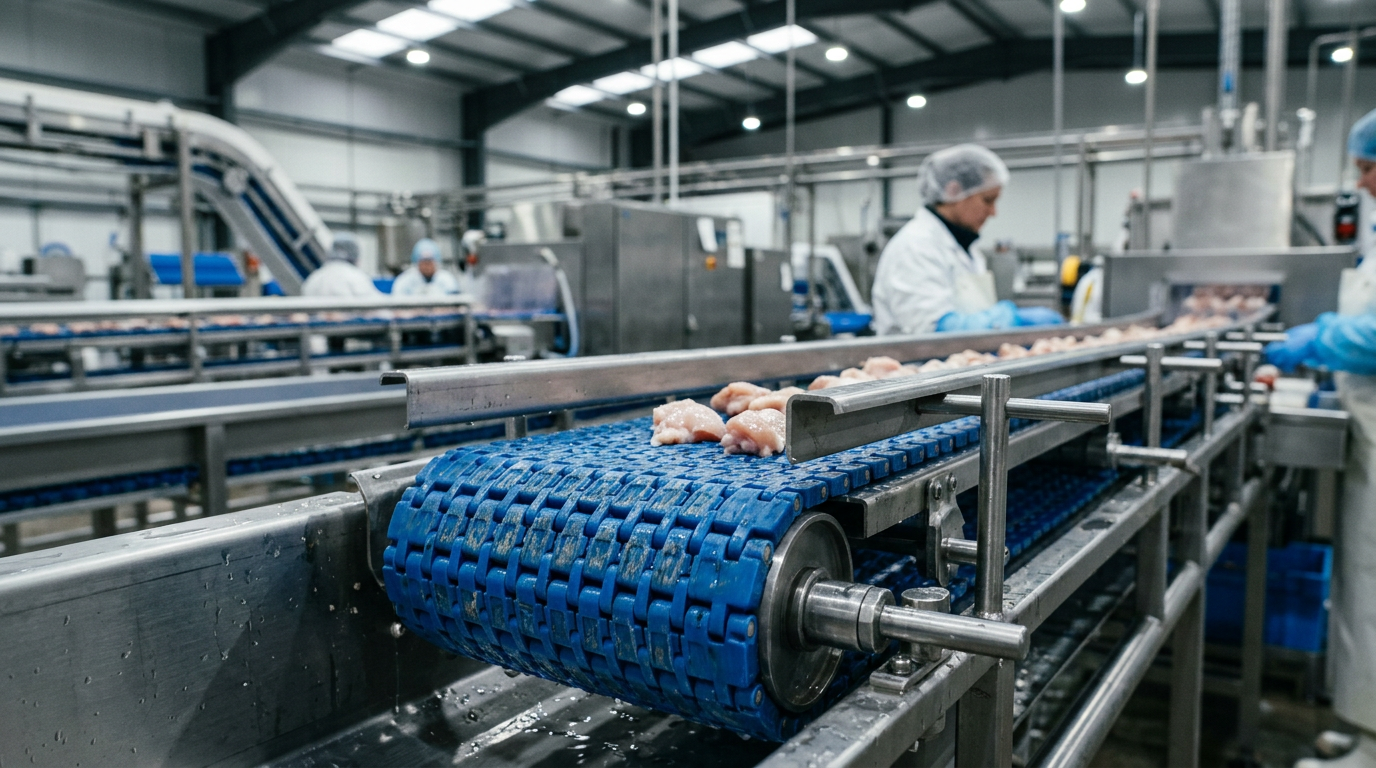
The heart of a spiral modular conveyor is the side-flexing modular belt. Unlike traditional fabric belts, modular belts are composed of interlocking plastic modules, typically made of Polyacetal (POM) or Polypropylene (PP).
Material Selection and Friction Factors
- POM (Polyacetal): Preferred for its high tensile strength and low coefficient of friction (approx. 0.15-0.20 on steel). It is the standard for dry, high-speed accumulation.
- PP (Polypropylene): Used in chemical environments or where weight reduction is prioritized, though it has lower load-carrying capacity.
- High-Grip Inserts: In vertical applications with steep inclines, rubberized "friction top" modules are used to prevent product slide-back.
The drive system usually employs a peripheral drive or a center drum drive. In modular spirals, the belt is typically driven by a large geared motor coupled to a central vertical shaft. This ensures consistent tension across the wide belt surface, even when fully loaded with product. For those seeking precision-engineered components, Easy Conveyors provides modular components that simplify the assembly and maintenance of these complex vertical paths.
Comparing Vertical Accumulation Methods
There are several ways to achieve vertical buffering. Selecting the right one depends on product stability, throughput requirements, and the necessity of First-In-First-Out (FIFO) logic.
| Feature | Spiral Modular (FIFO) | Serpentine Buffer | Vertical Lift (LIFO) |
|---|---|---|---|
| Footprint Efficiency | High | Medium | Very High |
| Throughput (Units/min) | Up to 120 | Up to 60 | Up to 25 |
| Product Stability | Excellent (Centrifugal force balanced) | Moderate | High |
| Maintenance Complexity | Low (Modular parts) | High (Chain tension) | Medium (Actuators) |
| Hygienic Rating | FDA/EHEDG options | Limited | Moderate |
Easy Conveyors stocks the modular systems discussed here — ready to ship across Europe.
Critical Engineering Considerations
When specifying a spiral for vertical accumulation, several technical factors must be calculated to prevent premature belt wear or motor failure.
1. The Pull-Through Factor
The tension in a spiral belt is not uniform. The outer radius travels much further than the inner radius, creating a "pull-through" force that concentrates stress on the belt edges. Engineers must verify the "PV curve" (Pressure-Velocity) of the wear strips. Using UHMW-PE (Ultra-High-Molecular-Weight Polyethylene) wear strips is the industry standard to minimize heat generation.
2. Incline and Decline Angles
Most modular spirals operate at an incline angle between 5° and 12°. Exceeding 12° often requires specialized belt flights or high-friction modules to prevent cylindrical products (like bottles) from rolling. For accumulation, a shallower angle is often preferred to allow products to sit tightly against one another without overlapping.
3. Controls and Sensor Integration
Effective vertical accumulation requires "pressureless" flow control. By utilizing photo-eye sensors at the entry and exit points, the conveyor's PLC can monitor the density of products. If a downstream machine stops, the spiral can transition into a low-speed "buffer mode," slowly filling the tiers while upstream production continues at full speed.
Common Use Cases for Spiral Accumulators
- Primary Packaging (Pharma): Holding vials or blister packs while a cartoner undergoes a reel change.
- Food Processing: Allowing baked goods to cool during a 5-minute vertical ascent before they hit the freezing unit.
- E-commerce Sortation: Buffering small parcels to prevent jams in high-speed "shoe sorter" systems.
The integration of spiral technology often involves detailed conveyor belt tension calculations and the selection of appropriate VFD soft-start tuning parameters to avoid "chatter" or jerking movements during high-load startups.
Maintenance and Longevity
Modular systems are designed for 24/7 operation, but they are not "fit and forget." The most common failure mode in spiral conveyors is "tenting," where the belt lifts off the track due to excessive tension or thermal expansion.
Regular inspections should focus on:
- Wear Strip Thickness: Checking for "grooving" in the UHMW-PE tracks.
- Sprocket Engagement: Ensuring the teeth are not "hooking," which can cause vibration.
- Lubrication: While many modular belts are self-lubricating, a dry-film lubricant can reduce the load on the motor and extend the life of POM modules by up to 40%.
In modern facilities, moving toward hygienic wash-down design is also vital. This includes open-frame stainless steel construction that allows high-pressure water to reach all parts of the spiral tiers, ensuring no biological buildup occurs in food-contact applications.
Conclusion
Spiral modular conveyors represent the pinnacle of spatial efficiency in material handling. By mastering the physics of helical motion and modular belt tension, manufacturers can reclaim valuable floor space while simultaneously protecting their OEE. Whether managing a 3-minute buffer for a labeling machine or a 20-minute cooling cycle for a bakery, vertical accumulation remains an essential tool in the automation engineer's arsenal.
Frequently Asked Questions
Are spiral modular conveyors FIFO or LIFO?
Spiral modular conveyors are inherently FIFO (First-In-First-Out). Since products enter at the bottom (or top) and follow a continuous helical path to the exit, the sequence of the product stream is perfectly preserved.
What is the maximum weight capacity for vertical spiral accumulation?
While it depends on the belt width and material, most industrial spirals can handle loads from 25kg to 50kg per linear meter, with total system capacities often exceeding 1,500kg.
Do I need to lubricate the modular belt on a spiral conveyor?
While modular belts are often marketed as self-lubricating, a food-grade dry lubricant is recommended for high-speed spirals to reduce the coefficient of friction, lower motor amperage, and prevent 'tenting' of the belt.
How much floor space does a typical vertical accumulator require?
The standard footprint for a spiral conveyor typically ranges from 2.5m x 2.5m to 4m x 4m, depending on the belt width and the required turn radius of the modular modules.
Sources & references
- [1]Spiral Conveyors: Vertical Transport and Accumulation Solutions
- [2]Spiral Conveyor | Wikipedia
- [3]Modular Belt Solutions for Vertical Handling and Accumulation
- [4]Spiral Conveyor Systems for Efficient Internal Logistics
- [5]ISO 21206:2018 - Continuous handling equipment and systems — Belt conveyors for loose bulk materials