The Engineering Guide to Side Guides, Transfer Plates, and End Rollers
Master the stability triad of conveyor systems: side guides, transfer plates, and end rollers. Learn how to minimize friction and prevent product tipping.
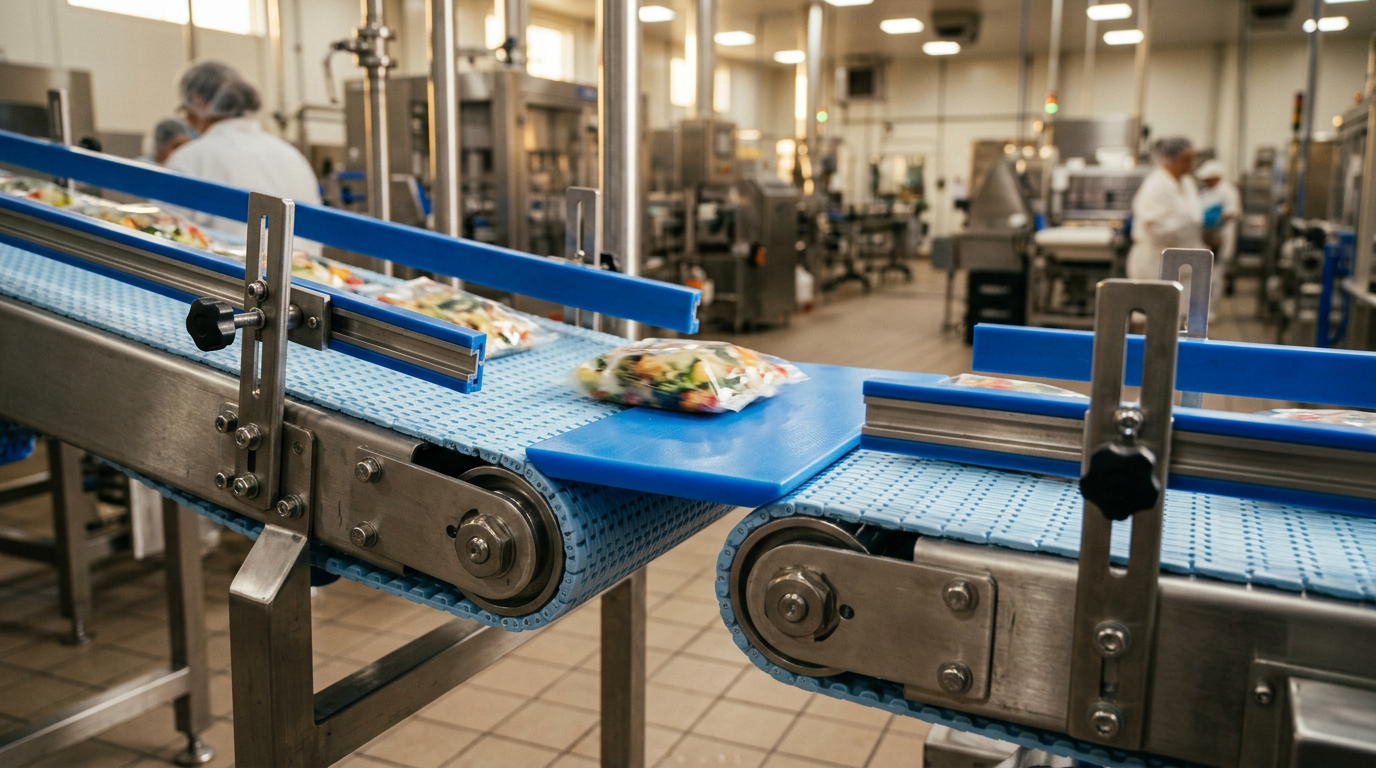
To achieve optimal throughput and minimize product loss, industrial conveyors rely on a "stability triad": side guides for lateral constraint, transfer plates for bridging gaps between modules, and end rollers for minimizing friction at transition points. In high-speed sortation or fragile food handling, the transition gap should ideally not exceed 25% of the minimum product length to prevent snagging or "tipping."
The Engineering Logic of Side Guides
Side guides are the primary method of lateral product control. While they appear to be simple rails, their design significantly impacts system friction, noise, and product integrity. Engineers must choose between fixed rails for dedicated lines and adjustable systems for multi-format packaging environments.
Material Selection and Friction Coefficients
The choice of lining material is critical. High-density polyethylene (PE-HD) or Ultra-High Molecular Weight Polyethylene (UHMW-PE) is standard due to its low coefficient of friction and high wear resistance. According to ISO 15510 standards regarding stainless steel, using 304 or 316L stainless steel supports for these guides ensures durability in wash-down environments.
- Fixed Guides: Best for high-speed, vibration-prone lines where product dimensions never change.
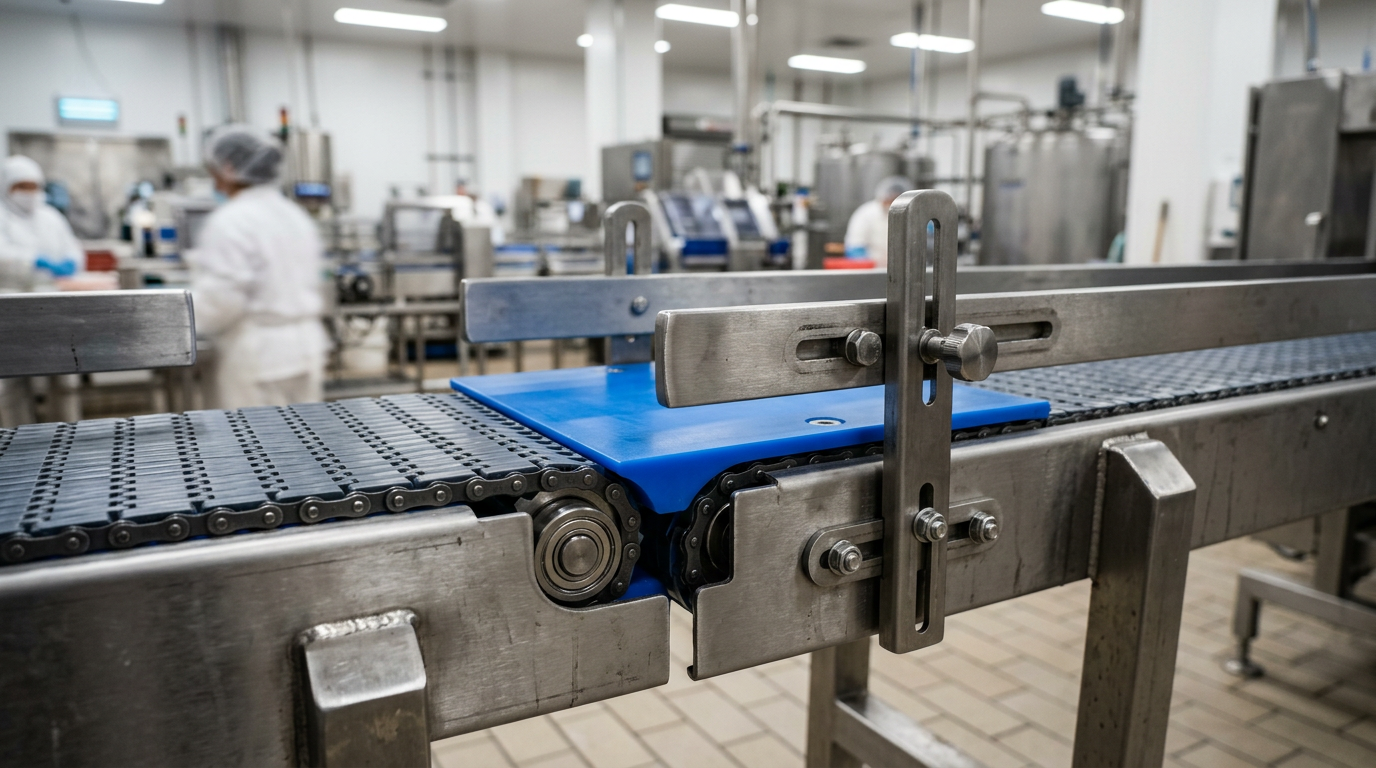
- Adjustable Guides: Essential for contract packaging. Modern "quick-change" guides utilize calibrated scales to allow operators to reset guide widths for different SKUs without tools, significantly reducing Changeover Time (SMED).
Bridging the Gap: Transfer Plates
Transfer plates (or "dead plates") are stationary surfaces installed between two conveyor segments or between a conveyor and a processing machine. Their primary function is to provide a continuous support surface as the belt returns around the drive sprocket or idler.
Design Configurations
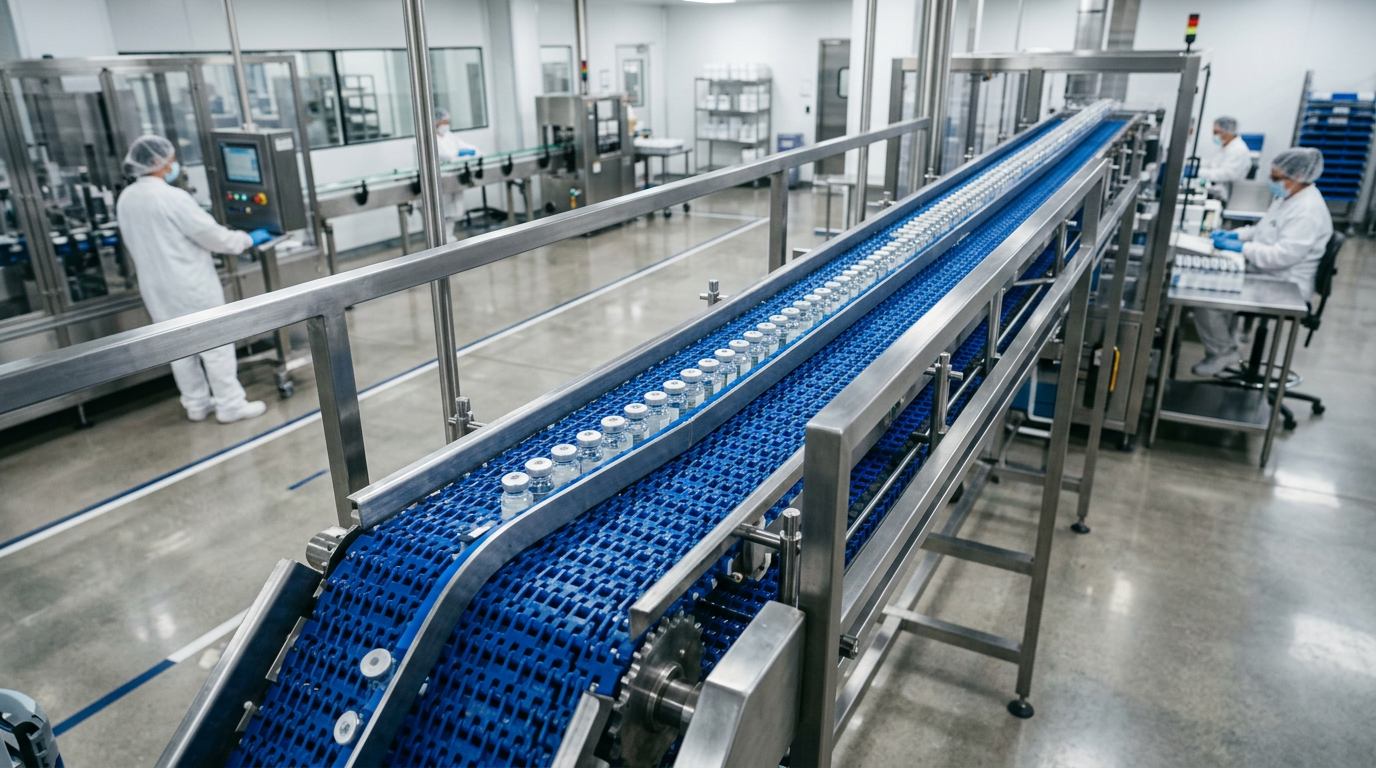
- Comb-Style Transfers: Used exclusively with modular plastic belts. The "fingers" of the plate reach into the grooves of the belt, allowing even small products (like unstable vials or small electronics) to pass over the gap without the risk of tipping.
- Roller Transfers: Incorporate small-diameter rollers within the plate to eliminate sliding friction. This is vital for heavy loads or applications where backpressure could cause product damage.
- Active Transfers: Small powered rollers integrated into the transition zone to ensure the product does not stall, particularly important for lightweight packaging that lacks the inertia to cross a dead plate.
When designing these zones, it is crucial to consult a specialist like Easy Conveyors to ensure the transfer plate geometry matches the catenary sag and sprocket diameter of the modular belt, preventing mechanical interference.
The Role of End Rollers and Nose Bars
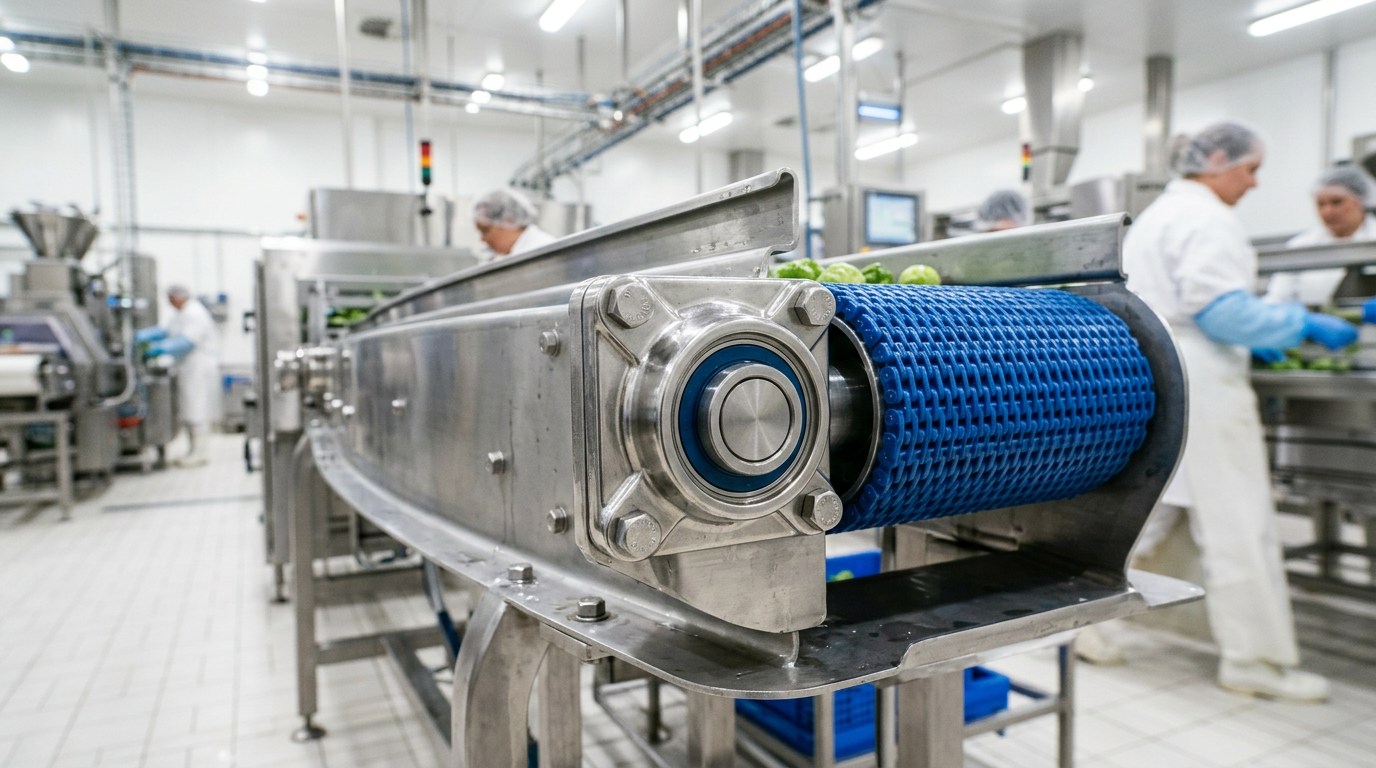
At the terminal ends of a conveyor module, the belt must transition from the transport surface to the return path. The diameter of this transition point—the "nose bar" or end roller—determines the "gap" that must be bridged.
Small Diameter Nose Bars
In industries like food processing (baking, confectionery) or pharmaceutical packaging, products are often small. A standard drive sprocket might have a diameter of 100mm, creating a massive gap. Engineers use "nose bars"—small-diameter stationary or ro
Easy Conveyors stocks the conveyor components discussed here — ready to ship across Europe.
lling bars (typically 6mm to 20mm)—to create a tight turn radius.
- Heat Dissipation: Small-diameter stationary nose bars generate significant friction heat. High-performance polymers or needle-roller assemblies are required to prevent belt melting or premature wear.
- Belt Tension: Tight radii require higher belt tension and can increase fatigue on modular belt hinges.
Technical Comparison: Transfer Solutions
| Feature | Dead Plate (PE-HD) | Roller Transfer | Comb-Style Plate |
|---|---|---|---|
| Friction Level | High (Sliding) | Low (Rolling) | Medium |
| Product Size | Medium to Large | Large | Very Small |
| Maintenance | Low (Wear-part) | Medium (Bearings) | Low |
| Hygiene (EHEDG) | Excellent | Moderate | Good |
| Application | General Conveying | Heavy Boxes/Crates | Bottling/Small Packs |
Integration with Automation and Safety
The interaction between side guides and transfer plates must be seamless. If a side guide terminates too early before a transfer, the product may lose its orientation. Conversely, if the guide is too tight at the transfer point, the product may bridge and cause a jam.
For safety compliance, particularly under OSHA 1910.212, all "nip points" created by end rollers and belt transitions must be guarded. Transfer plates often serve a dual purpose as both a functional bridge and a safety guard, preventing fingers from reaching the rotating sprockets.
Maintenance and Troubleshooting
Common failure modes in these components often stem from misalignment. A side guide that is not parallel to the belt travel will cause "crabbing," where the product rotates or skews, leading to downstream errors in barcode scanning or robotic picking.
- Guide Wear: Inspect UHMW-PE liners for "trenching." Once the product has worn a groove into the guide, the friction increases exponentially.
- Transfer Alignment: Transfer plates should be set roughly 0.5mm to 1.0mm lower than the upstream belt and level with the downstream belt to facilitate a smooth "step-down" transition.
- Roller Seizure: In roller transfers, dust and debris can seize small bearings. Regular cleaning and the use of shielded bearings are recommended.
Correct component selection is not merely about preventing products from falling off the line; it is about managing the energy and orientation of the product throughout the entire material handling lifecycle. Whether implementing "VFD soft-start tuning" to reduce the impact at these transitions or selecting "hygienic wash-down design" components for food safety, the details of the side guides and transfers define the system's ultimate reliability. Moving forward, the trend toward "smart" side guides—actuated by servos to change widths based on RFID product tags—will further bridge the gap between mechanical hardware and digital automation.
References
- Standardization of stainless steel grades for conveyor components (ISO 15510).
- Safety requirements for conveyor pinch points (OSHA 1910.212).
- Hygienic design principles for food conveyors (EHEDG Guidelines).
- General principles for conveyor belt tension and transitions (Intralox Technical Manual).
Frequently Asked Questions
At what height should a transfer plate be installed relative to the belt?
Transfer plates should be positioned roughly 0.5 to 1.0 mm lower than the discharging conveyor and flush with the receiving conveyor to prevent catch-points.
What is the best material for side guide liners?
UHMW-PE (Ultra-High Molecular Weight Polyethylene) is the industry standard due to its extremely low coefficient of friction, high impact strength, and FDA compliance.
When should I use a nose bar instead of a standard drive sprocket?
A nose bar is a small-diameter (often 6-15mm) stationary or rolling bar used at the conveyor end to allow the transfer of very small products that would fall into the gap of a standard sprocket.
How do I know when my side guides need replacement?
Signs include 'trenching' (grooves worn into the plastic), increased motor amp draw due to friction, and product 'shingling' where items overlap because they are snagging on the guides.