Advanced Conveyor Bearings and Shaft Seals for Hygienic Applications
Discover how high-performance bearings and shaft seals prevent contamination in food and pharma conveyors, featuring IP69K ratings and EHEDG design principles.
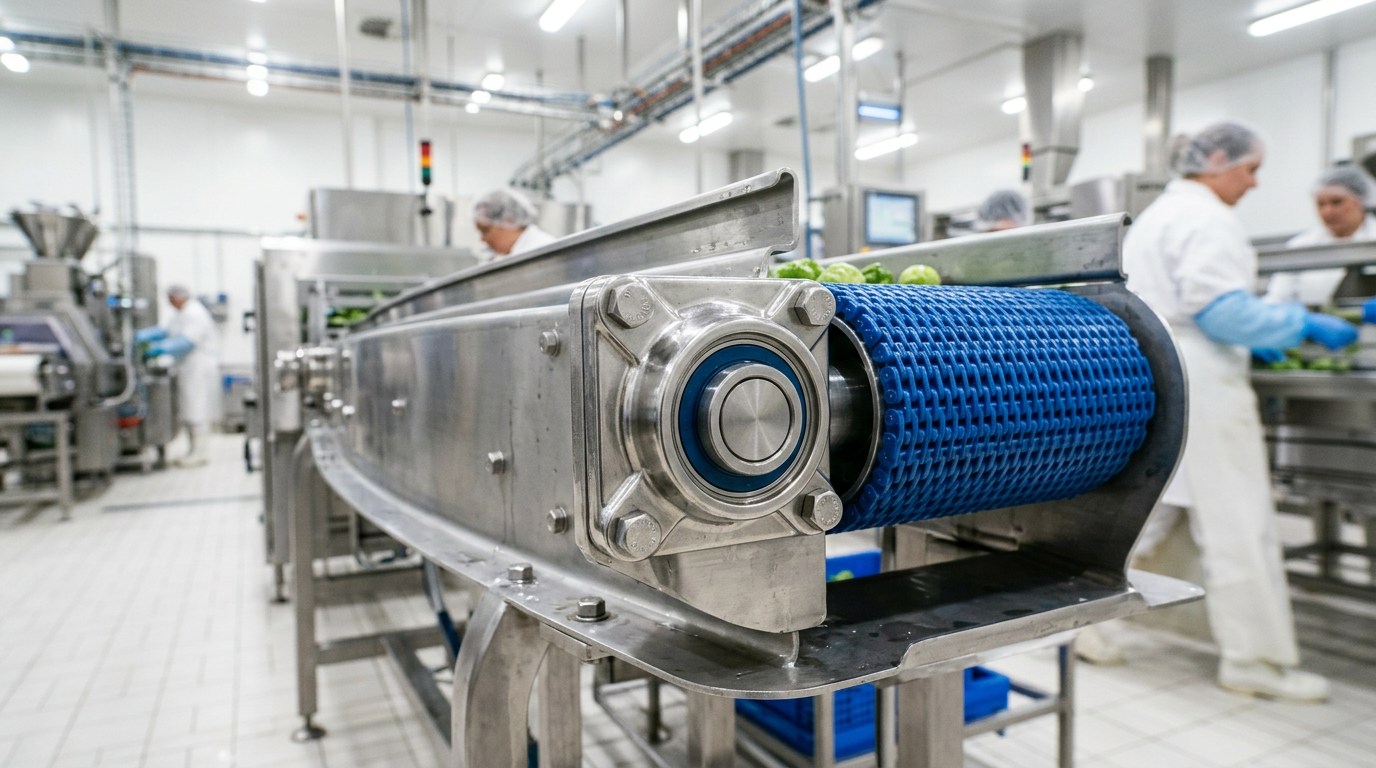
In hygienic conveyor design, the selection of bearings and shaft seals is a critical factor in preventing microbial growth, with specialized food-grade bearing units reducing the risk of bacterial harboring by up to 90% compared to standard industrial housings. To ensure compliance with global safety standards, these components must utilize non-porous materials like 316-grade stainless steel or high-performance polymers that withstand rigorous Clean-in-Place (CIP) cycles and meet FDA 21 CFR requirements.
The Critical Role of Bearings in Food and Pharma
In the context of material handling, bearings are often the "hidden" failure point in food safety. Standard bearings rely on grease that can leak, or housings with sharp corners and cavities where organic matter accumulates. In hygienic environments—ranging from poultry processing to pharmaceutical packaging—the goal is to eliminate these "dead zones."
The industry has moved toward Hygienic Design Principles, primarily governed by the European Hygienic Engineering & Design Group (EHEDG). These principles dictate that every component must be self-draining, smooth, and resistant to chemical corrosion. When specifying components for a modular system, engineers must look beyond load ratings to consider the "cleanability" of the bearing unit.
Material Science: Stainless Steel vs. Thermoplastic
Selection begins with the housing material. While cast iron is standard in heavy industry, it is strictly avoided in hygienic zones due to its porosity and tendency to flake paint.
- Stainless Steel Housings (AISI 304/316): These offer the highest mechanical strength and heat resistance. They are ideal for heavy-duty washdown areas where high-pressure water (up to 100 bar) is used.
- Thermoplastic Housings: Often reinforced with glass fiber, these are lightweight, chemically inert, and cost-effective. They are frequently used in modular conveyor systems where high-speed throughput is required without extreme mechanical loads.
Advanced Shaft Sealing Technologies
The seal is the primary barrier between the internal lubricant and the external environment. In a hygienic conveyor, the seal must perform two roles: keeping the lubricant in and keeping the cleaning chemicals out.
- Labyrinth Seals: Use a complex path to prevent ingress without direct contact, reducing friction but offering less protection against pressurized water.
- Flinger Shields: A rotating shield that uses centrifugal force to throw liquid away from the shaft entry point.
- Multi-Lip Contact Seals: These provide a physical barrier, often made from NBR or EPDM, which are resistant to the caustic detergents used in CIP processes.
Comparison of Hygienic Bearing Types
| Feature | Standard Shielded Bearing |
Easy Conveyors stocks the conveyor components discussed here — ready to ship across Europe.
Fully Sealed Stainless Unit | Solid-Lube Polymer Unit | | :--- | :--- | :--- | :--- | | Housing Material | Cast Iron / Steel | 316 Stainless Steel | PBT Thermoplastic | | Lubrication Type | Mineral Grease | H1 Food-Grade Grease | Solid Oil Matrix | | Washdown Rating | None | IP66 / IP69K | IP69K | | EHEDG Compliant | No | Yes (Selected Models) | Yes | | Max Temp | 120°C | 150°C | 80°C | | Corrosion Resistance | Low | Very High | Excellent |
The Move Toward Lubricated-for-Life Systems
One of the most significant advancements in hygienic conveyor components is the shift toward Solid Lubrication. Traditional grease can be "washed out" during high-pressure cleaning, leading to premature bearing failure and potential food contamination. Solid oil technology (SKF/SEW-Eurodrive) involves a polymer matrix saturated with lubricating oil that completely fills the internal cavity of the bearing.
This design offers three distinct advantages:
- Zero Leakage: Because the lubricant is solid, it cannot leak out into the product stream.
- Inhibits Ingress: There is no empty space inside the bearing for water or contaminants to occupy.
- Maintenance-Free: These units do not require re-greasing, which eliminates the risk of technicians using the wrong (non-food-grade) grease during maintenance.
Shaft Seal Geometry and Dead Space
According to ISO 14159, machines must be designed to prevent the accumulation of microorganisms. For shaft seals, this means avoiding "shadow zones" where a spray ball cannot reach.
Easy Conveyors integrates these principles by utilizing rounded housing profiles and back-side seals that prevent moisture from being trapped between the conveyor frame and the bearing unit. When installing these components, it is vital to ensure that the mounting surface is also hygienic; using standoff spacers can allow for cleaning behind the bearing housing.
Failure Modes in Hygienic Environments
Engineers should be aware of specific failure modes unique to these environments:
- Hydrogen Embrittlement: Occurs when high-strength steels are exposed to certain cleaning chemicals, leading to sudden shaft failure.
- Thermal Shock: Rapidly moving from a cold processing room to a hot washdown cycle can cause seal contraction, sucking moisture into the bearing.
- Chemical Degradation: Using incorrect seal materials (e.g., standard Viton in certain alkaline environments) can lead to seal hardening and cracking.
For optimal performance, always cross-reference the chemical compatibility of your seal elastomers with the specific detergents used in your facility. Modern hygienic wash-down design necessitates a holistic approach where the bearing, seal, and housing act as a single, impenetrable barrier.
Frequently Asked Questions
What does IP69K mean for conveyor bearings?
IP69K is a protection rating that ensures a component can withstand high-pressure (80-100 bar) and high-temperature (80°C) water jets, which is essential for heavy washdown environments in food production.
How do H1 and H2 food-grade lubricants differ?
H1 lubricants are food-grade lubricants acceptable for use in meat and poultry plants where incidental food contact may occur. H2 lubricants are for equipment where there is no possibility of food contact.
Are solid-lube bearings better than greased bearings for hygienic use?
Solid oil bearings use a polymer matrix saturated with oil that fills the entire bearing cavity. This prevents water ingress and eliminates the need for re-greasing, making them ideal for hygienic washdown zones.
Why is 316 stainless steel preferred over 304 for shaft components?
316 stainless steel contains molybdenum, which provides significantly better resistance to pitting and corrosion from chlorides and chemical cleaning agents compared to 304 stainless steel.