Side Guides, Transfer Plates, and End Rollers: The Engineering Guide
Master the technical nuances of side guides, transfer plates, and end rollers to eliminate product loss and maximize throughput in modular conveyor systems.
Optimizing material handling performance requires minimizing product loss and turbulence at transition points, where up to 70% of conveyor-related damage typically occurs. Selecting the correct combination of side guides, transfer plates, and end rollers ensures that products maintain orientation and stability while crossing the physical gaps between distinct conveyor modules or processing zones.
The Role of Guidance and Transition Components
In a modular conveyor architecture, the "active" surface of the belt or chain is only one part of the equation. To achieve high-throughput automation, the system must control the product’s lateral position and its transition from one belt to the next. Without precision-engineered side guides, products drift due to centrifugal force or vibration; without optimized transfer plates or end rollers, small or fragile items can become trapped in the "dead zone" between pulleys, leading to catastrophic line jams.
Side Guides: Lateral Stability and Product Flow
Side guides act as the rails of the conveyor system, defining the product path. In modern industrial settings, these are no longer simple metal strips but sophisticated assemblies designed for specific friction coefficients and hygiene standards.
Types of Side Guides
- Fixed Rail Guides: Typically stainless steel or aluminum profiles with a low-friction plastic liner (often UHMW-PE). These are ideal for high-speed bottling or canning lines.
- Adjustable Side Guides: Essential for facilities running multiple SKU sizes on a single line. These allow for rapid changeovers using hand wheels or pneumatic actuators to widen or narrow the lane.
- Roller Side Guides: Used in heavy-duty applications or where lateral pressure is high (e.g., merging zones). These minimize friction by replacing sliding contact with rolling contact, reducing wear on both the guide and the product packaging.
When designing for food-grade environments, guides must adhere to EHEDG guidelines to ensure there are no "dead spaces" where bacteria can accumulate. Easy Conveyors provides a comprehensive range of these components, ensuring that modular systems can be adapted to various packaging geometries without compromising hygiene or throughput.
Transfer Plates: Bridging the Gap
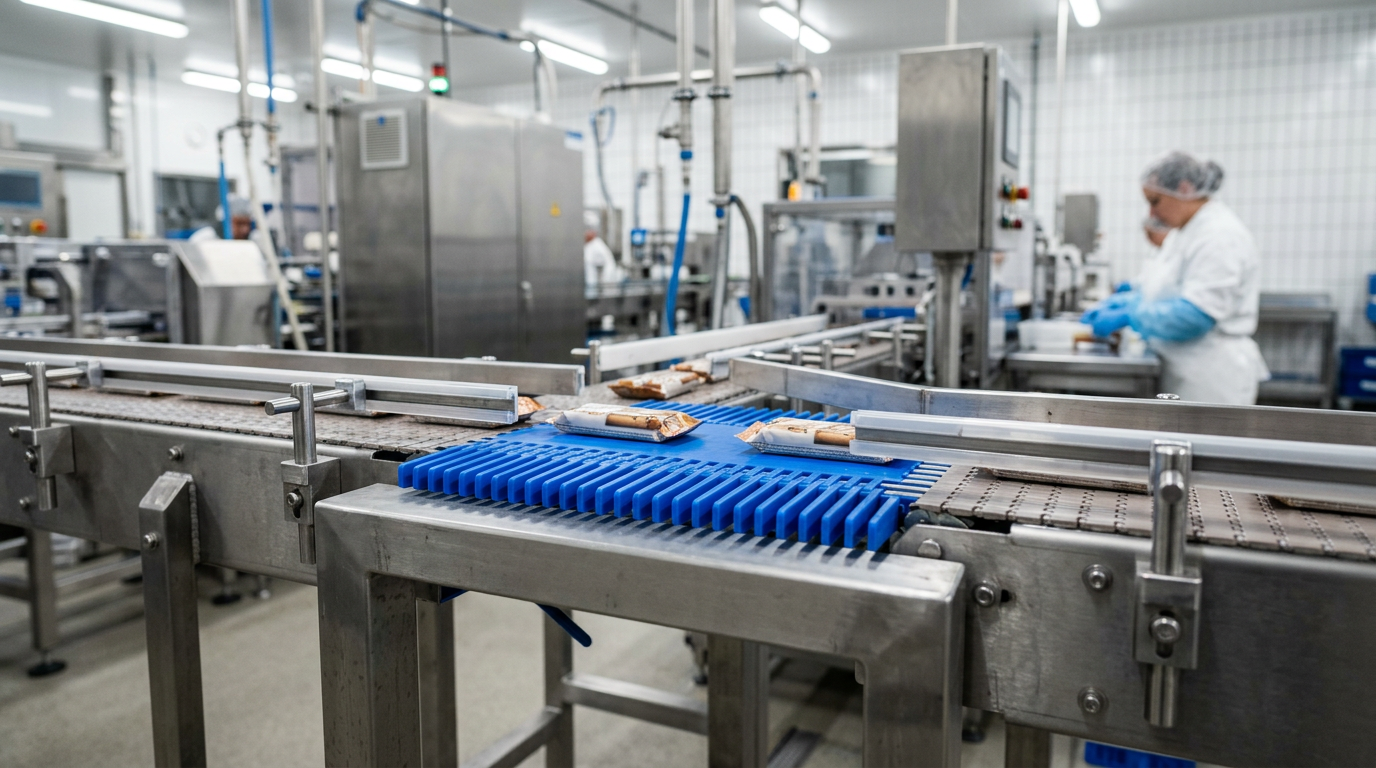
A transfer plate (or "dead plate") is a stationary bridge installed between two conveyors or between a conveyor and a processing machine. Its primary function is to provide a smooth, continuous surface for products to slide across.
Design Considerations for Transfer Plates
- The "Gap" Challenge: As conveyor belts wrap around end pulleys, a triangular gap is created. The larger the pulley diameter, the larger the gap.
- Material Selection: Transfer plates are typically made from Acetal (POM) for low friction, or stainless steel for heavy-duty industrial use.
- Finger Transfer Plates: In modular plastic belt applications, "finger" plates interlock with the belt's ribs. This allows for a seamless transition even for very small products (like vials or unstable bottles) that would otherwise tip over in a standard gap.
End Rollers and Nose Bars
Where transfer plates provide a stationary bridge, end rollers and nose bars focus on minimizing the radius of the belt's turn.
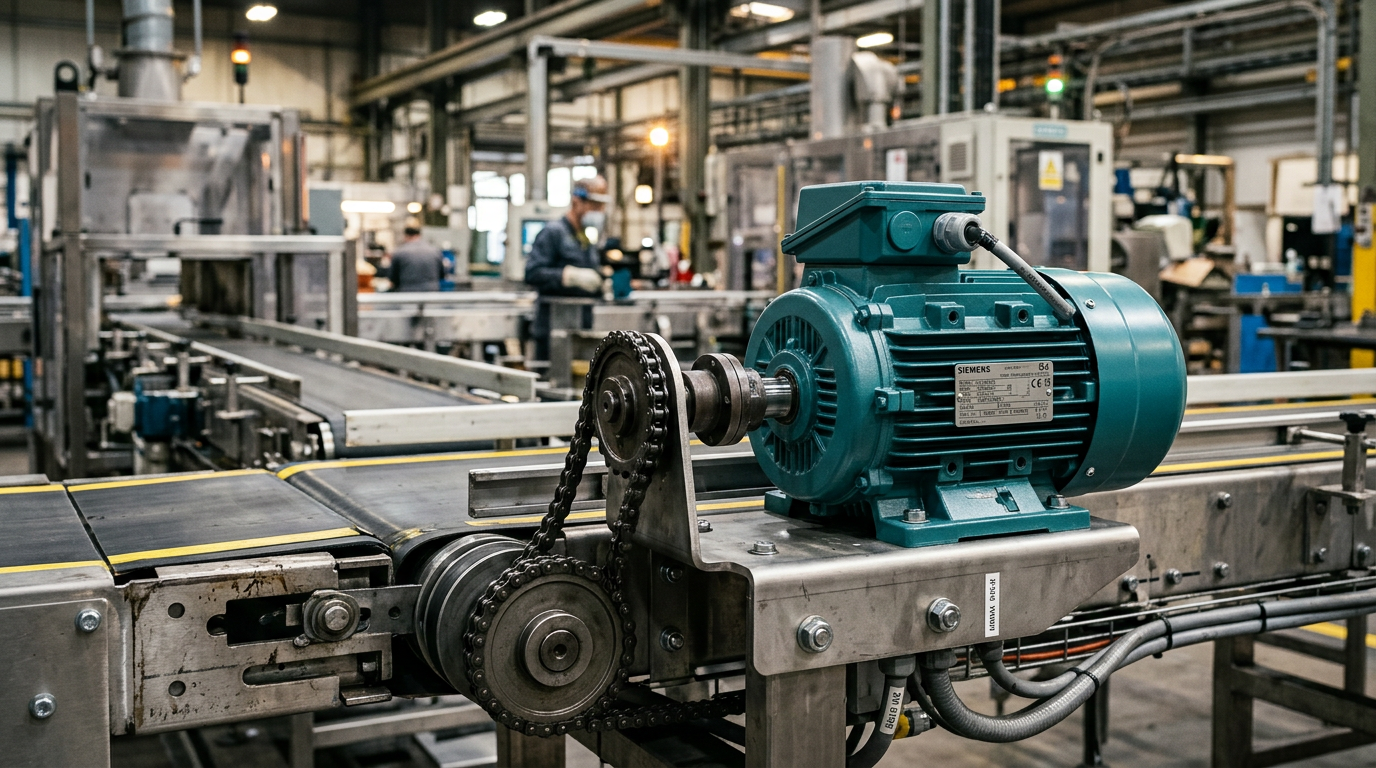
- Standard End Rollers: T
Easy Conveyors stocks the conveyor components discussed here — ready to ship across Europe.
hese are large diameter pulleys (typically 50mm to 100mm) used for heavy loads. While durable, they create a large gap that requires a wide transfer plate.
- Nose Bars (Fixed or Rolling): For "tight" transfers, engineers use nose bars with radii as small as 3mm to 6mm. This allows the two conveyor surfaces to be placed nearly flush against each other, often eliminating the need for a transfer plate entirely.
Technical Comparison: Transition Methods
| Feature | Transfer Plate (Dead Plate) | Finger Transfer | Nose Bar (Small Radius) | Roller Transfer |
|---|---|---|---|---|
| Product Stability | Moderate | High | Excellent | Good |
| Maintenance | Low (Stationary) | Moderate (Alignment) | High (Bearing Wear) | Moderate |
| Min. Product Size | > 50mm | > 10mm | > 5mm | > 25mm |
| Friction Level | High (Sliding) | Moderate | Low (Rolling) | Very Low |
| Best Use Case | Robust packaging | Modular rib belts | Small electronics/vials | Heavy cartons |
Engineering for Efficiency: The Impact of Friction
Every contact point—whether it is a side guide or a transfer plate—introduces friction. According to IEC 60034-30-1 standards for motor efficiency, reducing system-wide friction is critical to maintaining an IE3 or IE4 efficiency rating. If side guides are too tight or transfer plates are misaligned, the conveyor motor must work harder, increasing energy consumption and premature wear on the belt’s underside.
Key Sizing Rules for Side Guides
- Clearance: For most rigid packaging, a total clearance of 3mm to 5mm over the maximum product width is recommended to prevent wedging.
- Lead-in Tapers: Every side guide section should begin with a flared "lead-in" to gently funnel products that may have drifted off-center.
- Expansion Gaps: Plastic guide liners expand at different rates than steel frames. Use slotted mounting holes to prevent "snaking" when ambient temperatures rise.
Maintenance and Failure Modes
Components like transfer plates and end rollers are often overlooked during routine inspections, yet they are frequent sources of failure.
- Plate Wear: Over time, sliding friction creates grooves in transfer plates. These grooves can catch the edge of a product, causing it to pivot and jam the line.
- Bearing Failure in End Rollers: Small-diameter nose bar rollers spin at much higher RPMs than the main drive drum. They require high-quality sealed bearings to prevent seizing in dusty or wet environments.
- Misalignment: If a transfer plate sits even 1mm higher than the downstream belt, it creates a "trip hazard" for products, leading to fallen items and downstream blockages.
Integration with Modular Systems
In modern material handling, the trend is toward "plug-and-play" modularity. This means components must be standardized. Using components that follow ISO 21138 or similar dimensional standards ensures that if a plant needs to switch from a belt conveyor to a roller conveyor, the transition hardware remains compatible.
When selecting these components, engineers should prioritize "wash-down" capability if working in food or pharma. This involves selecting materials that meet FDA 21 CFR requirements for direct food contact. Properly implemented side guides and transfers not only protect the product but also extend the life of the entire conveyor system by ensuring smooth, centered loading.
Frequently Asked Questions
What is the difference between a nose bar and a standard end roller?
A nose bar is a very small diameter end transition (often 6mm-12mm radius) that allows two conveyors to be placed close together, minimizing the gap for small products. Standard end rollers are larger (50mm+) and used for heavier loads where a tight gap isn't critical.
How much clearance should I leave between the product and the side guides?
For standard rigid packaging like boxes or bottles, a clearance of 1.5mm to 2.5mm per side (3mm to 5mm total) is generally recommended to prevent friction while maintaining alignment.
When should I use a finger transfer plate instead of a flat dead plate?
Finger transfer plates feature a comb-like structure that interlocks with the longitudinal ribs of a modular belt, providing continuous support even as the belt rounds the pulley, which prevents thin or small items from tipping.
Can side guide selection affect my conveyor's energy efficiency?
Yes, using roller side guides or low-friction UHMW-PE liners reduces the drag on the conveyor motor. According to IEC 60034-30-1, reducing mechanical load is a key step in achieving higher IE efficiency ratings for the overall system.