Side Guides, Transfer Plates and End Rollers Explained for Industrial Systems
Master the critical roles of side guides, transfer plates, and end rollers in conveyor systems to prevent product tipping, reduce friction, and improve OEE.
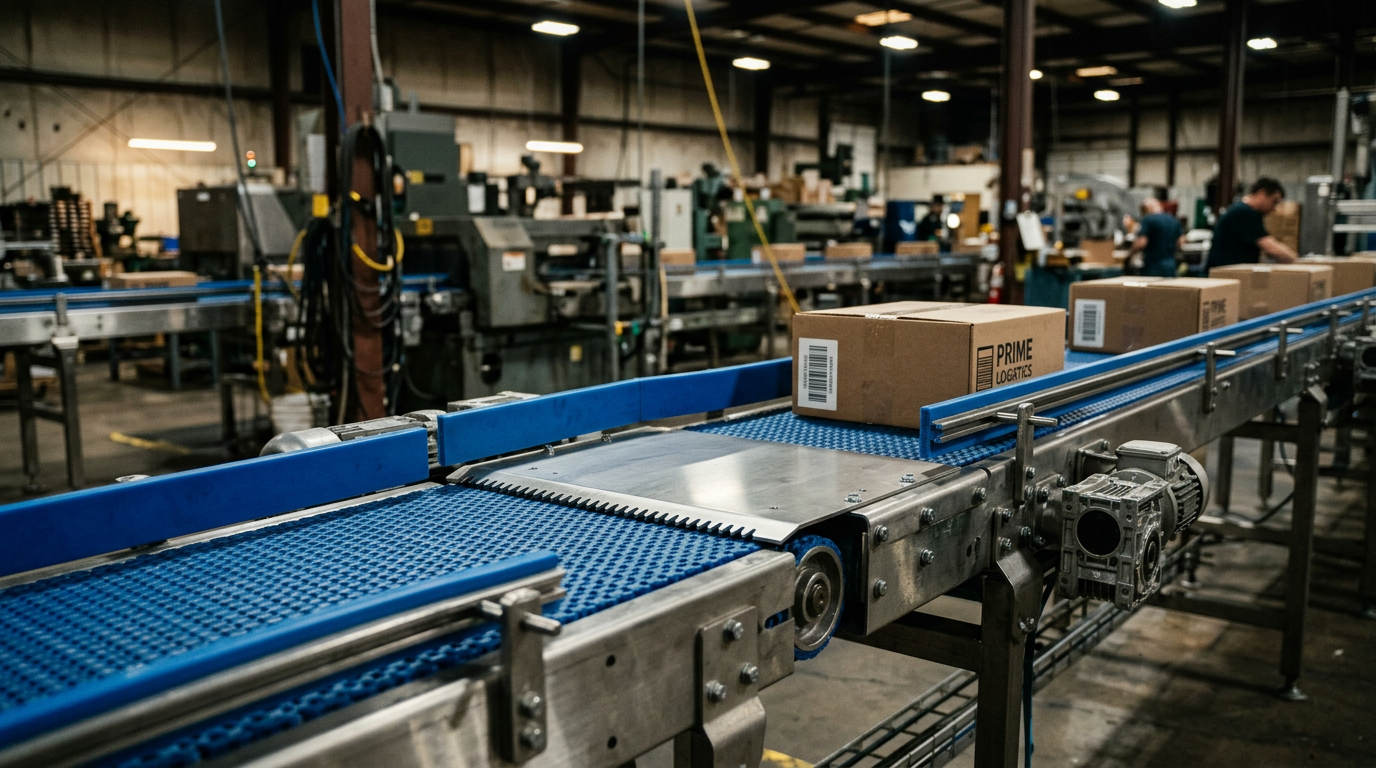
Effective conveyor system integration relies on three critical interface components: side guides, transfer plates, and end rollers, which collectively account for up to 80% of product stability issues during high-speed transitions. These components bridge the gaps between conveyor modules, ensuring that lateral movement is constrained and that products weighing as little as 50 grams can transition between belts without tipping or stalling.
Key Takeaways
- Transfer Plate Gaps: Dead plates should ideally be no wider than 50% of the product’s footprint to prevent "stalling" or product tipping.
- Side Guide Friction: Low-friction UHMW-PE guides reduce motor load by up to 15% compared to standard PVC or steel rails.
- End Roller Diameter: Small-pitch chains (e.g., 8mm to 12.7mm) require nose bars or micro-rollers to handle fragile items like electronics or small vials.
- Hygienic Standards: In food applications, all transfer components must adhere to EHEDG guidelines, utilizing open-frame designs for washdown accessibility.
Side Guides: Maintaining Lateral Control
Side guides (or lateral rails) are the primary mechanism for directing product flow and preventing spillage. While they appear simple, their design significantly impacts system efficiency and product integrity.
Material Selection and Friction
The coefficient of friction between the side guide and the product is a critical design variable. High-friction guides increase the drag on the conveyor motor, potentially leading to premature wear of the modular belt or chain.
- UHMW-PE (Ultra-High-Molecular-Weight Polyethylene): The industry standard for high-speed lines, offering excellent wear resistance and low friction.
- Stainless Steel: Used primarily in heavy-duty or high-temperature environments, though often lined with plastic to protect the product.
- Roller Guides: Essential for accumulation zones where products press against the guide for extended periods; these utilize vertical rollers to convert sliding friction into rolling resistance.
Adjustment Mechanisms
Fixed guides are suitable for dedicated lines, but modern e-commerce and packaging facilities require modularity. Adjustable side guides allow for rapid changeovers between different SKU sizes. Manual handwheels with digital position indicators are common, though automated servo-driven guides are increasingly used in Industry 4.0 setups to minimize downtime.
Transfer Plates: Bridging the Modular Gap
Transfer plates, often called "dead plates," are stationary surfaces placed between two conveyor sections. Their primary role is to provide a smooth bridge for products to slide across as they move from one powered belt to the next.
Static vs. Powered Transfers
In many applications, a simple static plate made of POM (Polyoxymethylene) or stainless steel is sufficient. However, for lightweight products or high-speed lines, "active" or powered transfers may be necessary. These can involve small rollers or specialized belt extensions that ensure the product never loses momentum.
When selecting a transfer plate, the "gap" is the most critical dimension. According to industry best practices, the gap should never exceed half the length of the shortest product being transported. If a product is 100mm long, the dead plate area must be designed so the product is always supported by at least one powered surface or is carried by its own momentum over a gap no wider than 50mm.
Roller Transfers
For heavy loads or scenarios where friction must be minimized, roller transfer plates are utilized. These consist of rows of small-diameter rollers embedded in a plate. This setup is particularly effective in modular conveyor systems provided by specialists like Easy Conveyors, where seamless integration between different conveyor types (e.g., roller to belt) is required.
Easy Conveyors stocks the conveyor components discussed here — ready to ship across Europe.
End Rollers and Nose Bars: The Pivot Points
End rollers (or drive/idler sprockets in modular belts) define the geometry of the conveyor's ends. The diameter of these rollers dictates the "transfer gap"—the physical space between two adjacent conveyors.
The Nose Bar Advantage
For ultra-small products, such as pharmaceutical blisters or small plastic components, standard 50mm or 100mm rollers are too large. In these cases, a nose bar is used. A nose bar is a small-diameter stationary or rolling bar (often 6mm to 18mm) that allows the conveyor belt to turn at a much tighter radius.
Using a nose bar requires specific belt characteristics. The belt must be flexible enough to handle the tight wrap without fatigue failure. Modular belts with a small pitch (e.g., 0.5 inches or less) are specifically designed for these tight transitions.
| Component Type | Best For | Typical Material | Friction Level |
|---|---|---|---|
| Fixed Side Guide | Single SKU high-speed lines | UHMW-PE / Alum | Low |
| Roller Side Guide | Accumulation zones | Steel/Plastic Rollers | Very Low |
| Dead Plate | General packaging | Stainless / POM | Medium |
| Nose Bar | Small/Fragile items | Hardened Steel | N/A (Rolling) |
| Powered Transfer | Lightweight/High-speed | Mini-belts | Active Drive |
Design Trade-offs and Common Failure Modes
When designing or maintaining these components, engineers must balance several factors:
- Heat Dissipation: In high-speed sliding transfers, friction generates heat. If the transfer plate material has a low melting point, it can deform or leave residues on the product.
- Product Orientation: Improperly aligned side guides can cause "shingling" (products overlapping) or "bridging" (products wedging against each other), leading to line stops.
- Sanitation: In food-grade environments (FDA compliant), transfer plates must be easily removable for cleaning. Trapped organic matter between a transfer plate and the belt is a primary source of bacterial growth.
Integration with Automation
The selection of these components affects the overall automation strategy. For example, if using vision systems for quality control, side guides must be positioned to avoid casting shadows or obscuring the camera's view. Furthermore, the transition must be smooth enough to prevent product vibration, which could interfere with "pick-and-place" robotics downstream.
Proper maintenance of end rollers involves checking for "eccentricity"—if a roller is not perfectly circular or is mounted off-center, it will cause rhythmic tension spikes in the belt. Over time, this leads to premature belt stretch and failure of the drum motor selection or external drive system.
Troubleshooting Transition Issues
If products are frequently tipping at the transfer point, consider the following checklist:
- Check the Height Differential: The downstream conveyor should typically be 1-2mm lower than the upstream conveyor to prevent "stubbing" (the product hitting the edge of the next belt).
- Inspect the Nose Bar Wear: On stationary nose bars, look for grooving. Grooves increase friction and can cause the belt to jump or track poorly.
- Validate Side Guide Width: The guide width should be 3-5mm wider than the maximum product width to allow for variances without causing jams.
By paying close attention to these "minor" components, facility managers can significantly improve OEE (Overall Equipment Effectiveness) and reduce the total cost of ownership for their material handling systems. For complex layouts involving diverse product sizes, consulting with an engineering partner like Easy Conveyors ensures that the transition components are matched to the specific mechanical requirements of the modular chain and the drive units.
Properly tuned side guides and transfer plates are not just accessories; they are the fundamental guards of throughput in the modern automated factory. Selecting the right VFD soft-start tuning parameters can further protect these components by reducing the mechanical shock during startup, ensuring that transfer plates and guides remain aligned over years of operation. In high-hygiene sectors, ensuring hygienic wash-down design for all transfer interfaces is mandatory to meet international safety standards.
Frequently Asked Questions
What is the maximum allowable gap for a transfer plate?
Dead plates should be no wider than 50% of your smallest product's length. For very small items, use a nose bar or powered transfer instead of a static plate.
Which material is best for side guides in high-speed applications?
UHMW-PE (Ultra-High-Molecular-Weight Polyethylene) is generally the best choice due to its low coefficient of friction, high wear resistance, and cost-effectiveness.
How does a nose bar differ from a standard end roller?
A nose bar is a very small diameter roller or stationary bar used at the conveyor end. It allows for a tighter turning radius, reducing the gap between two conveyors to keep small products stable.
Should conveyors be perfectly level at a transfer point?
The downstream conveyor should be approximately 1-2mm lower than the upstream conveyor. This 'step down' prevents products from catching on the leading edge of the next belt.