Side Guides, Transfer Plates and End Rollers Explained: A Technical Guide
Discover how side guides, transfer plates, and end rollers optimize material handling. Learn technical specs for friction control, gap management, and high-speed transfers.
The Critical Role of Conveyor Accessories in System Stability
While the belt and motor represent the heart and lungs of a material handling system, side guides, transfer plates, and end rollers function as the skeletal structure and joints that ensure product integrity. In high-speed automation, a deviation of just 5mm in product positioning can lead to catastrophic jams or sensor misfires. Engineering these accessories requires a balance between low friction, mechanical rigidity, and accessibility for maintenance.
Properly configured side guides prevent lateral migration of products, especially during high-speed transitions or 90-degree transfers. Transfer plates bridge the "dead zone" between two independent conveyor sections, ensuring that small or fragile items do not tip or become trapped. End rollers, or nose bars, minimize the gap between conveyors by reducing the radius of the belt wrap, which is essential for handling micro-parts or thin packaging.
Side Guides: Precision Lateral Control
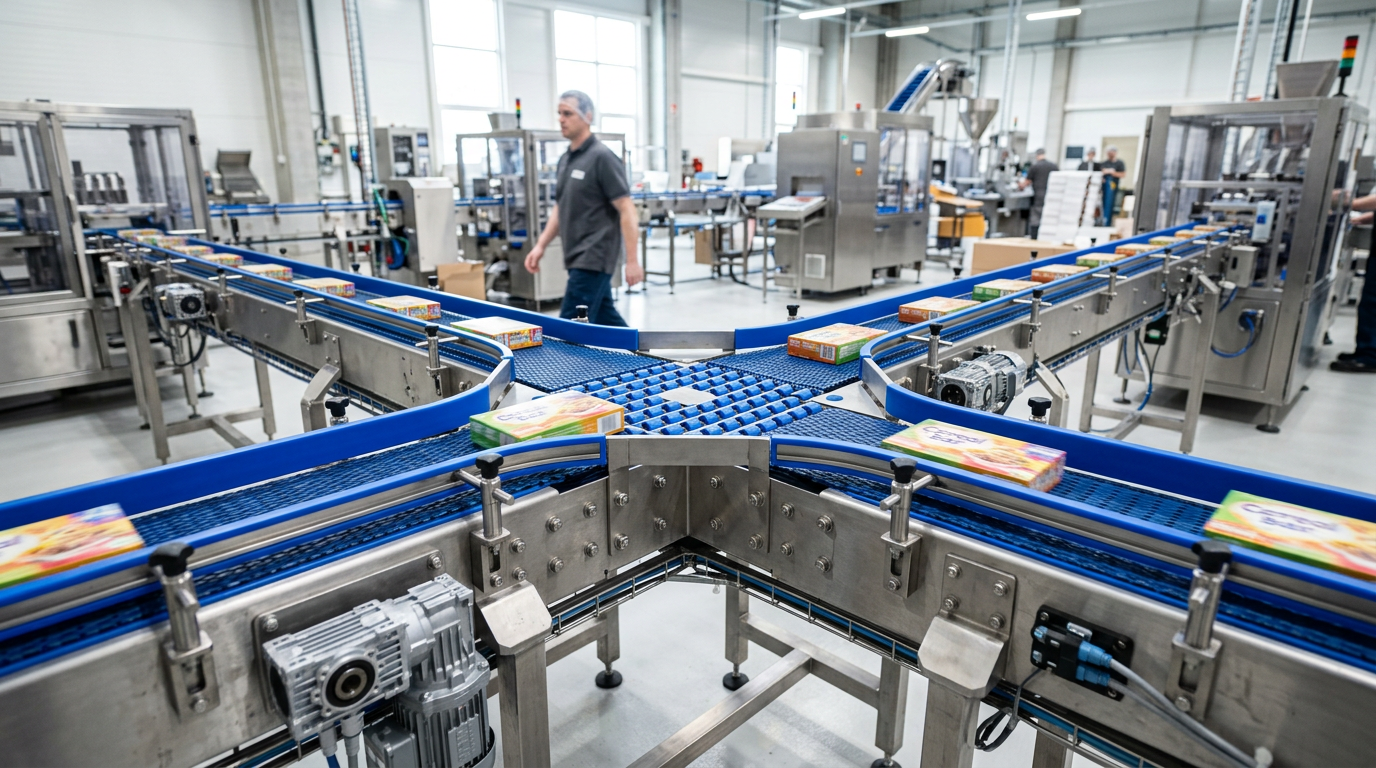
Side guides (or lateral guides) are the primary method for maintaining product orientation. In modular systems, these are rarely "set and forget" components; they must often be adjustable to accommodate varying SKU widths.
Material Selection and Friction
The choice of material for side guide rails significantly impacts the energy consumption of the conveyor motor. According to VDMA standards for conveyor efficiency, friction losses can account for up to 30% of total power consumption in long-distance transport.
- PE-UHMW (Ultra-High Molecular Weight Polyethylene): The industry standard for low-friction and high wear resistance. It offers excellent "slip" properties, which prevents scuffing on delicate packaging.
- Stainless Steel: Used primarily in food and pharma for hygiene, often paired with a plastic clip-on "liner" to prevent metal-on-product contact.
- Anodized Aluminum: Provides high structural rigidity for heavy-duty applications like automotive parts handling.
Adjustable vs. Fixed Guides
For facilities running a single product size, fixed bracket guides are preferred for their stability. However, in e-commerce and multi-SKU packaging lines, "tool-less" adjustable guides are essential. These often feature hand knobs or digital position indicators to ensure repeatable setups during changeovers. Easy Conveyors provides a range of modular side guide supports designed for rapid reconfiguration, allowing operators to adjust the entire line width in minutes rather than hours.
Transfer Plates: Eliminating the "Dead Zone"
A "dead zone" occurs at the junction of two conveyors where the belt wraps around the drive or idler sprocket. Without a transfer plate, the gap between conveyors can swallow small items or cause "nose-diving," where a product tips forward as it loses support.
Types of Transfer Solutions
- Fixed Dead Plates: Static plates made of stainless steel or low-friction plastic. These are cost-effective but can cause friction heat at high speeds.
- Roller Transfer Plates: These incorporate small, non-powered micro-rollers (typically 10mm to 20mm diameter). They are ideal for heavy products or high-speed lines where friction must be minimized to prevent product damage.
- Powered Transfers: A small auxiliary belt or chain driven by the main conveyor. These are reserved for the most demanding applications where zero-speed gaps are unacceptable.
| Feature | Fixed Dead Plate | Roller Transfer Plate | Powered Transfer |
|---|---|---|---|
| Price Tier | Low | Medium | High |
| Maintenance | Zero | Low (cleaning rollers) | Moderate (belt/drive) |
| Max Speed | < 30 m/min | < 100 m/min | > 150 m/min |
| Hygiene (EHEDG) | High | Moderate | Low |
| Ideal For | Large Boxes | Fragile/Small Goods | High-Speed Sortation |
End Rollers and Nose Bars: Sizing the Gap
The diameter of the end roller (or the radius of a static nose bar) determines the minimum size of the product that can be safely transferred. For micro-transfers—such as moving small pharmaceutical vials or electronics—a standard 50mm diameter roller is insufficient.
Nose Bar Technology
A nose bar is a fixed, small-radius edge (often 3mm to 10mm) that allows the modular belt to wrap tightly, creating a nearly seamless transition between belts. Use of nose bars requires specific belt materials; modular belts with a small pitch (e.g., 8mm or 12.5mm) are necessary to wrap around such tight radii without "cogging" or excessive wear.
Dynamic End Rollers
Unlike fixed nose bars, dynamic end rollers rotate with the belt. This reduces back-tension on the belt and lowers the torque required from the motor. When selecting end rollers, engineers must reference ISO 21484 for safety distances to prevent finger entrapment in these tight "pinch points."
Easy Conveyors stocks the conveyor components discussed here — ready to ship across Europe.
Engineering Trade-offs: Heat and Tension
Using tight end rollers and extensive side guiding increases the mechanical load on the system.
- Belt Tension: Tight radii increase the "chordal action" of the belt, which can lead to vibration.
- Thermal Expansion: In long conveyor runs, side guides must be installed with expansion gaps. If a PE-UHMW guide is bolted too tightly across a 20-meter run, it may buckle as ambient temperatures rise, leading to product jams.
- VFD Tuning: When using high-friction side guides, VFD soft-start tuning is critical to prevent the belt from jerking and causing product tip-over during startup.
Selection Criteria for Different Industries
- Food Processing: Requires FDA-compliant materials and EHEDG-certified designs. Transfer plates must be easily removable for daily wash-downs. Open-hinge side guides are preferred to prevent bacterial growth.
- E-commerce/Logistics: Focuses on durability and noise reduction. Roller transfer plates are often used to handle the wide variety of packaging types (polybags, cardboard, padded envelopes) that may snag on fixed plates.
- Pharmaceuticals: Focuses on precision. Small-diameter nose bars are the standard to ensure tiny vials remain upright during high-speed filling and capping transitions.
Integration with Automation
Modern side guides and transfer sections are increasingly being fitted with sensors. Inductive sensors mounted on the side guide can detect if a product is "leaning," while photo-eye sensors integrated into transfer plates can signal a downstream jam before a pile-up occurs. When designing these systems, ensure that the hygienic wash-down design of the sensor mounts matches the rest of the conveyor to prevent sanitation bottlenecks.
Common Failure Modes to Avoid
- Improper Gap Setting: If the gap between the belt and the transfer plate is too wide, polybags can get sucked into the gap. If it is too tight, the belt will rub, causing heat and premature wear. A rule of thumb is a gap of 1.5x the belt thickness.
- Inconsistent Guide Height: Side guides that are too low can cause top-heavy products to "climb" over the rail. Guides that are too high may interfere with the labeling or scanning of the product.
- Ignoring Material Compatibility: Using a high-friction side guide with a high-friction belt material (like certain rubbers) can stall the motor or melt the guide rail surface. Always consult the coefficient of friction (COF) charts provided by the belt manufacturer.
By treating side guides, transfer plates, and end rollers as precision components rather than afterthoughts, engineers can significantly improve the OEE (Overall Equipment Effectiveness) of their production lines, reducing downtime caused by minor but frequent product handling issues.
Frequently Asked Questions
How do I prevent small products from tipping at conveyor junctions?
Use a 'nose bar' or small-diameter end roller (3mm-10mm radius) and a micro-roller transfer plate to ensure the product is always supported by at least two points.
What is the best material for low-friction side guides?
PE-UHMW is the industry standard due to its extremely low coefficient of friction, high impact strength, and FDA compliance for food applications.
What is the recommended gap between a belt and a fixed transfer plate?
A general rule of thumb is to set the transfer plate gap at 1.5 to 2.0 times the thickness of the conveyor belt to allow for thermal expansion and belt movement.
When should I choose adjustable side guides over fixed ones?
Adjustable side guides are essential when handling multiple SKUs on one line, allowing for rapid changeovers without tools, which increases OEE.
What are the benefits of a rolling end roller versus a fixed nose bar?
Fixed nose bars create more friction and heat. Rolling end rollers reduce the torque required from the motor and extend the life of the modular belt.