Optimizing Shaftless Screw Conveyors for Sludge and Biomass Handling
Shaftless screw conveyors offer 50% higher fill rates for sludge and biomass by eliminating the center shaft, preventing clogs and reducing maintenance in high-torque loads.
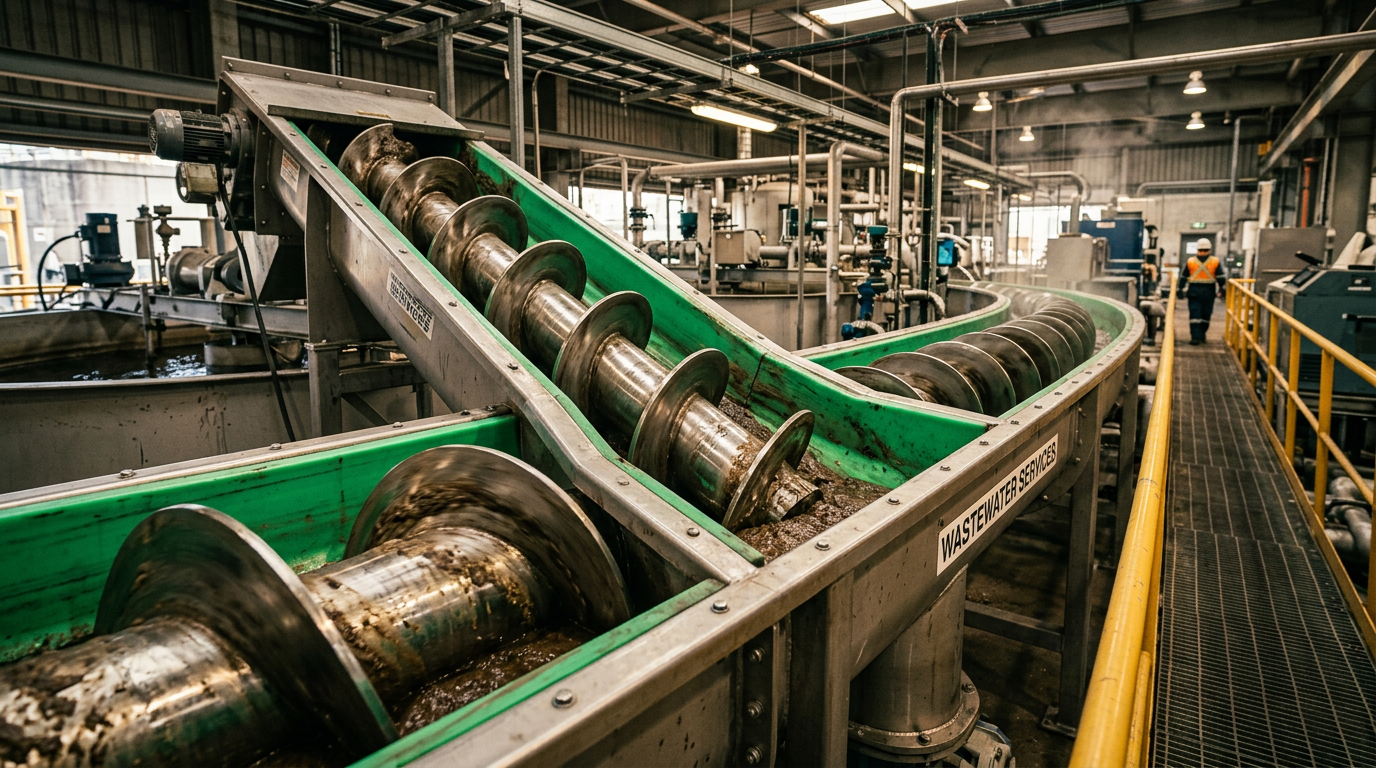
Shaftless screw conveyors operate on a centerless design principle that allows for a 30% to 50% higher fill rate compared to traditional shafted screws, making them the primary choice for handling viscous, stringy, or non-homogeneous materials like municipal sludge and forest biomass. By eliminating the central pipe, these systems prevent material build-up and "bridging," ensuring a continuous flow of high-moisture solids that would otherwise clog standard equipment.
The Mechanics of Shaftless Design
In a traditional screw conveyor, the flighting is welded to a central shaft. In contrast, a shaftless screw (also known as a spiral) is a heavy-duty, high-strength steel coil that is supported by a replaceable liner, usually made of ultra-high-molecular-weight polyethylene (UHMWPE) or specialized alloys. This design allows the entire cross-section of the trough to be utilized for material transport.
For sludge handling, this is critical. Sludge is often "sticky" and tends to wrap around central shafts. By removing the shaft, the conveyor provides a clear path for the material. Furthermore, the spiral is driven from one end, typically by a high-torque geared motor, and is "floated" in the trough, which reduces the need for intermediate and end bearings—components that are notorious failure points in abrasive or corrosive environments.
Key Performance Advantages in Biomass and Sludge
- High Trough Loading: Because there is no central shaft displacing volume, shaftless conveyors can operate at higher trough loading percentages (up to 45-50%) without the risk of plugging.
- Handling Heterogeneous Solids: Biomass, such as wood chips, bark, or agricultural waste, often contains irregular chunks. Shaftless spirals can accommodate these larger particles more easily than shafted versions where the clearance between the shaft and the trough is limited.
- Total Containment: These systems are typically fully enclosed. For municipal wastewater treatment plants (WWTP), this is vital for odor control and preventing the leakage of hazardous bio-solids.
- Low Maintenance: The absence of internal bearings eliminates the need for lubrication inside the product zone, which is a major benefit when dealing with the abrasive nature of biomass or the chemically aggressive profile of treated sludge.
Material Selection and Liner Technology
The interaction between the spiral and the liner is the most critical wear interface in the system. According to standards for abrasive material handling (ISO 12891), selecting the correct hardness ratio between the spiral and the liner is essential for longevity.
| Feature | Shaftless Screw | Shafted Screw |
|---|---|---|
| Primary Use Case | Sludge, Biomass, Caking Solids | Dry, Free-flowing Powders |
| Max Fill Rate | 50% | 15-30% |
| Maintenance | Low (no internal bearings) | High (intermediate bearings) |
| Clogging Risk | Minimal (no center pipe) | High (stringy material wraps shaft) |
| Drive Orientation | Pull or Push (Single End) | Both Ends (Shafted) |
| Wear Part | Replaceable Liner | Bearings and Seals |
In demanding European biomass applications, Easy Conveyors emphasizes the importance of modularity and ease of
Easy Conveyors stocks the material handling discussed here — ready to ship across Europe.
maintenance, ensuring that liners can be replaced without dismantling the entire structural trough.
Sizing and Engineering Considerations
When sizing a shaftless conveyor for sludge, engineers must account for the "Dry Solids" (DS) content. A 20% DS sludge behaves very differently than a 40% DS sludge. The higher the DS, the higher the friction coefficient against the liner.
- Torque Requirements: Shaftless spirals require significant startup torque. It is standard practice to utilize IE3 or IE4 efficiency class motors (IEC 60034-30-1) coupled with heavy-duty gearboxes to overcome the initial inertia of settled sludge.
- Spiral Thickness: The spiral must be thick enough to resist the torsional forces without a central support. In biomass applications where rocks or metal debris might be present, the spiral is often manufactured from high-tensile carbon steel or 316 stainless steel with a thickness exceeding 20mm.
- Incline Limits: While horizontal transport is most efficient, shaftless conveyors can operate at inclines. However, as the angle increases, the capacity drops. At 30°, capacity may drop by 25% compared to horizontal flow.
Integration with Downstream Automation
Modern material handling facilities integrate these conveyors with VFDs (Variable Frequency Drives) to match the feed rate of downstream equipment like centrifuges, belt presses, or biomass gasifiers. By monitoring the motor current, the control system can detect potential blockages or "over-torque" conditions before mechanical failure occurs. This is a common strategy in "VFD soft-start tuning" to protect the drive train from the shock loads associated with non-homogeneous biomass.
Environmental and Safety Compliance
In the US, OSHA and in Europe, the CE machinery directive, mandate strict guarding for screw conveyors. Because shaftless screws exert immense pressure, the covers must be interlocked. If a cover is removed for inspection, the power must be cut instantly. Furthermore, in biomass handling, the risk of dust explosions must be managed according to ATEX/DSEAR zones, requiring spark-resistant materials and specialized grounding to prevent static buildup on the floating spiral.
Operational Challenges: The "Walking" Phenomenon
One unique challenge with shaftless spirals is "walking" or longitudinal expansion. As the spiral rotates under load, it can physically lengthen. Engineering designs must include a "compression" or "expansion" zone at the tail end to account for this movement, especially in long-run conveyors (over 15 meters). Failure to account for this can lead to the spiral grinding against the end plates, causing premature mechanical wear.
Conclusion
Shaftless screw conveyors represent the gold standard for moving "difficult" materials. By prioritizing a high-torque drive, selecting the appropriate UHMWPE liner, and ensuring the spiral metallurgy matches the abrasiveness of the sludge or biomass, operators can achieve years of reliable service with minimal intervention. As the global push for renewable energy increases the demand for biomass processing, the efficiency and robustness of shaftless technology remain indispensable.
Frequently Asked Questions
Why is a shaftless design better for sticky materials?
By removing the central shaft, there is no surface for stringy or sticky materials to wrap around. The open center allows for higher volumes of non-homogeneous materials like bark or wet sludge to pass without bridging or clogging.
What is the primary wear part in a shaftless conveyor?
The most common wear component is the trough liner, usually made of UHMWPE or specialized Xylethon. Depending on the abrasiveness of the material, these liners typically last 2 to 5 years before requiring replacement.
Can shaftless screw conveyors operate on an incline?
Yes, shaftless conveyors can operate at inclines up to 90 degrees (vertical), though capacity significantly decreases as the angle increases. For steep inclines, specialized spiral pitches and higher motor speeds are required.
What motor type is best for sludge conveyors?
High-torque, low-RPM geared motors are preferred. Using IE3-rated motors with a Variable Frequency Drive (VFD) is recommended to handle the high startup inertia of settled sludge or heavy biomass.