Mastering Line Balancing and OEE Improvement in Conveyor-Based Material Flow
Learn how to optimize line balancing and OEE in modular conveyor systems through strategic buffering, VFD speed matching, and ZPA logic to eliminate bottlenecks.
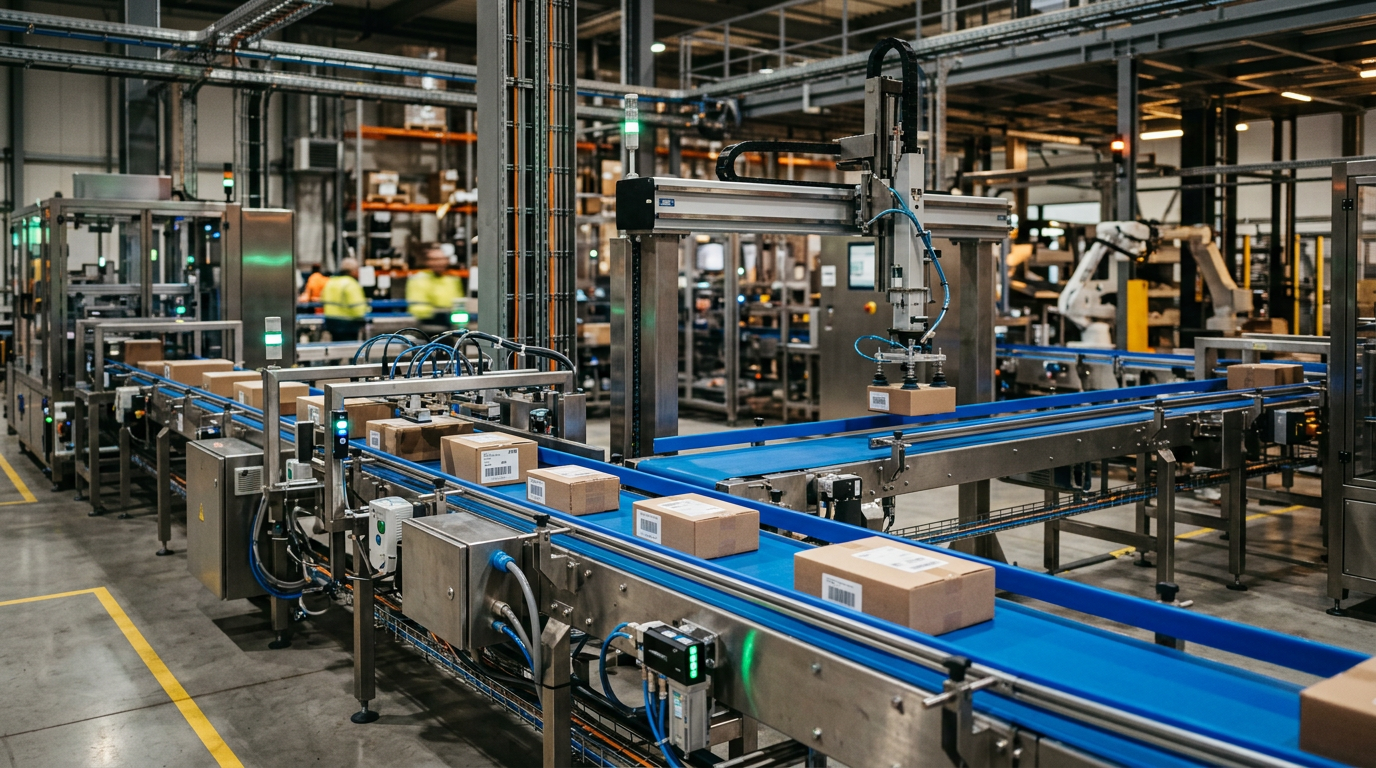
Line balancing in conveyor-based material flow refers to the strategic synchronization of sequential process steps to ensure that cycle times are harmonized, typically aiming for a throughput efficiency where the bottleneck station operates at >95% utilization. Achieving optimal line balance is the primary driver for improving Overall Equipment Effectiveness (OEE), particularly by reducing "Idling and Minor Stoppages" (Performance) and "Reduced Speed" (Availability) losses.
The Physics of Material Flow: Why Balance Matters
In a modular conveyor environment, the flow of goods is rarely a steady stream; it is a series of pulses governed by the cycle times of upstream and downstream equipment. If a case packer processes 20 units per minute but the upstream filling station delivers 25, the system faces "slugging"—a phenomenon where back-pressure builds, causing mechanical wear on modular belts and frequent micro-stops for sensors.
Line balancing acts as the buffer management strategy. According to LEAN manufacturing principles, the goal is to align the "Takt Time" (the rate at which a finished product must be completed to meet customer demand) with the cycle time of each individual module.
Quantifying the OEE Impact
Overall Equipment Effectiveness is calculated as Availability × Performance × Quality. In conveyor systems, poor line balancing degrades all three metrics:
- Availability: Imbalanced lines cause frequent motor starts/stops. Excessive cycling increases heat in gearmotors, leading to premature failure and unplanned downtime.
- Performance: If a conveyor module runs at a fixed high speed but is frequently starved of product, its "Performance" rating drops due to idling.
- Quality: Sudden surges in line pressure (back-log) can crush fragile packaging or cause product orientation issues, leading to rejects at the vision inspection station.
Strategic Buffering: Accumulation vs. Speed Control
Effective line balancing requires a mix of hardware modularity and software intelligence. Large-scale manufacturers often look to Easy Conveyors for modular chain systems that allow for easy reconfiguration of accumulation zones, which are critical for absorbing the "micro-variations" in cycle times between machines.
Zero-Pressure Accumulation (ZPA)
ZPA is a cornerstone of modern line balancing. By dividing a conveyor into zones, each powered by a motorized drive roller (MDR) and controlled by a logic controller, products can be moved independently. This prevents "train crashes" on the line and ensures that if a downstream machine stops for 30 seconds to reload labels, the upstream flow doesn't immediately grind to a halt.
| Balancing Strategy | Primary OEE Benefit | Complexity | Hardware Requirement |
|---|---|---|---|
| Fixed Speed | Low cost, high Quality | Low | Standard AC Motors |
| VFD Speed Matching | Performance (reduced idling) | Medium | Variable Frequency Drives |
| ZPA Accumulation | Availability (buffer time) | High | MDRs + Photo-eyes |
| **Dynam |
Easy Conveyors stocks the material handling discussed here — ready to ship across Europe.
ic Re-routing** | Performance (throughput) | Very High | Diverters + PLC Logic |
The Role of VFDs and Soft-Starts
Frequency converters or Variable Frequency Drives (VFDs) are essential for fine-tuning line balance. Instead of a binary "On/Off" state, VFDs allow the conveyor to ramp up or down based on the fill level of the downstream buffer. This aligns with IEC 61800 standards for adjustable speed electrical power drive systems, ensuring that energy consumption is optimized alongside throughput.
By implementing "Cascaded Speed Control," where each subsequent conveyor section runs slightly faster than the one before it (typically a 5-10% speed increase), engineers can create natural gaps between products. This ensures that sensors have enough "clear air" to accurately count items and trigger divert gates, directly improving the Quality component of OEE.
Identifying the Bottleneck: The Theory of Constraints
Every conveyor line has a bottleneck—the slowest point that dictates the maximum possible throughput. Improving OEE starts with identifying this constraint. If the bottleneck is a manual packing station, adding high-speed conveyors upstream will not improve OEE; it will only increase work-in-process (WIP) and physical congestion.
To optimize, engineers should:
- Calculate the Pitch: The distance between the centers of two consecutive items.
- Monitor Occupancy: Use PLC data to track how long a conveyor zone is "blocked" versus "clear."
- Implement Dwell Times: Short delays in motor activation can prevent "hunting"—where a motor switches on and off rapidly as a sensor flickers at the edge of a product.
Advanced Automation: Digital Twins and Simulation
As we move toward Industry 4.0, line balancing is increasingly managed through digital twins. By simulating the material flow before a single modular frame is bolted to the floor, engineers can predict where "traffic jams" will occur. High-efficiency motors, such as those meeting IE3 or IE4 efficiency classes (IEC 60034-30-1), are then mapped to specific loads to ensure the system remains energy efficient even under varying load conditions.
Hygiene and Maintenance Considerations
In food and pharma applications, line balancing must also account for wash-down cycles. If one section of the line requires a deep clean (CIP) while others are dry-running, the modular system must be capable of bypass or isolation. Using EHEDG-certified components ensures that the physical hardware does not become a bottleneck due to excessive cleaning time, which would negatively impact the "Availability" portion of the OEE equation.
Summary of Best Practices
For a line to be truly balanced, the material flow must be viewed as a single, integrated organism rather than a collection of independent machines. By utilizing modular conveyors that allow for flexible layout changes and integrating smart sensing for real-time speed adjustment, facilities can reach OEE scores above 85%—the "World Class" benchmark for manufacturing excellence.
Frequently Asked Questions
What is OEE in the context of material handling?
OEE (Overall Equipment Effectiveness) is a standard metric that multiplies Availability, Performance, and Quality to measure how well a manufacturing operation is utilized compared to its full potential.
How does line balancing directly improve OEE?
Line balancing minimizes 'micro-stops' and 'reduced speed' losses. By ensuring a steady flow, it prevents the motor wear and sensor errors that typically degrade OEE scores.
What is ZPA and why is it used for balancing?
Zero Pressure Accumulation (ZPA) allows products to accumulate on a conveyor without touching each other, using sensors and individual zone control to prevent back-pressure and product damage.
How do I find the bottleneck in my conveyor system?
The 'Takt Time' is the pace of customer demand. To balance a line, every conveyor segment and machine cycle time must be synchronized to match or slightly exceed the Takt Time.