Shaftless Screw Conveyors for Sludge and Biomass Handling
Shaftless screw conveyors offer 100% more throughput for sludge and biomass than shafted versions, eliminating clogging while reducing energy costs through high filling rates.
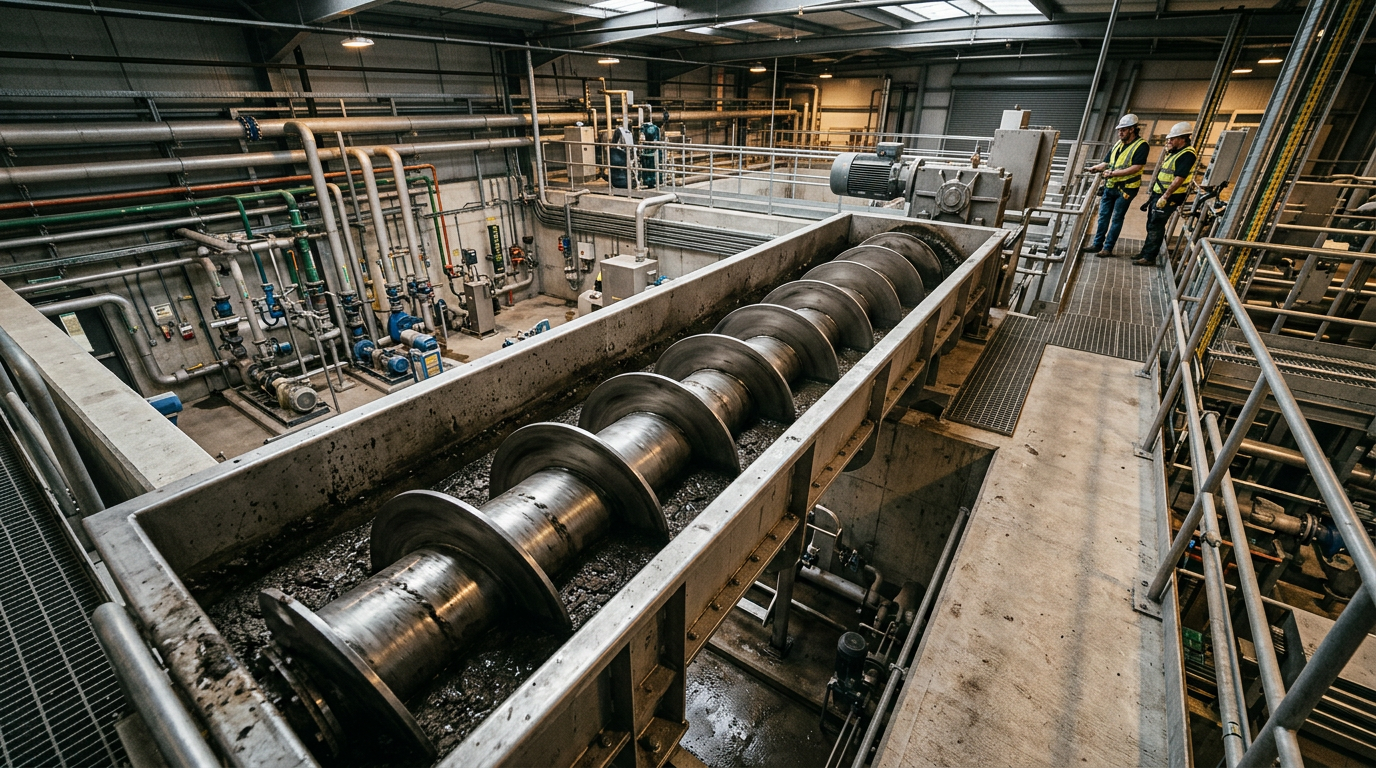
Shaftless screw conveyors operate on a design principle that eliminates the central pipe or shaft found in traditional augers, allowing for a 100% higher fill rate and the ability to transport extremely viscous, stringy, or irregular materials like dewatered sludge and forest biomass without clogging. By utilizing a heavy-duty spiral that rotates on a low-friction liner (typically UHMWPE or specialized alloys), these systems achieve mechanical efficiencies often exceeding 90% in horizontal configurations, significantly reducing the energy required to move high-solid content media.
The Engineering Logic of Shaftless Design
Traditional shafted conveyors rely on a central pipe to support the flighting. While effective for free-flowing powders, they fail when handling "difficult" materials. Sludge from wastewater treatment or wet biomass tends to wrap around the central shaft, leading to "bridging" and catastrophic blockages.
The shaftless screw conveyor solves this by using a cold-formed, heavy-duty spiral. Because there is no central shaft, the entire cross-section of the trough is available for material transport. This design provides several distinct advantages:
- Non-Clogging Operation: Ideal for materials that are "long-fibered" or tend to mat together.
- High Filling Rates: Shaftless units can operate at 35-50% trough loading for sludge, whereas shafted units are often limited to 15-30% to avoid bearing stress.
- Lower Maintenance: The absence of internal hanger bearings eliminates the most common point of failure in abrasive environments.
Technical Specifications and Material Selection
When specifying a shaftless conveyor for industrial sludge or biomass, the selection of the spiral material and the trough liner is critical. According to ISO 12944 standards for corrosion protection, stainless steel (304 or 316L) is the baseline for municipal sludge, while biomass applications may require high-carbon steel for increased abrasion resistance.
Comparison: Shafted vs. Shaftless Screw Conveyors
| Feature | Shafted Screw | Shaftless Screw |
|---|---|---|
| Material Types | Dry, free-flowing, granular | Wet, sticky, stringy, sluggish |
| Max Filling Rate | 15% - 30% | 35% - 50% |
| Hanger Bearings | Required every 3-4 meters | Not required |
| Maintenance | High (bearing lubrication/replacement) | Low (liner replacement only) |
| Energy Efficiency | Moderate | High (less internal friction) |
| Incline Capability | Up to 90° (with loss of volume) | Up to 30° (standard), 90° (vertical) |
The Role of the Liner
Since the spiral sits directly on the trough, a sacrificial liner is required. High-performance plastics like UHMWPE (Ultra-High-Molecular-Weight Polyethylene) are common. In biomass applications where temperatures might fluctuate, or where wood chips are highly abrasive, multi-layered liners with visual wear indicators are often used to prevent trough damage.
Application in Sludge and Biomass Handling
Wastewater Treatment (Sludge)
In modern wastewater facilities, sludge is often dewatered using centrifuges or belt presses. The resulting "cake" is extremely sticky. Shaftless conveyors are the industry standard for transporting this cake to silos or incinerators. Because these systems are totally enclosed, they excel at odor control and preventing spillage, meeting strict environmental regulations.
Biomass and Bioenergy
Biomass, including wood chips, bark, and agricultural waste, is notoriously inconsistent in size and moisture content. Traditional conveyors often suffer from "plugging" at the intake. The open-center design of a shaftless spiral allows larger chunks of biomass to pass through without getting wedged between a shaft and the trough wall. For large-scale biomass plants, modularity is key. Engineering partners like Easy Conveyors provide the structural frameworks and modular components that allow these heavy-duty screw systems to integrate seamlessly with standard belt or roller conveyors for secondary packaging or transport.
Easy Conveyors stocks the material handling discussed here — ready to ship across Europe.
Drive Systems and Efficiency Standards
To move heavy sludge, high torque at low RPM is required. This is typically achieved using a gearmotor coupled directly to the spiral's drive end. For European and North American installations, complying with IEC 60034-30-1 efficiency classes is mandatory.
- IE3/IE4 Motors: Premium and Super Premium efficiency motors are recommended to reduce long-term operational costs.
- Variable Frequency Drives (VFDs): Essential for handling varying feed rates. Implementing VFD soft-start tuning helps protect the spiral from high-torque shocks during startup when the conveyor is fully loaded.
- Torque Monitoring: Modern systems utilize electronic torque monitoring to detect blockages before the spiral undergoes permanent deformation.
Design Considerations for Inclined Transport
While horizontal transport is straightforward, many sludge handling facilities require lifting material into silos. Shaftless conveyors can operate at inclines, but there is a trade-off. As the angle increases, the "fallback" of material increases, reducing the effective capacity.
- 0-15°: Minimal loss in capacity.
- 15-30°: Capacity drops by approximately 10-20%; requires higher RPM.
- Vertical (90°): Possible with specialized "vertical shaftless" designs that utilize centrifugal force and high-wall friction.
Maintenance and Operational Life
The primary wear item in a shaftless conveyor is the liner. Depending on the abrasiveness of the material, a UHMWPE liner can last between 2 to 5 years. Monitoring wear is critical; if the liner wears through, the metal spiral will begin to erode the trough, leading to a much more expensive repair.
When performing maintenance, engineers should check for:
- Spiral Pitch Stretching: In high-load biomass applications, the spiral may elongate over time.
- Drive Coupling Alignment: Ensuring the motor is perfectly aligned with the spiral end-plate to prevent fatigue.
- Seal Integrity: Protecting the drive-end bearing from corrosive sludge liquor is paramount.
Environmental and Safety Compliance
Enclosed shaftless conveyors are inherently safer and cleaner than open systems. They comply with OSHA standards for dust and odor containment, which is vital in biomass handling where wood dust can pose an explosion risk (ATEX zones). Furthermore, for facilities handling organic waste, ensuring the system meets FDA or EHEDG guidelines for wash-down may be necessary if the sludge is being processed for fertilizer or animal feed additives.
By integrating robust shaftless technology with modern automation, facilities can achieve a "set and forget" material handling workflow that handles the toughest industrial waste with ease.
Frequently Asked Questions
Why choose shaftless over shafted screw conveyors for sludge?
Shaftless conveyors eliminate the central shaft, allowing for much higher filling rates and preventing 'stringy' materials like sludge or wood bark from wrapping around the center and causing clogs.
How long do the liners in shaftless conveyors last?
The main wear component is the trough liner, typically made of UHMWPE. Under normal sludge-handling conditions, these liners last 2 to 5 years before requiring replacement.
Can shaftless screw conveyors operate on an incline?
Yes, shaftless conveyors can operate vertically or at steep inclines, though capacity decreases as the angle increases. Specialized flighting and higher speeds are often required for vertical lifts.
What motor efficiency is required for heavy sludge transport?
For sludge and biomass, high-torque gearboxes with IE3 or IE4 efficiency class motors are recommended. Variable Frequency Drives (VFDs) should be used to manage torque during startup.