Accumulation Conveyors for Buffer Management in Packaging Lines
Maximize OEE with accumulation conveyors. Learn how Zero-Pressure Accumulation (ZPA) and modular buffer management decouple packaging stages to eliminate downtime.
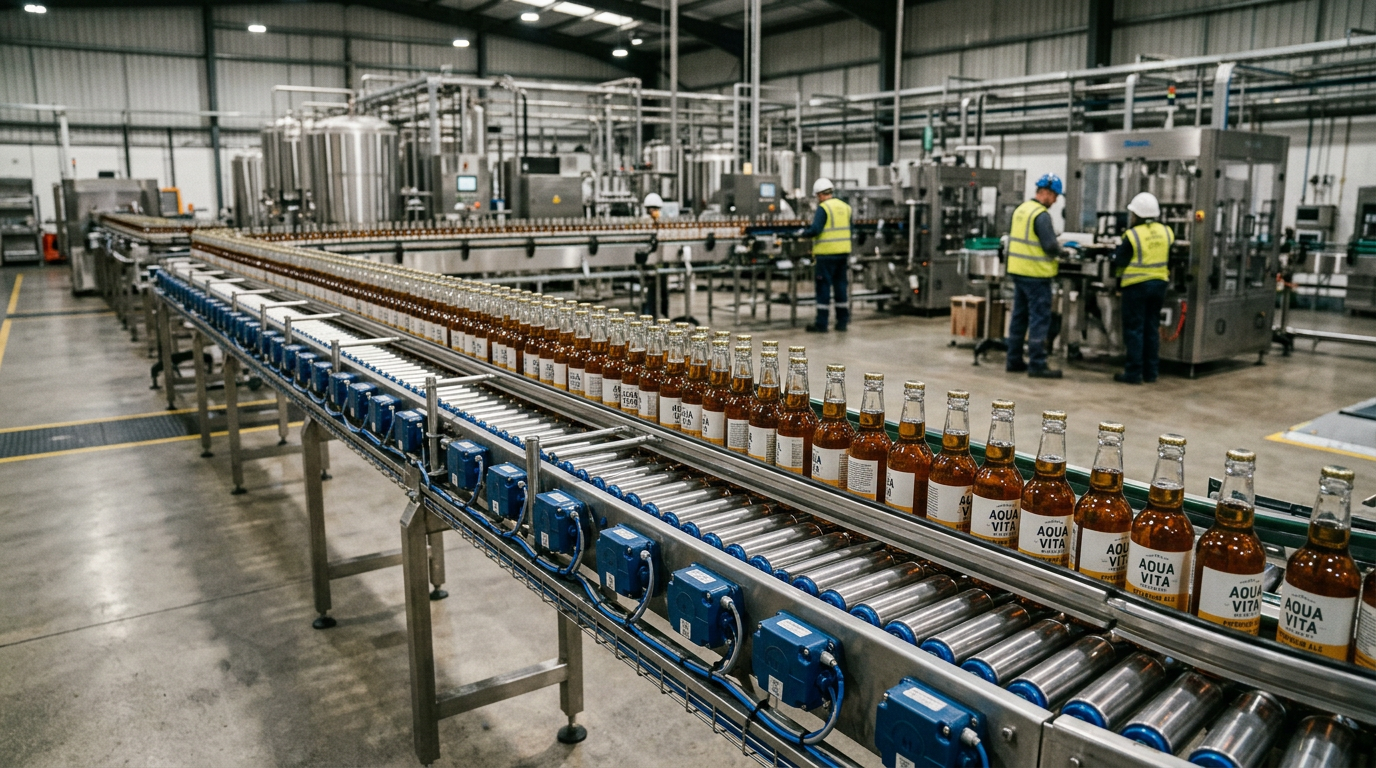
To optimize high-speed packaging lines, accumulation conveyors for buffer management must provide enough dwell time to absorb 110% of downstream downtime while preventing product damage through zero-pressure logic. By decoupling upstream processing from downstream packaging, these systems maintain line efficiency (OEE) even when individual machines encounter momentary stops for label rolls or film changes.
The Role of Accumulation in Packaging Efficiency
In a perfectly synchronized packaging line, every machine operates at the same speed. However, real-world production is prone to micro-stops. According to industry benchmarks for Overall Equipment Effectiveness (OEE), a typical packaging line may lose 5-15% of its potential output due to minor synchronization errors. Accumulation conveyors act as a physical "shock absorber," allowing the upstream filler or capper to continue running while a downstream palletizer or labeler is momentarily offline.
Selecting the right accumulation strategy depends on the product’s fragility, weight, and the required throughput. For instance, in the beverage industry, mass accumulation is common, whereas in pharmaceuticals, single-file zero-pressure accumulation (ZPA) is mandatory to prevent label scuffing or vial breakage.
Core Accumulation Technologies
There are three primary methods used to manage product buffering in modern facilities:
1. Zero-Pressure Accumulation (ZPA)
ZPA systems are designed so that products never touch one another. The conveyor is divided into "zones," each typically powered by a 24V DC Roller (MDR). When a zone is occupied and the downstream zone is full, the motor stops, keeping the products separated. This is critical for preventing "back pressure," which can crush light cardboard boxes or cause round containers to shingle (climb over each other).
2. Minimum Pressure Accumulation
These systems allow products to touch but use low-friction rollers or slipping-clutch mechanisms to minimize the force exerted on the products. This is often achieved through a continuously running drive chain that lightly engages the rollers. While cost-effective, they are not suitable for delicate items or high-speed applications where product orientation must be maintained.
3. Mass Flow Buffering (Bi-Directional Tables)
Common in bottling and canning, these large tables or wide modular belts allow products to move from a narrow single lane into a wide mass flow. When the downstream line stops, the table fills up. Some advanced designs use "First-In, First-Out" (FIFO) vertical buffers or spiral accumulators to save floor space while maintaining a strict product sequence.
Technical Comparison of Accumulation Methods
| Feature | Zero-Pressure (ZPA) | Minimum Pressure | Mass Flow Buffer |
|---|---|---|---|
| Product Contact | None (100% gap) | Light contact | High contact |
| Drive System | 24V DC MDR / VFD | AC Motor / Chain | Modular Belt / Multi-lane |
| Typical Efficiency | 98-99% | 85-90% | 95% |
| Energy Consumption | Low (Run-on-demand) | Medium (Continuous) | High (Massive load) |
| Maintenance | Low (Modular) | Moderate (Chain tension) | Moderate (Belt tracking) |
| Control Logic | Decentralized (AS-i/Ethernet) | Centralized | VFD Speed Matching |
Design Considerations for Buffer Management
When engineering a buffer system, the "accumulation length" is the most critical variable. A common rule of thumb is to provide enough buffer to cover the time it takes for a standard operator intervention—usually 3 to 5 minutes.
- Calculate Buffer Capacity: $Capacity = (Target Downtime in Minutes) \times (Units Per Minute)$.
- Back Pressure Calculation: In non-ZPA systems, back pressure increases linearly with the number of accumulated products. For
Easy Conveyors stocks the material handling discussed here — ready to ship across Europe.
heavy loads, this can exceed the structural limits of the conveyor frame or damage the product. 3. Modular Flexibility: Using a modular approach allows for future expansion. Easy Conveyors offers aluminum and stainless steel modules that can be reconfigured as line requirements evolve, which is particularly useful in high-growth e-commerce and FMCG sectors.
Integrating Controls and Sensors
Modern accumulation relies heavily on the integration of photo-eye sensors and decentralized control logic. The IEC 61131-3 standard provides the framework for the PLC programming used to manage these zones.
- Singulation Logic: The ability of the conveyor to release one product at a time with a specific gap for downstream scanners or check-weighers.
- Slug Release: Releasing all accumulated products simultaneously to quickly prime a downstream machine after a long stop.
- Dynamic Buffering: Using Variable Frequency Drives (VFDs) to adjust conveyor speed based on the "fill level" of the buffer, preventing abrupt starts and stops that cause mechanical wear.
Hygiene and Safety Standards
In food and pharmaceutical packaging, accumulation systems must comply with specific sanitary designs. Systems used in "wash-down" environments should adhere to EHEDG guidelines for cleanability. This includes using open-frame designs to prevent bacterial harbor points and ensuring all motors meet at least IP66 or IP69K ratings for water ingress protection.
Safety is equally paramount. Accumulation zones often involve moving parts that can create pinch points. According to ISO 13849-1, safety-related parts of control systems must be evaluated to ensure that an accumulation jam doesn't lead to a hazardous condition when an operator attempts to clear it manually.
Maintenance and Failure Modes
The most common failure point in accumulation systems is sensor misalignment or contamination. Dust in a packaging plant can coat the lens of a photo-eye, signaling a "false full" condition that shuts down the entire upstream line.
- Roller Wear: In MDR systems, the internal gearboxes of the motorized rollers have a finite life, typically 15,000 to 20,000 run-hours depending on the load.
- Drive Belt Tension: For systems using O-rings or poly-V belts to slave rollers together, improper tension leads to slipping, which disrupts the ZPA timing logic.
- VFD Soft-Start Tuning: Incorrectly tuned acceleration ramps can cause products to tip over during the transition from accumulation to transport mode.
Ensuring a robust preventive maintenance schedule—focused on "drum motor selection" for the right torque and "VFD soft-start tuning" for smooth transitions—is essential for long-term reliability. Engineers should also consider "hygienic wash-down design" early in the procurement phase if the system handles primary food packaging.
Future Trends: AI and Virtual Flow
The next generation of accumulation involves "virtual buffering," where software controls the speed of every individual conveyor in the plant to create gaps without needing physical accumulation space. However, for most high-volume packaging operations, physical buffer management remains the most reliable method to ensure consistent throughput and protect expensive downstream equipment. As Industry 4.0 matures, we expect to see more "smart zones" that can self-diagnose mechanical wear before a failure occurs, utilizing IO-Link sensors to monitor motor current and temperature in real-time.
Frequently Asked Questions
What is ZPA in conveyor systems?
ZPA stands for Zero-Pressure Accumulation. It uses sensors and zoned motors to ensure products never touch, preventing back-pressure and potential damage during buffering.
How much accumulation time do I need for a packaging line?
A buffer should ideally hold 3 to 5 minutes of production output. This provides enough time for operators to clear common minor faults like label jams or film roll changes without stopping the whole line.
Are MDR rollers better than traditional AC drives for accumulation?
MDR (Motorized Driven Roller) systems are more energy-efficient because zones only run when a product is present. They also offer higher safety due to low-voltage 24V DC operation.
Can accumulation conveyors be used in wash-down environments?
Yes, by using stainless steel frames, IP69K-rated motors, and EHEDG-compliant modular belts, accumulation systems can be safely used in high-care food and pharma zones.