Engineering Guide: Shaftless Screw Conveyors for Sludge and Biomass
Shaftless screw conveyors increase volumetric efficiency by up to 30% for sludge and biomass. Learn about spiral design, UHMWPE liners, and maintenance tips.
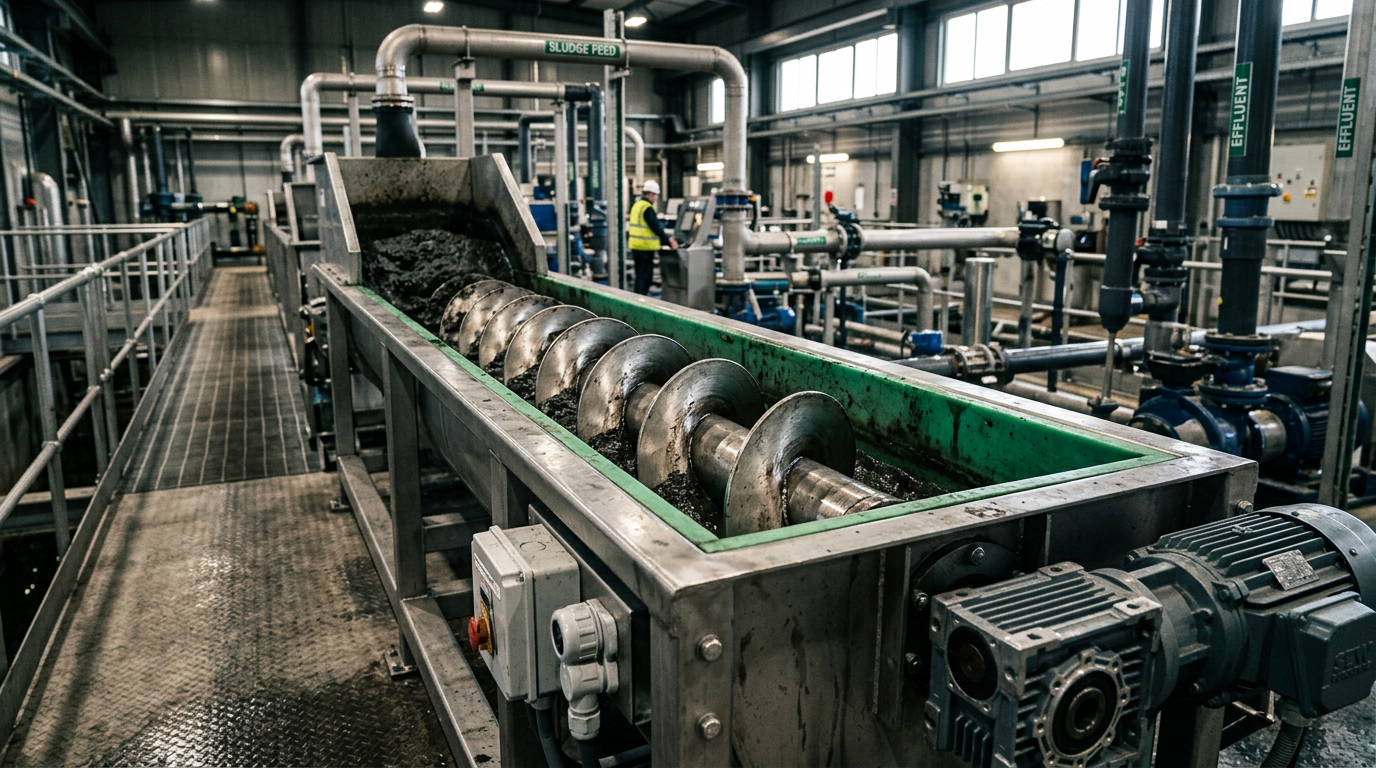
Shaftless screw conveyors operate at 20% to 30% higher volumetric efficiency compared to shafted designs when handling non-homogeneous materials like sludge and biomass, as the absence of a center pipe eliminates the risk of material wrapping and clogging. These systems utilize a high-strength spiral supported by a low-friction liner, typically made of Ultra-High Molecular Weight Polyethylene (UHMWPE), to move difficult, sticky, or stringy materials that would otherwise bridge or choke a conventional auger.
The Mechanics of Shaftless Conveying
Unlike traditional screw conveyors that rely on a central pipe to transmit torque and support the flights, shaftless screw conveyors—also known as spiral conveyors—feature a heavy-duty spiral driven from one end. The spiral is supported by a liner that sits at the bottom of a U-shaped trough. This design is governed by standards such as CEMA (Conveyor Equipment Manufacturers Association) guidelines for screw conveyors, though the shaftless variant offers unique advantages for specific industrial "difficult" materials.
The absence of a central shaft provides a larger cross-sectional area for material flow. In biomass handling, where wood chips, straw, or agricultural waste may contain large, irregular pieces, this open center prevents the "bottleneck" effect. In sludge handling, particularly in wastewater treatment plants (WWTP), the lack of internal bearings or hangers eliminates points where fibrous material can collect and cause mechanical failure.
Key Components and Design Specifications
To ensure long-term reliability in harsh environments, several engineering factors must be addressed during the design phase:
- The Spiral: Usually manufactured from high-yield carbon steel or stainless steel, the spiral must be cold-formed to maintain structural integrity. For biomass applications, high-torque spirals are required to overcome the internal friction of the material.
- The Liner: The liner is the primary wear part. It is often color-coded (e.g., a green wear layer over a red base layer) to provide a visual indication for maintenance teams that replacement is necessary. Materials like UHMWPE or specialized alloys are selected based on the abrasiveness of the sludge.
- The Drive Unit: Because torque is transmitted directly through the spiral, the drive end must be robust. Direct-coupled gearmotors are standard, often featuring IE3 or IE4 efficiency classes according to IEC 60034-30-1.
Comparison: Shafted vs. Shaftless Conveyors
| Feature | Shafted Screw Conveyor | Shaftless Screw Conveyor |
|---|---|---|
| Material Suitability | Dry, free-flowing, granular | Sticky, stringy, wet, sluggish |
| Internal Hanger Bearings | Required every 3-4 meters | Not required |
| Clog Risk | High (wrapping around shaft) | Very Low (open center) |
| Volumetric Efficiency | 15% - 45% (standard) | Up to 50% - 60% |
| Maintenance | Bearing lubrication/replacement | Liner inspection/replacement |
| Inclination Capability | High (up to vertical) | Moderate (steep |
Easy Conveyors stocks the material handling discussed here — ready to ship across Europe.
angles reduce capacity) |
Applications in Sludge and Biomass
Wastewater Treatment Sludge
Dewatered sludge is notoriously difficult to transport. It is adhesive, viscous, and often contains grit. Shaftless conveyors excel here because they can be totally enclosed to contain odors and prevent spills. The spiral’s "self-cleaning" action against the liner ensures that the trough does not fill with stagnant material, which is critical for meeting environmental safety standards.
Biomass and Waste-to-Energy
In biomass plants, fuel sources range from forest residues to municipal solid waste (MSW). These materials are often non-uniform. Easy Conveyors specializes in modular transport solutions that can be integrated with these specialized screw systems to create a seamless flow from the intake hopper to the boiler feed. The high torque capacity of shaftless spirals is essential when handling biomass that may contain tramp metal or large stones.
Sizing and Selection Criteria
Selecting the right shaftless conveyor requires an understanding of the material's "slug" behavior. The following parameters are critical:
- Trough Loading: For sludge, a 30% trough loading is common to prevent overflows.
- Rotational Speed: Lower RPMs (15-30 RPM) are preferred for abrasive materials to extend liner life.
- Torque Requirements: Biomass requires higher starting torque due to potential jamming. VFD (Variable Frequency Drive) soft-start tuning is highly recommended to manage these surges.
Maintenance and Wear Management
The primary failure mode in shaftless systems is liner wear. According to ISO 12824 (related to surface treatments and wear), selecting the right hardness for the spiral relative to the liner is essential. If the spiral is too hard, it may crack under fatigue; if too soft, it will wear prematurely.
Regular inspection intervals should be established every 2,000 operating hours to check the liner thickness. If the liner wears through to the trough, the structural integrity of the entire conveyor is compromised, leading to costly stainless steel repairs.
Environmental and Safety Considerations
Shaftless conveyors are inherently safer for handling hazardous biomass or bio-solids because they are easily sealed. This minimizes dust explosions—a significant risk in biomass handling—and ensures compliance with OSHA standards regarding combustible dust. Furthermore, the lack of intermediate hanger bearings reduces the risk of frictional heat buildup inside the material stream, which is a common fire trigger in dry biomass silos.
Integrating these conveyors into a larger plant often requires synchronization with downstream equipment. Whether it is feeding a centrifuge or a gasifier, the shaftless conveyor provides a metered, consistent flow that shafted designs struggle to maintain with non-uniform feedstock. For plant engineers, the trade-off is clear: higher initial capital expenditure for the spiral and liner is offset by significantly lower downtime and the elimination of complex internal bearing maintenance.
Frequently Asked Questions
Why are shaftless conveyors better for stringy materials?
Because there is no center shaft, stringy and sticky materials like dewatered sludge or wood fibers have nothing to wrap around, preventing the common 'bridging' or 'choking' seen in traditional augers.
How often should the UHMWPE liner be replaced?
The liner should typically be inspected every 2,000 to 4,000 operating hours. Most modern liners feature a dual-color wear indicator that shows when the primary wear surface has been depleted.
Can shaftless screw conveyors operate at steep inclines?
While possible, high-angle shaftless conveyors (above 30 degrees) suffer from significant 'fallback' of material. They are most efficient at inclines below 25 degrees unless specialized spiral pitches are used.
What materials are used for the spiral?
Common materials include carbon steel for general waste and 304 or 316 stainless steel for corrosive sludge or food-grade biomass applications to ensure longevity and chemical resistance.