Optimizing Shaftless Screw Conveyors for Sludge and Biomass Handling
Shaftless screw conveyors increase fill rates to 45% for sludge and biomass by eliminating the central shaft, preventing clogs and reducing maintenance in viscous applications.
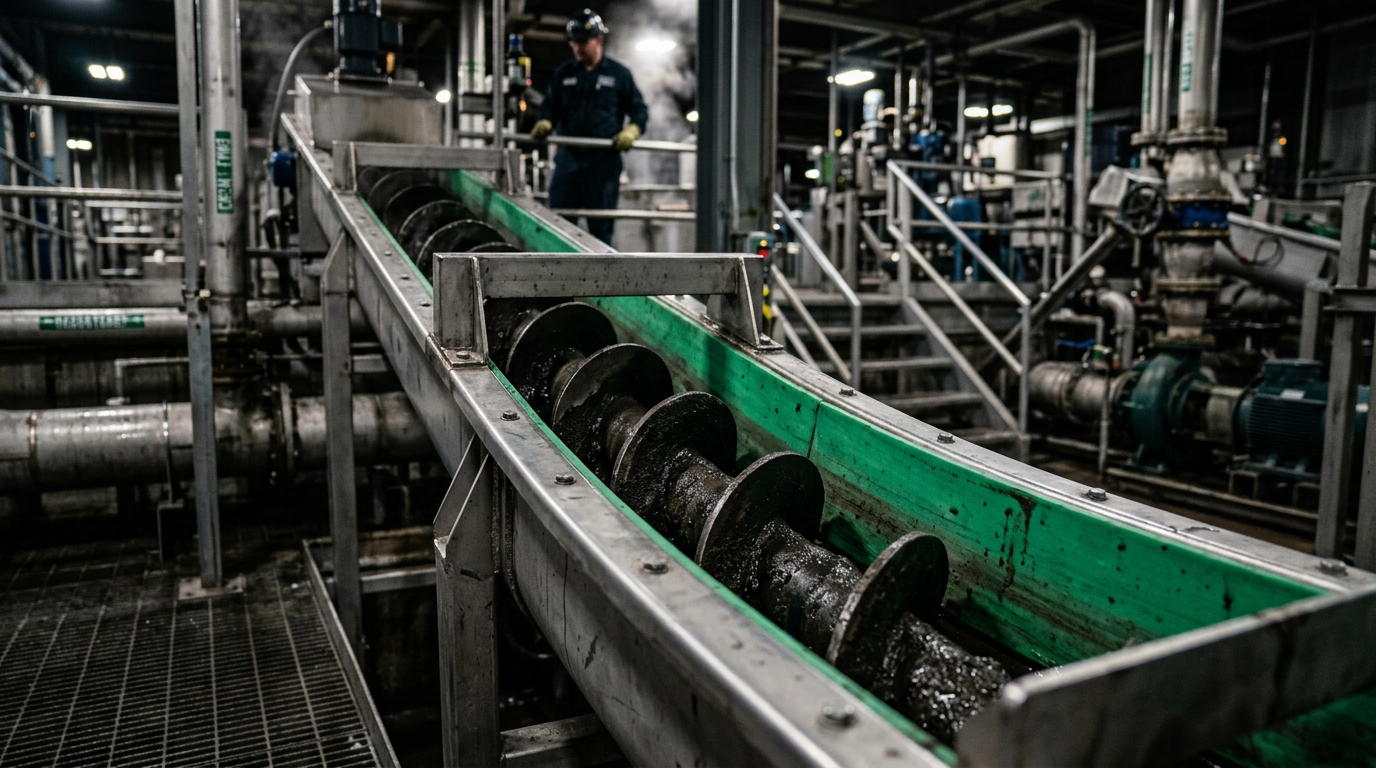
Shaftless screw conveyors operate at higher fill rates (up to 35-40%) compared to shafted variants (15-30%) because the absence of a central pipe allows for an unobstructed material flow path, making them the primary choice for transporting non-homogeneous, stringy, or highly viscous materials like dewatered sludge and biomass. By utilizing a high-strength spiral that rotates on a low-friction liner, these systems eliminate intermediate hanger bearings, which are the most common point of failure in traditional screw conveyors handling abrasive or wet materials.
Understanding Shaftless Screw Conveyor Design
The fundamental difference between a conventional screw conveyor and a shaftless system lies in the internal architecture. While a standard conveyor relies on a central pipe to support the flights, a shaftless conveyor uses a heavy-duty spiral (or helix) that is driven at one end and supported by a liner—typically made of Ultra-High-Molecular-Weight Polyethylene (UHMWPE)—along the bottom of the trough.
For sludge and biomass handling, this design solves two critical engineering hurdles:
- Elimination of Hanger Bearings: In shafted conveyors, hanger bearings are required every 3 to 4 meters to prevent the pipe from sagging. In sludge applications, these bearings become submerged, leading to rapid seal failure and material buildup.
- Increased Volumetric Capacity: The "empty" core of the shaftless spiral allows for a larger cross-sectional area of material, enabling the transport of larger particles or "slugs" of biomass that would otherwise wrap around a central shaft.
Easy Conveyors specializes in modular conveyor systems that integrate seamlessly with these bulk handling units, ensuring a smooth transition from primary sludge processing to secondary transport modules.
Performance Comparison: Shaftless vs. Shafted
| Feature | Shaftless Screw Conveyor | Shafted Screw Conveyor |
|---|---|---|
| Material Handling | Viscous, stringy, wet | Dry, free-flowing, granular |
| Efficiency Class | IE3/IE4 compatible | IE3/IE4 compatible |
| Fill Rate | 35% – 45% | 15% – 30% |
| Max Inclination | Up to 90° (vertical) | Typically < 30° |
| Maintenance Need | Low (Liner replacement only) | High (Hanger bearing service) |
| Trough Material | Stainless Steel (304/316) | Carbon or Stainless Steel |
Engineering Specifications for Sludge and Biomass
When sizing a shaftless conveyor for municipal or industrial sludge, engineers must account for the material's shear strength and moisture content. Sludge with a dry solids (DS) content of 20-30% behaves like a non-Newtonian fluid, requiring high torque at low RPMs (typically 15-25 RPM).
The Role of the Spiral
The spiral is the "heart" of the system. For biomass applications, these are often manufactured from cold-formed micro-alloy steel or stainless steel with high yield strength. According to ISO 12944, the choice of material and coating is critical for corrosion resistance in wastewater environments where hydrogen sulfide (H2S) is present.
Trough Liners and Wear Management
Since the spiral rests directly on the trough, the liner is the primary wear component. Materials such as UHMWPE or specialized multi-layered plastics (e.g., "Robalon") are used. The thickness of the liner (typically 10mm to 20mm) and its wear-indicator color coding allow maintenance teams to perform visual inspections without dismantling the unit.
Easy Conveyors stocks the material handling discussed here — ready to ship across Europe.
Key Advantages in Biomass Logistics
Biomass materials—ranging from wood chips and agricultural waste to poultry litter—are notoriously difficult to convey due to their irregular shapes.
- Non-Clogging Operation: Because there is no center pipe, stringy biomass fibers cannot wrap around the shaft. This reduces the risk of "plugging" at the inlet or discharge points.
- Odour and Dust Containment: Shaftless conveyors are typically fully enclosed with bolted or gasketed covers, adhering to OSHA safety standards for dust explosion prevention (ATEX zones) and odor control in urban treatment plants.
- Vertical Conveying: Shaftless spirals are highly effective for vertical lifting (up to 90 degrees) because the centrifugal force presses the material against the trough walls, creating a "plug flow" that moves the biomass upward without the fallback seen in shafted screws.
Maintenance and Failure Modes
While shaftless conveyors are marketed as low-maintenance, they are not "no-maintenance." The most common failure modes include:
- Liner Wear: If the liner wears through to the stainless steel trough, the entire trough may require replacement. Regular measurement of the liner thickness is essential.
- Spiral Compression: Under extreme loads, the spiral can compress axially. Designing for "end-play" and ensuring proper drive-end thrust bearing selection (according to NEMA standards) is vital.
- Torque Overload: Non-homogeneous biomass may contain large contaminants (stones, metal scrap). VFD soft-start tuning and torque-limiting couplings are recommended to prevent spiral permanent deformation.
System Integration and Automation
Modern sludge handling lines require tight integration with upstream equipment like centrifuges or belt filter presses. Utilizing Variable Frequency Drives (VFDs) allows the conveyor speed to be slaved to the discharge rate of the dewatering equipment. This prevents "surging" and ensures the conveyor operates within its optimal 35-40% fill range.
For engineers designing a complete facility, considering the "hygienic wash-down design" is necessary even in sludge applications to prevent the buildup of anaerobic bacteria during downtime. Modular components, including sensors for zero-speed detection and cover safety interlocks, should be integrated into the central PLC for real-time monitoring.
Conclusion
Shaftless screw conveyors represent a specialized solution for the toughest material handling challenges in the green energy and wastewater sectors. By removing the central shaft, these systems offer higher throughput, lower maintenance, and the ability to handle materials that would seize traditional conveying equipment. When combined with modern IE3 efficiency motors and robust UHMWPE liners, they provide a reliable, long-term solution for the circular economy's biomass and sludge processing needs.
Frequently Asked Questions
What is the purpose of the trough liner in a shaftless conveyor?
The liner is a sacrificial wear surface (usually UHMWPE) that protects the trough from the rotating spiral. It typically needs inspection every 6-12 months depending on the abrasiveness of the sludge or biomass.
How does the fill rate differ between shafted and shaftless conveyors?
Shaftless conveyors can operate at much higher fill rates (up to 45%) compared to shafted versions (15-30%) because the absence of a central shaft creates more internal volume for material flow.
Can shaftless screw conveyors handle vertical lifting?
Yes, shaftless conveyors are excellent for vertical applications up to 90 degrees. They use a 'plug flow' mechanism where the material fills the entire cross-section, preventing fallback.
What materials are typically used for sludge conveyor construction?
Common materials include 304 or 316 stainless steel for the trough and covers to resist corrosion, while the spiral is typically made from high-strength carbon steel or stainless steel alloys.