Shaftless Screw Conveyors for Sludge and Biomass Handling: Engineering Guide
Shaftless screw conveyors eliminate the central pipe to boost volumetric efficiency by 50% for sludge and biomass. Learn about liners, torque requirements, and maintenance.
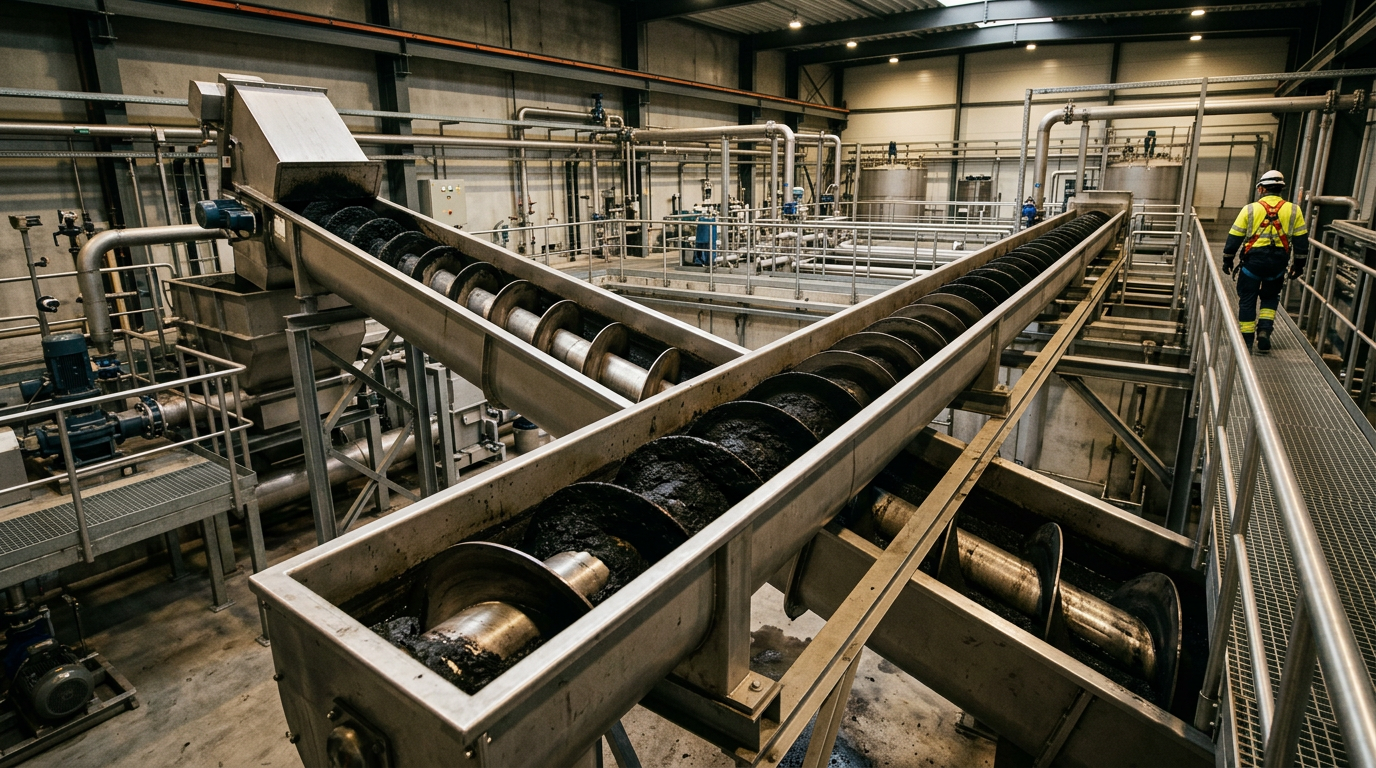
For handling non-homogeneous, high-moisture materials like wastewater sludge and forestry biomass, shaftless screw conveyors offer a volumetric efficiency increase of up to 50% compared to traditional shafted designs by eliminating the central pipe that typically restricts material flow. These systems rely on a heavy-duty, high-torque spiral (often manufactured from high-tensile carbon steel or 304/316 stainless steel) that rotates on a low-friction liner, allowing for the transport of "difficult" materials that would otherwise wrap around or clog a standard center shaft.
The Engineering Logic Behind Shaftless Design
In a conventional screw conveyor, the central shaft provides the structural support for the flights. However, when dealing with "sticky" materials like dewatered sludge or "stringy" materials like biomass chips, this shaft becomes a liability. Material tends to build up on the shaft, reducing the effective cross-sectional area and leading to "slugging" or complete blockages.
The shaftless screw conveyor, governed by CEMA (Conveyor Equipment Manufacturers Association) standards for screw design, replaces the shaft with a thicker, more robust spiral. This spiral is driven from one end and rests on a liner—typically made of Ultra-High Molecular Weight Polyethylene (UHMWPE)—which lines the bottom of a U-shaped or O-shaped trough. Because there is no center pipe, the conveyor can handle much larger particles and higher moisture contents without the risk of material bridging.
Key Components and Material Specs
| Feature | Specification / Detail |
|---|---|
| Spiral Material | High-tensile alloy steel (up to 250 HB hardness) or AISI 316 |
| Trough Liner | UHMWPE (standard), Ceramic (abrasive), or Xylethon® |
| Throughput Increase | 40% to 50% vs. shafted screws of same diameter |
| Max Incline | Up to 30° (standard); Vertical possible with specific design |
| Maintenance | Single-point lubrication; liner wear-strips are the only consumable |
Application in Sludge Handling
Wastewater treatment plants (WWTP) face significant challenges when moving dewatered sludge from centrifuges or filter presses to storage silos. The sludge is often thixotropic, meaning its viscosity decreases under stress, but it remains highly adhesive.
Shaftless conveyors are the industry standard for this application for several reasons:
- Total Enclosure: Unlike belt conveyors, shaftless screws are fully enclosed, which is critical for odor control and preventing the escape of hazardous gases (H2S).
- Horizontal-to-Vertical Transitions: Engineers can design systems that transition from a horizontal collection screw to a vertical lift screw using simple bolted flanges, saving significant floor space.
- No Hanger Bearings: Traditional screws require intermediate hanger bearings for long spans. In sludge handling, these bearings are notorious for clogging. Shaftless designs eliminate them entirely, allowing for continuous spans of up to 15-20 meters without intermediate support.
Biomass and Bulk Solids Challenges
In the renewable energy sector, biomass—including wood chips, agricultural waste, and pellets—presents a different set of challenges. Biomass is often abrasive and contains "oversized" contaminants like tramp metal or large stones.
The heavy-duty spiral of a shaftless conveyor is designed to withstand high torque loads and can often "swallow" large objects that would wedge themselves between a shaft and the trough wall in a standard conveyor. For high-capacity biomass lines, integrating modular systems can streamline the flow from the intake hopper to the boiler feed. For example, Easy Conveyors provides specialized modular conveyor solutions that can interface with these heavy-duty bulk handling units to ensure smooth transitions between primary processing and final packaging or sortation.
Liner Selection and Wear Management
The "consumable" heart of a shaftless screw is the liner. Since the spiral rests directly on the trough, the liner bears the weight and friction of the operation.
- UHMWPE Liners: Excellent for sludge and general biomass. They offer a low coefficient of friction and good chemical resistance.
- Two-Color Wear Indicators: Many modern liners use a dual-layer color system (e.g., green top, red base). When the green layer wears through, maintenance crews have a visual signal to schedule a liner replacement before the steel trough is damaged.
- High-Temperature Biomass: If the biomass is being moved directly from a dryer, liners must be upgraded to PTFE or specialized alloys to withstand temperatures exceeding 100°C.
Easy Conveyors stocks the material handling discussed here — ready to ship across Europe.
Sizing and Power Calculations
Sizing a shaftless screw for sludge requires understanding the "percent trough loading." For sludge and heavy biomass, a 30% to 45% loading factor is typically used to prevent over-torquing the drive.
The power requirement ($P$) is calculated based on the material's friction factor ($f_m$) and the conveyor's inclination. According to ISO 1050:1975 for screw conveyor dimensions, the torque required to start a screw under load can be 2.5 times the running torque, necessitating the use of high-efficiency IE3 motors and often VFDs (Variable Frequency Drives) for soft starts and speed modulation.
Maintenance and Failure Modes
While shaftless conveyors are marketed as "low maintenance," they are not "no maintenance."
- Spiral Elongation: Under extreme torque, the spiral can stretch over time. This is common in long horizontal runs. Engineers must check the clearance at the non-drive end annually.
- Liner Thinning: If the material is abrasive (like sand-laden sludge), the liner can wear unevenly. This leads to the spiral "walking" or vibrating, which can eventually fatigue the drive-end coupling.
- Seal Integrity: The drive end features a packing gland or mechanical seal. If handling liquid-heavy sludge, this seal must be checked for leakage to prevent damage to the gearbox.
Integrating sensors for "zero-speed" detection and trough-high-level switches is a standard safety requirement under OSHA 1910.212 to ensure operators are protected from the powerful rotational forces of the spiral.
Integrating with Automation Systems
Modern biomass and sludge plants are increasingly automated. Shaftless conveyors are easily integrated into a SCADA system using VFD soft-start tuning and load monitoring. If the VFD detects a spike in amperage, it can trigger a "reverse-pulse" to clear a potential jam before a mechanical failure occurs. This level of control is essential for unmanned operations in large-scale municipal or industrial plants.
Conclusion
Shaftless screw conveyors represent the optimal balance between high-volume throughput and mechanical simplicity for the world's most difficult materials. By removing the center shaft, they eliminate the primary point of failure in sludge and biomass handling, offering a robust, enclosed, and efficient transport mechanism that meets the rigorous demands of modern environmental and energy engineering.
Frequently Asked Questions
What is the main advantage of a shaftless screw over a shafted one?
Shaftless conveyors eliminate the central shaft, allowing for much higher volumetric filling and preventing 'stringy' or 'sticky' materials from wrapping around the pipe, which is a common failure point in shafted designs.
Can shaftless screw conveyors be used for vertical lifts?
While horizontal is most efficient, shaftless screws can handle inclines up to 30 degrees with standard configurations. For vertical lifts, a specialized high-speed design or a 'piggyback' series is required.
What is the best liner material for abrasive biomass?
UHMWPE (Ultra-High Molecular Weight Polyethylene) is the most common material due to its low friction and high abrasion resistance, though ceramic or hardened steel liners are used for highly abrasive biomass.
How do you monitor liner wear in a shaftless conveyor?
Wear is typically monitored using a dual-color liner system. When the top color wears away, a secondary color is exposed, signaling that the liner has approximately 20% life remaining and should be replaced.
Are shaftless screw conveyors suitable for odor control?
Yes, because they are fully enclosed troughs with bolted lids and gaskets, they are excellent at containing odors and moisture, making them ideal for municipal sludge applications.