Optimizing Shaftless Screw Conveyors for Sludge and Biomass Handling
Discover how shaftless screw conveyors solve the challenges of sludge and biomass handling with higher fill rates and low maintenance. Technical guide for engineers.
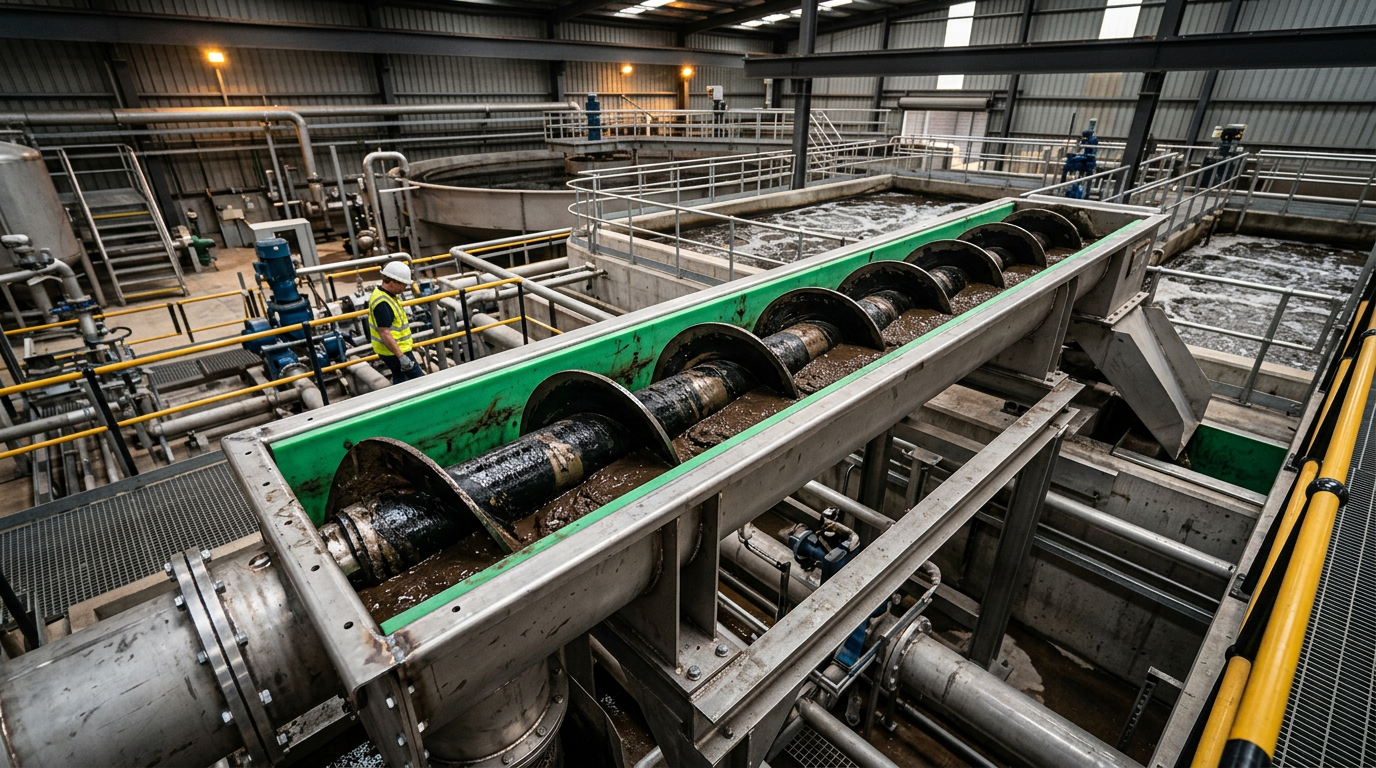
Shaftless screw conveyors operate with a fill rate typically between 30% and 45% for sludge handling, allowing them to transport high-viscosity, stringy, and non-homogeneous materials that would otherwise wrap around or clog a traditional center pipe. By replacing the central shaft with a high-strength, cold-formed spiral (flighting) that rests on a low-friction liner, these systems provide a clear longitudinal path for "difficult" materials like dewatered municipal sludge, screenings, and biomass feedstocks.
Critical Engineering Differences: Shafted vs. Shaftless
In a standard screw conveyor, the flighting is welded to a center pipe. While this provides structural rigidity, it creates a physical "dead zone" where sticky materials can accumulate. In biomass and wastewater applications, fibers and moisture-laden cakes tend to bridge across the shaft, leading to catastrophic "plugging."
The shaftless design eliminates this core. The spiral is driven from one end and remains "free" at the discharge end. This architectural shift allows for:
- Larger Volumetric Capacity: Without a center pipe, the conveyor can move higher volumes at lower RPMs, reducing wear.
- Elimination of Hanger Bearings: Traditional conveyors require intermediate bearings for long spans. In sludge handling, these bearings are points of failure. Shaftless units utilize a replaceable liner (usually UHMWPE) that supports the spiral along its entire length.
- Handling of Stringy Material: Rags, plastic strips, and long-fiber biomass can pass through the trough without wrapping around a central axle.
Material Selection for the Spiral and Liner
The spiral is the heart of the system. For sludge handling, it must possess high torsional strength to overcome the high starting torque of a packed trough. Most industrial spirals are manufactured from high-tensile carbon steel (e.g., 34CrNiMo6) or stainless steel (AISI 316) for corrosive environments.
The liner acts as the wear surface. According to ISO 15528 sampling principles for liquid and semi-solid materials, the consistency of sludge can vary wildly. Therefore, the liner must be robust. Common materials include:
- Ultra-High Molecular Weight Polyethylene (UHMWPE): The industry standard for low friction and decent wear resistance.
- Specialty Nylons: Used for high-temperature biomass applications.
- Hardened Steel Strips: Reserved for extremely abrasive materials like grit-heavy sludge.
| Feature | Shafted Screw Conveyor | Shaftless Screw Conveyor |
|---|---|---|
| Material Type | Free-flowing, dry powders | Sticky, wet, stringy, non-homogeneous |
| Max Fill Rate | 15% - 30% | 35% - 45% |
| Incline Capability | High (up to vertical) | Moderate (efficiency drops >30°) |
| Maintenance | Hanger bearing lubrication | Liner inspection/replacement |
| Power Efficiency | Higher (lower friction) | Lower (spiral slides on liner) |
Integration with Downstream Automation
In modern waste-to-energy and wastewater treatment plants, shaftless conveyors are rarely standalone units. They are integrated into a wider digital ecosystem. Most drives use IE3 or IE4 high-efficiency motors to meet IEC 60034-30-1 standards. For precise dosing of biomass into a boiler or anaerobic digester, these conveyors are often paired with Variable Frequency Drives (VFDs).
Engineers must accou
Easy Conveyors stocks the material handling discussed here — ready to ship across Europe.
nt for "start-under-load" conditions. Sludge can settle and harden during downtime. Therefore, the drive motor must be sized for high breakaway torque, often 200% of the nominal running torque. This is where Easy Conveyors provides critical insight, ensuring that while the modular components are standardized, the drive selection reflects the specific rheology of the material being moved.
Design Considerations for Biomass and Sludge
When designing a system, two factors supersede all others: torque and trough deflection.
1. Torque and Torsional Stress
The spiral is a long spring. When the conveyor starts, the spiral twists. If the material is too heavy or the spiral is too thin, the "spring" can over-compress or expand, causing it to rub against the trough covers. Engineers use a safety factor of at least 2.5x the maximum motor torque to select the spiral thickness.
2. Trough Liners and Wear Indicators
Liner wear is the primary maintenance concern. Many designs now include "two-color" wear indicators. A yellow top layer over a red base layer allows operators to visually inspect the liner depth through inspection ports. According to NEMA MG 1 standards for motor protection, torque sensors should also be used to trigger alarms if the liner wears through, causing metal-on-metal contact between the spiral and the trough.
Inclined Conveying Challenges
While shaftless units excel at horizontal transport, steep inclines present challenges. As the angle increases, material backflow (fallback) occurs because there is no center pipe to help "trap" the material against the flights. For inclines exceeding 25 degrees, engineers often specify "double-flighting" at the intake to increase the initial pressure and force the material upward.
Safety and Environmental Standards
Sludge and biomass often emit gases (H2S, methane) or create dust. All shaftless conveyors in these sectors must be fully enclosed. In the European Union, if the biomass is dry and dust-heavy, the system must comply with ATEX directives for explosive atmospheres. In North America, OSHA 1910.212 governs the general requirements for machine guarding, mandating that the trough be bolted shut during operation.
Failure Modes and Preventative Maintenance
The most common failure in a shaftless system is "spiral elongation." This occurs when the drive pulls the spiral so hard against a blockage that the pitch of the spiral permanently deforms.
- Prevention: Install zero-speed switches at the discharge and torque limiters on the drive shaft.
- Hygiene: In food-waste biomass applications, the system should include wash-down ports. While not as stringent as EHEDG guidelines for direct food contact, keeping the trough clean prevents the buildup of acetic acids that can corrode even high-grade stainless steels.
For further exploration of power transmission in heavy-duty handling, reviewing [VFD soft-start tuning] and [hygienic wash-down design] will provide a more comprehensive view of modern material handling requirements. Regular inspection of the liner remains the most cost-effective way to ensure a 20+ year lifespan for the conveyor trough.
Frequently Asked Questions
What is the typical fill rate for a shaftless screw conveyor?
A shaftless screw conveyor can typically handle a fill rate of 35% to 45%, compared to 15% to 30% for traditional shafted conveyors, due to the absence of a center pipe.
How long do the liners last in sludge applications?
Liner life depends on the abrasiveness of the material (e.g., grit content). In typical municipal sludge applications, a UHMWPE liner lasts 2 to 5 years before requiring replacement.
Can shaftless screw conveyors be used for vertical transport?
Yes, shaftless conveyors can operate vertically, but capacity decreases significantly. For inclines over 30 degrees, specialized spiral geometry and higher motor torque are required.
What are the main maintenance requirements?
The spiral is the only moving part and requires minimal maintenance. The primary tasks are checking the liner wear indicators and lubricating the main drive bearing housing.
Is a shaftless conveyor more energy efficient than a shafted one?
While shaftless designs handle non-homogeneous material better, they are slightly less power-efficient than shafted conveyors because the spiral must slide against the trough liner, creating friction.