Optimizing Shaftless Screw Conveyors for Sludge and Biomass Handling
Shaftless screw conveyors increase volume capacity by 50% for sludge and biomass. Learn how to optimize spiral design, liner selection, and torque management.
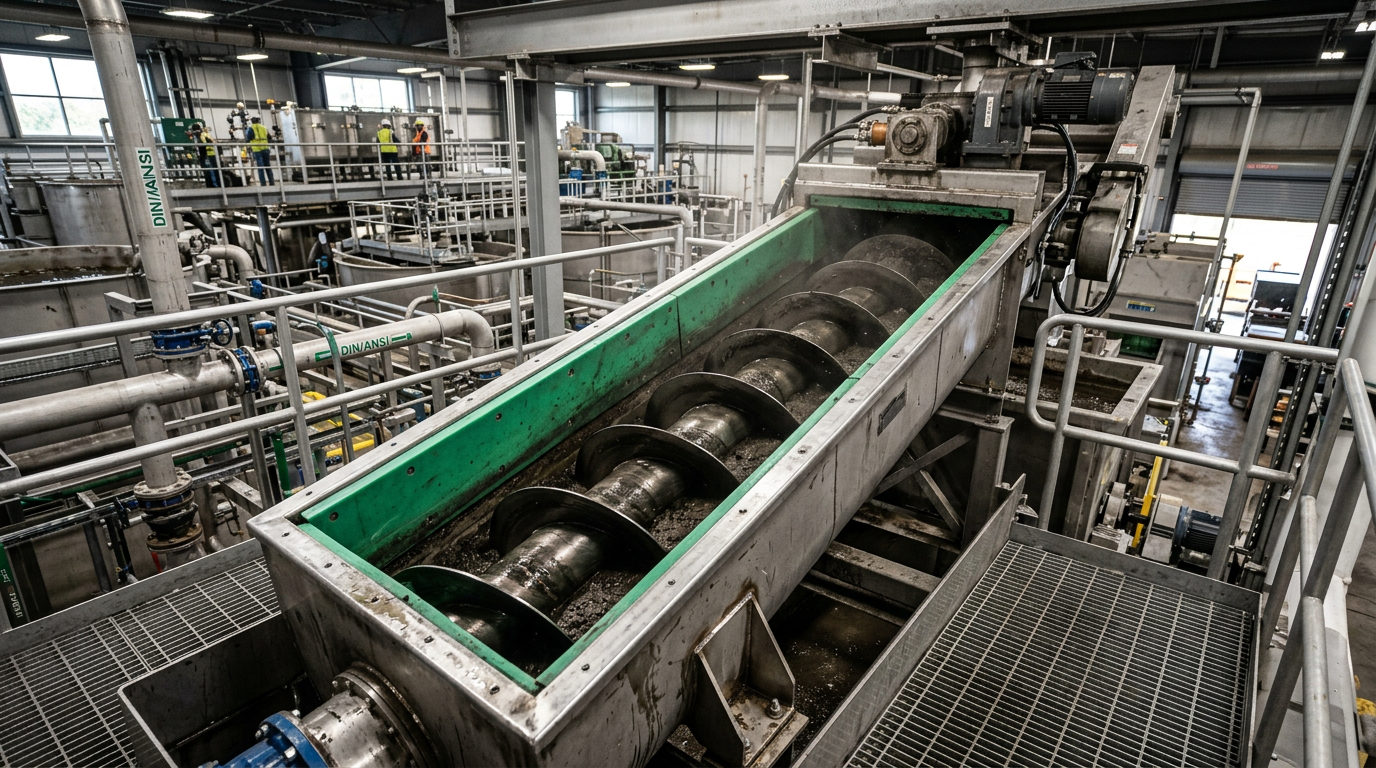
Shaftless screw conveyors represent the industry standard for transporting difficult, "non-free-flowing" materials, offering up to 50% more volume capacity than shafted alternatives by eliminating the central pipe that typically obstructs flow. These systems are specifically engineered to handle high-moisture sludge and heterogeneous biomass by utilizing a heavy-duty, high-torque spiral that rotates on a low-friction liner, effectively preventing material buildup and wrapping.
The Engineering Logic of Shaftless Design
In traditional screw conveyors, the central shaft serves as the structural backbone but also acts as a primary point of failure when dealing with sticky or fibrous materials. Sludge with high moisture content or biomass containing long-fibered organic matter tends to wrap around shafts, leading to "bridging" or "plugging" at hanger bearings.
The shaftless screw conveyor (also known as a spiral conveyor) solves this by using a cold-formed or hot-rolled spiral that is connected only at the drive end. The spiral rests directly on a liner—typically made of Ultra-High Molecular Weight Polyethylene (UHMWPE)—which lines the bottom of the U-trough. This design provides an open flow path, allowing for higher throughput of large-particle biomass and high-viscosity municipal sludge.
Advantages Over Shafted Systems
- Higher Filling Rates: Without a central shaft, the cross-sectional area available for material transport increases. While shafted screws usually operate at 15-30% trough loading, shaftless systems can often handle 35-45% loading for similar materials.
- Elimination of Hanger Bearings: Hanger bearings are the Achilles' heel of sludge handling. They create obstructions that lead to blockages. Shaftless systems remove these entirely, utilizing a continuous liner for support.
- Torsional Strength: Modern spirals are manufactured from high-strength carbon steel or stainless steel (304/316), designed to withstand high startup torques when dealing with settled sludge.
Critical Specifications for Sludge and Biomass
When selecting a conveyor for waste treatment or bioenergy plants, engineers must prioritize material compatibility and mechanical longevity.
| Feature | Sludge Handling (Dewatered) | Biomass Handling (Woodchips/MSW) |
|---|---|---|
| Spiral Material | High-tensile Alloy Steel | Hardened Carbon Steel |
| Trough Liner | UHMWPE (Work-hardening) | Ceramic or Bi-color HDPE |
| Typical RPM | 8 – 20 RPM | 20 – 45 RPM |
| Drive Configuration | Direct-coupled Gearmotor | Chain Drive or Direct (Heavy Duty) |
| Inclination Limit | Up to 30° (Standard) | Up to 45° (Special Flighting) |
Sludge Handling Nuances
For municipal wastewater treatment plants (WWTPs), the sludge is often dewatered to 15-30% dry solids. This cake-like substance is extremely adhesive. Shaftless conveyors are ideal here because the spiral acts as a moving floor, "scraping" the liner and preventing the material from rotating with the screw—a phenomenon known as "co-rotation" that kills efficiency in shafted designs.
Biomass and MSW Challenges
Biomass, including wood chips, pellets, or Municipal Solid Waste (MSW), is notoriously inconsistent. Large chunks or "stringy" contaminants can seize a shafted screw. The flexibility of a shaftless spiral allows it to deflect slightly to accommodate oversized particles, reducing the risk of catastrophic mechanical shear. For modular facilities looking to integrate these into broader sortation lines, working with a partner like Easy Conveyors ensures that the transition between spiral conveyors and standard modular belt systems is seamless and sensor-controlled.
Lining and Wear Protection
Since the spiral rotates directly on the trough, the liner is a sacrificial component. Most industrial applications utilize UHMWPE liners, often with a built-in wear indicator (a different colored bottom layer) to alert maintenance personnel when the liner thickness has decreased by 50-75%.
- Friction Management: A low coefficient of friction is vital for reducing power consumption.
- Thermal Limits: Standard UHMWPE is rated for continuous operation up to 80°C. For hotter biomass applications, specialized high-temp liners or ceramic tiles may be required.
- Chemical Resistance: Sludge can be acidic or highly alkaline depending on the treatment process (e.g., lime stabilization). Liners must be checked against ISO chemical compatibility charts to prevent swelling or degradation.
Easy Conveyors stocks the material handling discussed here — ready to ship across Europe.
Sizing and Power Calculation
Sizing a shaftless screw is not just about diameter; it is about torque. Because the spiral is only supported at one end, the "push" or "pull" forces are concentrated.
- Diameter Selection: Standard diameters range from 200mm to 600mm. For sludge, a slow-turning, larger-diameter screw is preferred to reduce wear.
- Motor Efficiency: Given the high torque requirements, IE3 or IE4 class motors are now standard in European installations to meet energy efficiency mandates.
- VFD Integration: Utilizing a Variable Frequency Drive (VFD) is mandatory. It allows for "soft-starts" to break the static friction of settled sludge and provides electronic torque limiting to protect the spiral from deformation during a jam. For more on drive parameters, see our guide on VFD soft-start tuning.
Vertical and High-Incline Transport
Shaftless conveyors excel in vertical transport (up to 90°) for sludge lifting. In these configurations, the centrifugal force holds the material against the trough wall, while the spiral "lifts" the column of sludge. However, vertical units require significantly more power and specialized "top-hang" bearing assemblies to manage the suspended weight of the spiral. For high-angle transitions, engineers should also evaluate modular belt selection for horizontal collection before feeding into a vertical spiral.
Maintenance and Failure Modes
While shaftless conveyors are marketed as "low maintenance," they are not "no maintenance."
- Liner Wear: This is the primary wear item. Inspection ports should be placed every 3 meters.
- Spiral Elongation: Over years of service, the spiral can permanently stretch (creep) under high load. If the end of the spiral begins to rub against the end-plate, it must be trimmed or replaced.
- Drive End Seals: Because sludge is often abrasive and pressurized, high-quality packing glands or mechanical seals are required to prevent leakage into the gearbox.
When designing a facility, ensure that the conveyor is part of a holistic material handling strategy. Integrating level sensors (ultrasonic or radar) at the discharge point prevents downstream backups that could over-torque the spiral.
Environmental and Safety Standards
In the EU and North America, sludge and biomass handling must often comply with ATEX (for explosive dust in biomass) or OSHA/CE safety standards. Shaftless conveyors are inherently enclosed, providing excellent odor control and preventing the release of pathogens or dust. The troughs are typically bolted with gasketed covers to maintain an airtight seal, making them a "best available technology" (BAT) for environmentally sensitive sites.
Frequently Asked Questions
How much more capacity does a shaftless screw provide?
Shaftless screws allow for 35-45% trough loading compared to 15-30% for shafted screws, as there is no central pipe obstructing the flow of material.
What is the best liner material for sludge handling?
UHMWPE is the most common liner material due to its low friction and work-hardening properties. For extremely abrasive or high-temperature materials, ceramic or specialized metallic liners are used.
Can shaftless screw conveyors operate vertically?
While horizontal is most efficient, shaftless conveyors can operate at 90 degrees (vertical) for sludge lifting, though power requirements increase significantly and filling rates decrease.
How often should the trough liner be replaced?
Liner thickness should be inspected every 6–12 months. Most operators replace liners when they reach 50% of their original thickness or when the wear-indicator color layer becomes visible.
Is ATEX certification necessary for biomass conveyors?
ATEX compliance is critical for dry biomass (wood dust/pellets) where explosive atmospheres can form. For wet sludge, ATEX is usually not required unless methane presence is a risk.
Sources & references
- [1]ISO 1050:1975 - Continuous mechanical handling equipment -- Screw conveyors -- Characteristics of conveyor screws
- [2]Screw conveyor - Wikipedia
- [3]Wastewater Treatment Systems and Automation
- [4]OSHA Technical Manual (OTM) - Section V: Chapter 1 - Conveyor Hazards
- [5]Industrial Automation for Mechanical Engineering and Plant Construction