Guide to Safety PLCs, Light Curtains, and SIL Ratings on Conveyor Lines
Learn how to integrate Safety PLCs and Type 4 light curtains to achieve SIL 3/PL e compliance on high-speed conveyor lines while optimizing muting functions.
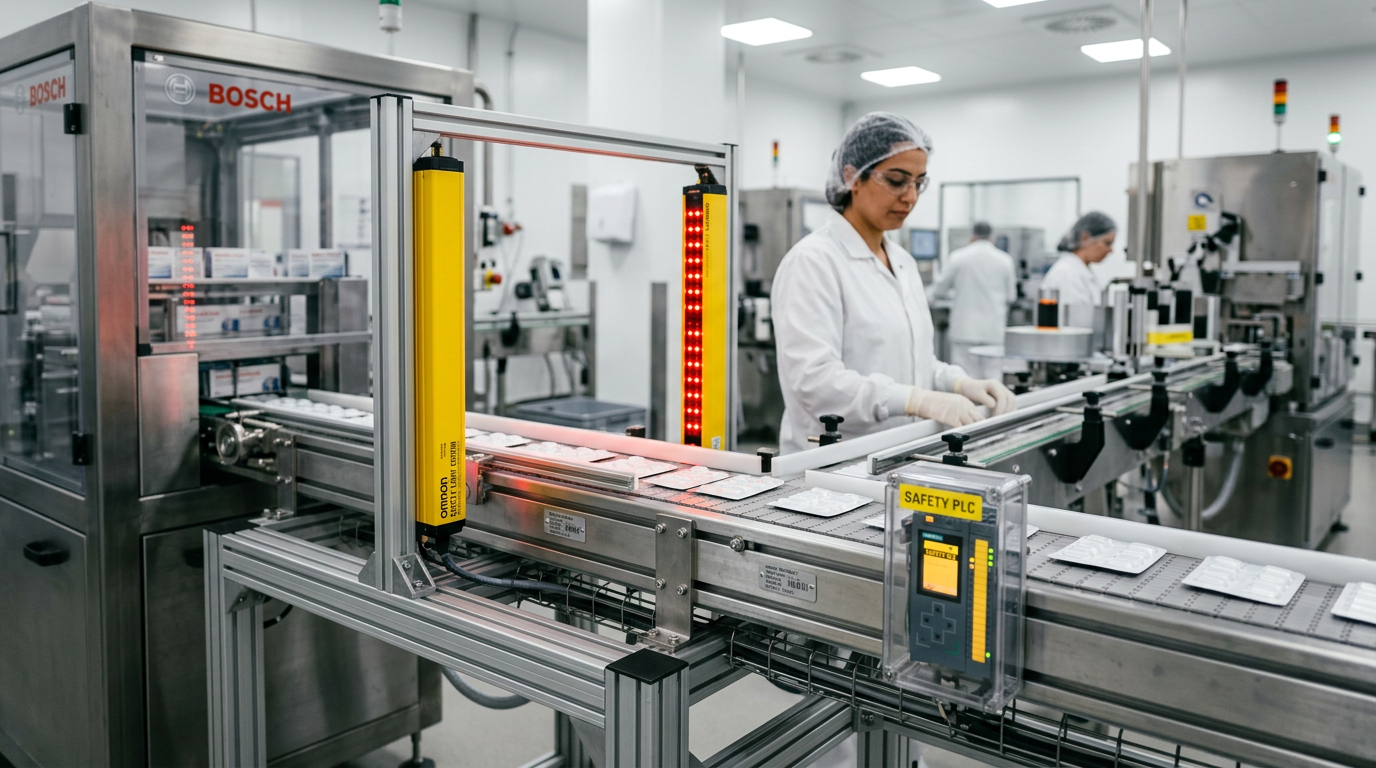
To achieve Safety Integrity Level 3 (SIL 3) or Performance Level e (PL e) on modern conveyor lines, engineers must implement a failsafe architecture that integrates safety PLCs with electro-sensitive protective equipment (ESPE), such as light curtains, maintaining a response time typically under 100ms. These systems ensure that any detected intrusion or hardware failure transitions the conveyor to a "safe state" by removing power from the drive actuators via redundant contactors or Safe Torque Off (STO) functions.
The Hierarchy of Conveyor Functional Safety
In the context of industrial automation, safety is no longer a bolt-on feature but a fundamental layer of the control architecture. Conveyor lines, particularly those involving high-speed sortation or heavy palletizing, present significant mechanical hazards. The governance of these systems falls under international standards such as ISO 13849-1 for Performance Levels (PL) and IEC 62061 for Safety Integrity Levels (SIL).
While standard PLCs handle the operational logic—sorting packages, managing throughput, and communicating with WMS—the Safety PLC is dedicated to monitoring safety-critical inputs. Unlike a standard controller, a safety PLC utilizes redundant microprocessors that perform "cross-checking." If a discrepancy occurs between the two processors, the unit triggers an emergency stop.
Key Differences: Standard vs. Safety PLCs
| Feature | Standard PLC | Safety PLC (SIL 3 / PL e) |
|---|---|---|
| Architecture | Single Channel | Redundant/Dual Channel |
| Diagnostics | Basic I/O monitoring | Internal self-testing & pulse testing |
| Failure Mode | May fail to "on" or "off" | Fails only to a defined "Safe State" |
| Software | Standard IEC 61131-3 | Certified safety function blocks |
| Communication | Standard Ethernet/IP, PROFINET | PROFIsafe, CIP Safety, Safety over EtherCAT |
Implementing Light Curtains for Perimeter Guarding
Light curtains, or electro-sensitive protective equipment (ESPE), serve as the primary interface between the physical environment and the safety logic. On conveyor lines, these are often used for "Point of Operation" guarding or "Perimeter Access" guarding.
According to IEC 61496, light curtains are classified into Types. Type 4 light curtains are mandatory for SIL 3 / PL e applications, offering high levels of fault tolerance and environmental resistance.
The Muting Paradox
One of the most complex aspects of conveyor safety is muting. Muting is the temporary, automatic suspension of a safety function to allow objects (like a pallet) to pass through the light curtain without tripping the E-stop, while still detecting a human presence. This requires precise timing and sensor placement, often using four sensors in a "cross-mating" or "sequential" pattern to differentiate between a rectangular pallet and a human body.
Understanding SIL Ratings and PL in Conveyor Design
When designing a modular system, such as those provided by Easy Conveyors, the risk assessment determines whether you need SIL 2 or SIL 3.
- SIL 1 (PL b/c): Low risk, minor injuries. Often sufficient for small, slow-moving tabletop conveyors.
- SIL 2 (PL d): Moderate risk, reversible injuries. Common for standard logistics conveyors.
- SIL 3 (PL e): High risk, permanent injury or death. Mandatory for robotic palletizing cells, high-speed sorters, and vertical lifters.
The SIL rating is not just about the component; it is about the Safety Function as a whole. This includes the sensor (input), the safety PLC (logic), and the motor starter/VFD (output). If you use a SIL 3 rated light curtain but connect it to a non-safety PLC, the entire loop defaults to a non-rated status.
Easy Conveyors stocks the industrial automation discussed here — ready to ship across Europe.
Safe Torque Off (STO) and Deceleration
Modern conveyor drives have evolved to support advanced safety functions. Instead of physically cutting power via bulky contactors—which can cause mechanical wear and tear—engineers now utilize Safe Torque Off (STO).
According to IEC 61800-5-2, STO ensures that no power can be sent to the motor to generate torque, preventing an accidental restart. In more sophisticated setups, Safe Stop 1 (SS1) is used. SS1 allows the VFD to ramp the conveyor down to a controlled stop before removing torque, which is critical for preventing "product pile-ups" or mechanical damage on high-inertia lines.
Wiring and Integration Best Practices
To maintain a high SIL rating, wiring must prevent "common cause failures." This is typically achieved through:
- Dual Channel Wiring: Running two separate signals for a single E-stop button.
- Pulse Testing: The safety PLC sends a brief "off" signal (too fast to affect the hardware) to ensure there isn't a short circuit to a 24V power supply.
- Separation of Concerns: Keep safety I/O in distinct, clearly labeled terminals, often colored yellow to distinguish them from standard automation components.
Common Failure Modes in Conveyor Safety
- Sensor Misalignment: Vibrations from the conveyor can cause light curtains to fall out of alignment, leading to nuisance trips.
- Muting Failure: Incorrectly positioned muting sensors may allow a human to "piggyback" behind a pallet.
- Bypassing: The most dangerous failure occurs when operators intentionally bypass safety interlocks to clear jams quickly. Modern safety PLCs track "reset frequency," which can help identify areas where operators are struggling with frequent jams, indicating a need for better "conveyor jam sensing logic" or mechanical adjustment.
The Role of Safety over Network Protocols
Traditionally, safety required miles of yellow hard-wiring. Today, protocols like PROFIsafe and CIP Safety allow safety data to ride on the same Ethernet cable as standard control data. This reduces installation costs and provides significantly more diagnostic data. For instance, a safety PLC can report exactly which beam of a light curtain was broken, allowing for faster troubleshooting on large-scale material handling systems.
When selecting components for a new facility, engineers should prioritize "VFD soft-start tuning" and "hygienic wash-down design" alongside their safety architecture to ensure that safety measures do not compromise equipment longevity or sanitation requirements in food-grade environments. Proper integration of these systems ensures that the conveyor line is not only productive but compliant with the strictest global safety mandates.
Frequently Asked Questions
What is the main difference between a standard PLC and a Safety PLC?
A standard PLC handles process logic and can fail in an unsafe 'on' state. A Safety PLC uses redundant processors and self-diagnostics to ensure any internal failure triggers a 'Safe State' (emergency stop).
What is the difference between muting and blanking in light curtains?
Muting is the temporary, automatic bypass of a light curtain to allow goods (like pallets) to pass while still protecting humans. Blanking is the permanent deactivation of specific beams in a light curtain to accommodate a fixed machine part.
How does a SIL rating relate to a Performance Level (PL)?
SIL (Safety Integrity Level) is defined by IEC 62061 and ranges from 1 to 4, while PL (Performance Level) is defined by ISO 13849 and ranges from a to e. Generally, SIL 3 is equivalent to PL e.
What is STO (Safe Torque Off) and why is it used on conveyors?
Safe Torque Off (STO) is a functional safety feature in VFDs that prevents the motor from generating torque. It allows the drive to remain powered while ensuring the motor cannot rotate, facilitating faster restarts than a full power disconnect.