Implementing Safety PLCs, Light Curtains, and SIL Ratings on Conveyors
Learn how Safety PLCs, light curtains, and SIL ratings protect modern conveyor lines. A deep dive into ISO 13849-1, SIL 3 compliance, and safe motion control.
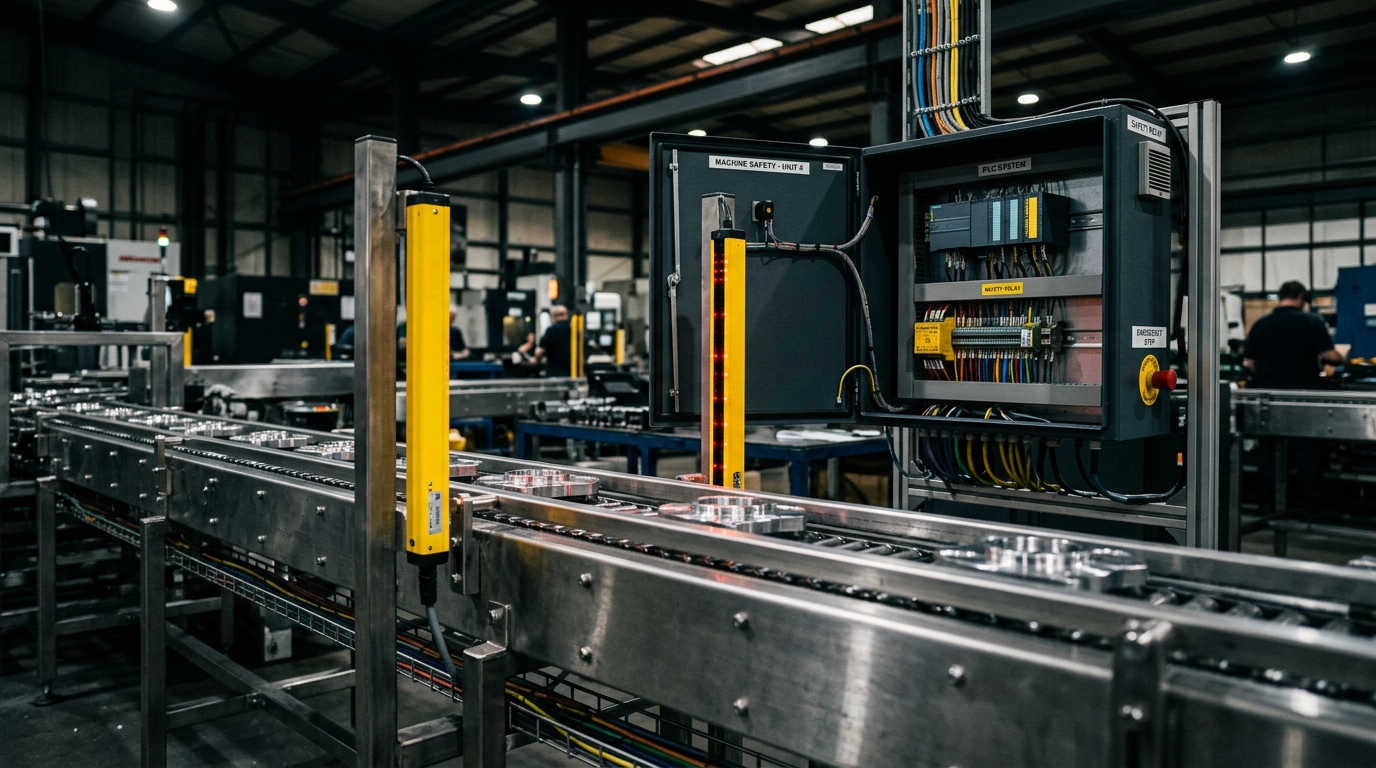
Designing safety systems for industrial conveyor lines requires achieving a Performance Level (PL) or Safety Integrity Level (SIL) that corresponds to the risk assessment, typically requiring SIL 2 or SIL 3 ratings for high-speed sortation and heavy-load palletizing environments. By integrating safety PLCs with optoelectronic protective devices like light curtains, engineers can reduce "Probability of Failure per Hour" (PFH) to less than 10⁻⁷, ensuring fail-safe operation in accordance with international safety standards.
The Architecture of Conveyor Safety Systems
Modern material handling relies on a layered approach to risk mitigation. While mechanical guards provide physical separation, automated systems require dynamic intervention. This is where the Safety PLC (Programmable Logic Controller) serves as the "brain," processing inputs from devices like E-stops, interlocks, and light curtains to execute a safe state—usually a Category 0 or Category 1 stop as defined by IEC 60204-1.
The primary advantage of a safety PLC over traditional hard-wired safety relays is its ability to handle complex logic. For instance, in a multi-zone conveyor system, a safety PLC can perform "zonal stopping." If a worker breaches a light curtain in Zone A, the PLC can bring Zone A to a controlled halt while allowing Zone B and C to continue at a reduced speed, maximizing uptime without compromising safety.
Understanding SIL and PL Ratings
When selecting components for a conveyor line, engineers must navigate two primary functional safety standards: EN ISO 13849-1 (Performance Levels a-e) and IEC 62061 (Safety Integrity Levels 1-3).
| Feature | Performance Level (PL) | Safety Integrity Level (SIL) | Application Type |
|---|---|---|---|
| Standard | ISO 13849-1 | IEC 62061 | Both are widely accepted |
| Logic | Category B, 1, 2, 3, 4 | SIL 1, 2, 3 | Architecture-based vs. Probability-based |
| Risk Metrics | MTTFd (Mean Time to Dangerous Failure) | PFHd (Prob. of Dangerous Failure/Hour) | Quantitative Reliability |
| Conveyor Usage | Most common for discrete machinery | SIL 3 | Complex, high-risk automation cells |
Light Curtains: Selection and Placement
Light curtains (AOPDs - Active Optoelectronic Protective Devices) are essential for palletizing and de-palletizing zones where physical fencing is impractical. To ensure these devices provide adequate protection, two factors are critical: Resolution and Safety Distance.
- Resolution: This refers to the spacing between the infrared beams. For finger detection, a resolution of 14mm is required; for hand detection, 30mm is standard. For conveyor access points where only body entry is a concern (e.g., pallet entry), larger resolutions are used.
- Safety Distance (S): Calculated using the formula
S = (K × T) + C, where K is the approach speed of the human body (usually 1600mm/s or 2000mm/s), T is the total response time of the system, and C is the additional distance based on the light curtain's resolution (ISO 13855).
Muting and Blanking in Conveyor Systems
A common challenge in conveyor automation is allowing products to pass through a light curtain without triggering a stop, while still detecting a human. This is achieved through Muting. Muting sensors (typically inductive or ultrasonic) detect the specific profile of a pallet. When the sensors recognize the load, they temporarily suspend the light curtain's safety function.
Refining these sequences requires precise timing and logic, often handled by the safety PLC to prevent "cheating" the system. For complex transitions, working with an experienced partner like Easy Conveyors ensures that the mechanical conveyor modules are pre-engineered to accommodate the mounting of these sensors and curtains at the correct heights and distances.
Easy Conveyors stocks the industrial automation discussed here — ready to ship across Europe.
Safety PLCs vs. Standard PLCs
A standard PLC is designed for process control; a safety PLC is designed for failure detection. Inside a safety PLC, processors are redundant (dual-channel) and constantly "cross-check" each other.
- Self-Diagnostics: Safety PLCs perform internal tests on their RAM, CPU, and clock cycles every few milliseconds.
- Pulse Testing: The PLC sends "test pulses" to input devices like light curtains to detect short circuits or "stuck-on" conditions in the wiring.
- Certified Software: Unlike standard ladder logic, safety logic utilizes certified function blocks (e.g., "E-Stop," "Two-Hand Control") that cannot be easily altered or bypassed by unauthorized personnel.
In high-speed sortation centers, integrating safety PLCs with VFD soft-start tuning techniques ensures that when a safety event occurs, the system doesn't just cut power (which could cause mechanical damage or load shifts) but performs a "Safe Torque Off" (STO) or "Safe Stop 1" (SS1) procedure.
Implementing Safe Motion Control
Legacy conveyor systems relied on cutting main power via a contactor. Modern systems utilize Safe Motion features integrated into the motor drives.
Safe Torque Off (STO)
STO is the most common safety function in drives. It electronically prevents the drive from generating torque in the motor. This is a SIL 3 / PL e rated function that eliminates the need for expensive and wear-prone dual-safety contactors.
Safe Speed Monitor (SSM) and SLS
In maintenance modes, it is often necessary for the conveyor to move while a technician is nearby. By using Safely-Limited Speed (SLS), the safety PLC ensures the motor does not exceed a predefined velocity (e.g., < 250mm/s). If the drive detects an overspeed, the safety system immediately initiates an emergency stop. This is a critical component of hygienic wash-down design protocols in food plants, where conveyors must be jogged slowly during sanitation.
Common Failure Modes and Maintenance
Even the most advanced SIL 3 system can fail if improperly maintained. In conveyor environments, external factors often degrade safety integrity:
- Alignment Drift: Vibration from heavy loads can cause light curtain transmitters and receivers to fall out of alignment, leading to "nuisance trips."
- Contamination: Dust in e-commerce hubs or moisture in food processing can block infrared beams. Selecting devices with high IP ratings (IP67 or IP69K) and integrated heating elements is vital.
- Bypassing: The "human element" often leads to operators taping over sensors or jumping out safety relays to meet production quotas. Safety PLCs mitigate this by logging every safety event, providing an audit trail that standard relays cannot offer.
Integrating these systems into a holistic design—from the initial drum motor selection to the final light curtain commissioning—ensures that the conveyor is not just a tool for throughput, but a secure environment for the workforce. Proper adherence to NEMA and IEC standards ensures global compliance and protects the enterprise from liability and downtime.
Frequently Asked Questions
What is the difference between SIL and PL in conveyor safety?
SIL (Safety Integrity Level) is defined by IEC 62061 and uses a probability-based approach, while PL (Performance Level) is defined by ISO 13849-1 and is architecture-based. For most conveyor lines, both are equivalent, with PL d/e corresponding roughly to SIL 2/3.
How does 'muting' work on a conveyor light curtain?
Muting is a temporary, automatic suspension of a safety function (like a light curtain) during a specific part of the machine cycle, such as a pallet passing through. It requires at least two independent sensors to ensure a human cannot trigger the muting sequence.
How do I calculate the safety distance for a light curtain?
Calculation is based on ISO 13855: S = (K x T) + C. You must account for the PLC's scan time, the drive's braking time, and the light curtain's response time to ensure the conveyor stops before a person can reach the hazard.
Can I use a standard PLC for safety functions if the logic is the same?
An standard PLC lacks the internal redundancy and self-diagnostic features required by industrial standards. Using a standard PLC for safety functions is a violation of OSHA and IEC regulations and can lead to catastrophic failure without warning.
How often should conveyor safety systems be tested?
At minimum, light curtains should be inspected monthly for alignment and beam strength. Safety PLC error logs should be reviewed weekly to identify 'nuisance trips' that might indicate a failing sensor or deliberate bypassing by staff.