Optimizing Safety PLCs and Light Curtains for SIL-Rated Conveyor Lines
Master Safety PLCs, SIL ratings, and light curtain integration for conveyor lines. Learn about STO, muting logic, and safety distance calculations to ISO standards.
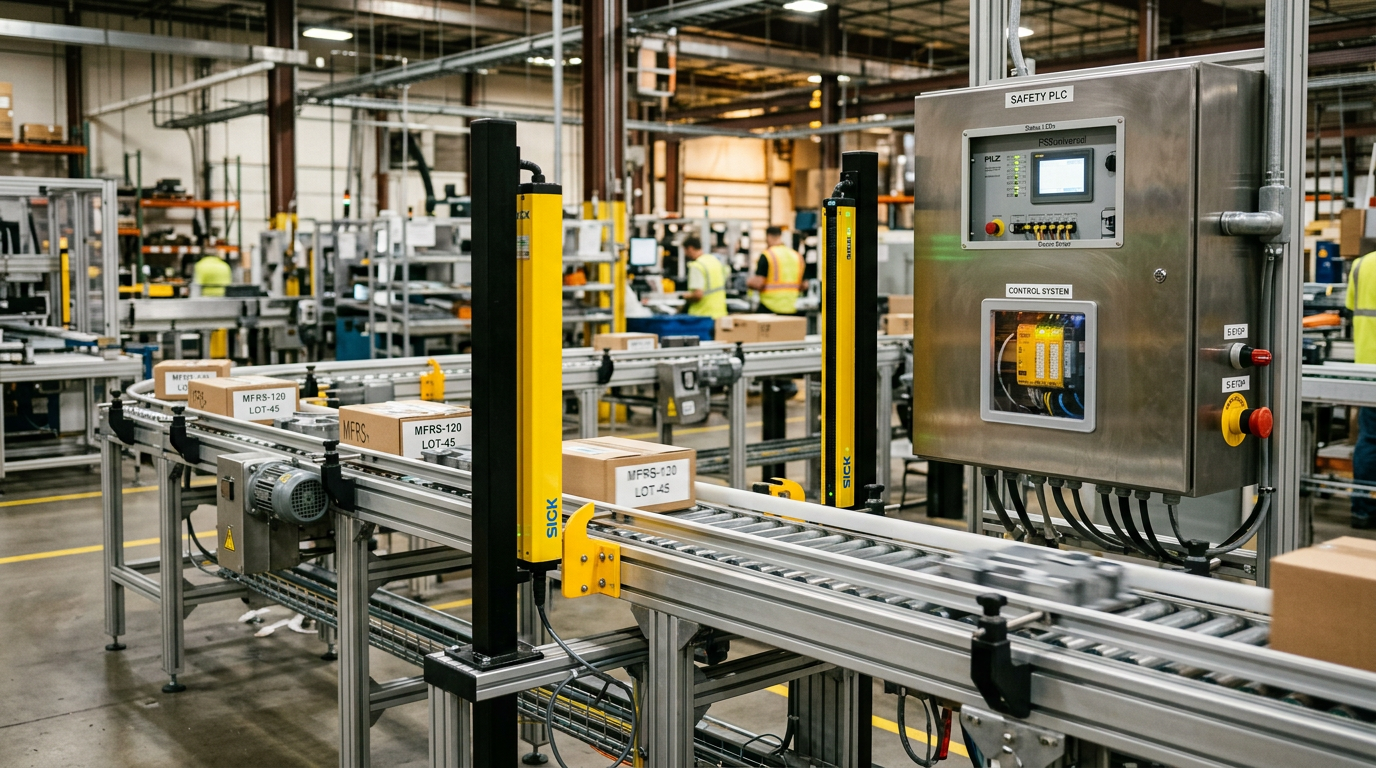
In modern automated material handling, achieving high-level machine safety requires integrating Safety PLCs and light curtains to meet Safety Integrity Levels (SIL) 2 or 3, as defined by IEC 61508, ensuring that a single component failure does not lead to a loss of safety functions. For high-speed conveyor lines, the rule of thumb is a response time under 100 milliseconds for the entire safety chain—from light curtain interruption to the VFD-enabled STO (Safe Torque Off) engagement—to prevent injury in zones where human-machine interaction is frequent.
The Architecture of Conveyor Safety Systems
The transition from traditional hard-wired safety relays to integrated Safety PLCs has revolutionized how engineers manage risk on long, complex conveyor networks. While a standard PLC manages the operational logic of the line—sorting, indexing, and speed control—the Safety PLC operates as a dedicated processor designed with redundant internal monitoring and "fail-safe" logic.
Safety PLCs are categorized by their ability to detect internal faults and maintain a safe state. In conveyor applications, these systems typically adhere to ISO 13849-1 Performance Levels (PL) or IEC 61508/62061 SIL ratings.
Why SIL Ratings Matter
The Safety Integrity Level (SIL) is a measure of the reliability and risk reduction provided by a safety function.
- SIL 1: Low risk; partial protection for simple conveyor segments.
- SIL 2: Moderate risk; typical for standard production lines where minor injuries could occur.
- SIL 3: High risk; required for robotic palletizing cells or conveyors where high-speed mechanical hazards are present.
Most modern modular systems, such as those provided by Easy Conveyors, are designed to be easily integrated into SIL 2 or SIL 3 environments by utilizing standardized mounting points for safety hardware and bus-ready motor controllers.
Optical Protection: Light Curtains and Muting
Light curtains serve as the "virtual fence" of a conveyor system. Unlike physical guarding, they allow for seamless product flow while protecting personnel. However, simply installing a light curtain is insufficient; the system must distinguish between a pallet of goods and a human limb.
Muting vs. Blanking
To maintain throughput without triggering false stops, engineers employ two primary techniques:
- Muting: The temporary, automatic suspension of the safety function. This is achieved using additional "muting sensors" (often photoelectric) that detect the specific shape and timing of a product. If the sensors are triggered in the correct sequence, the Safety PLC allows the product to pass through the light curtain without stopping the line.
- Blanking: The permanent or dynamic deactivation of specific beams within the light curtain. Fixed blanking is used when a conveyor rail or motor housing permanently obstructs the beams.
Safety Distance Calculations
The placement of light curtains must follow strict mathematical formulas to ensure the conveyor stops before a person can reach the hazard. According to ISO 13855, the safety distance ($S$) is calculated as: $S = (K \times T) + C$ Where $K$ is the approach speed of the human body, $T$ is the total system response time (including the Safety PLC and the motor's braking time), and $C$ is the "reach-in" distance.
| Component Type | Typical SIL Capacity | Response Time (ms) | Industrial Standard |
|---|---|---|---|
| Safety Relay | SIL 1-2 | 10–30 | ISO 13849-1 |
| Safety PLC | SIL 3 | 5–15 | IEC 61508 |
| Type 2 Light Curtain | SIL 1-2 | 20–50 | IEC 61496-1 |
| Type 4 Light Curtain | SIL 3 | 10–25 | IEC 61496-2 |
| VFD with STO | SIL 3 | <10 | IEC 61800-5-2 |
Easy Conveyors stocks the industrial automation discussed here — ready to ship across Europe.
Integrating Safety with Drive Technology
Modern conveyor automation relies heavily on Variable Frequency Drives (VFDs) with integrated safety functions. The most critical of these is Safe Torque Off (STO). When a light curtain is breached, the Safety PLC sends a signal to the VFD to cut power to the motor's power transistors. Crucially, STO does not disconnect the VFD from the main supply; it prevents the motor from generating torque, allowing for a faster restart once the safety zone is cleared.
For sophisticated applications, engineers may implement Safe Stop 1 (SS1), where the VFD actively brakes the conveyor to a standstill before engaging STO, or Safely Limited Speed (SLS), which allows the conveyor to run at a reduced, non-hazardous speed during maintenance or jams. Selecting the right motor controller is as vital as "drum motor selection" or choosing the correct "VFD soft-start tuning" parameters for heavy-load startups.
Failure Modes and Systematic Robustness
A common failure in conveyor safety is "nuisance tripping," often caused by improper sensor alignment or electromagnetic interference (EMI). To mitigate this, high-quality safety systems utilize:
- OSSD Signals: Output Signal Switching Devices (OSSDs) use pulsed signals to detect short circuits or "cross-talk" between safety channels.
- Redundancy: Using two separate channels for every safety signal ensures that a single wire break or contact weld does not disable the E-stop functionality.
- Hygienic Design: In food and pharma sectors, light curtains must meet IP69K ratings to withstand high-pressure washdowns without fogging or electrical failure, similar to "hygienic wash-down design" standards for conveyor frames.
Commissioning and Validation
The final stage of deploying a safe conveyor line is the validation process. This involves "fault injection testing"—deliberately inducing errors (such as disconnecting a sensor or shorting a signal) to prove the Safety PLC reacts correctly. Every safety function must be documented in a safety matrix, mapping every input (light curtain, E-stop, pull-wire) to its corresponding output (motor STO, brake engagement, indicator pilot lights).
Safety is not a bolt-on feature; it is an intrinsic part of the automation architecture. By combining certified Safety PLCs with correctly positioned Type 4 light curtains, manufacturers can achieve maximum throughput with zero compromises on worker safety. Referencing NEMA industrial standards for enclosure protection and VDMA guidelines for machine safety will ensure your system remains compliant throughout its operational lifecycle.
Frequently Asked Questions
What is the difference between SIL 2 and SIL 3 for conveyors?
SIL 2 is generally sufficient for standard conveyors with automated sorting, while SIL 3 is mandatory for hazardous robotic loading zones or high-speed machinery where the risk of severe injury is high.
Can I use a Type 2 light curtain for a SIL 3 safety function?
A Type 2 light curtain is lower cost and suitable for SIL 1/2 (lower risk), while a Type 4 light curtain provides higher fault detection, redundancy, and is required for SIL 3 applications.
Why is STO preferred over a standard motor stop?
Safe Torque Off (STO) is a safety function that ensures a motor cannot generate torque. It is safer than a standard stop because it is hardware-certified to prevent unexpected restarts even if the control logic fails.
How do muting sensors prevent the conveyor from stopping for products?
Muting requires at least two independent sensors to detect the product. In a 'T-muting' setup, sensors are placed on both sides of the curtain to confirm a valid object is passing through in a specific timeframe.
Sources & references
- [1]IEC 61508-1:2010 Functional safety of electrical/electronic/programmable electronic safety-related systems
- [2]ISO 13849-1:2023 Safety of machinery — Safety-related parts of control systems
- [3]IEC 61496-1:2020 Electro-sensitive protective equipment
- [4]Safe Torque Off (STO) Functionality in Motor Drives