Navigating Safety PLCs, Light Curtains, and SIL Ratings on Conveyor Lines
Learn how to integrate safety PLCs, light curtains, and SIL ratings into conveyor systems to meet IEC 61508 standards and protect personnel without sacrificing OEE.
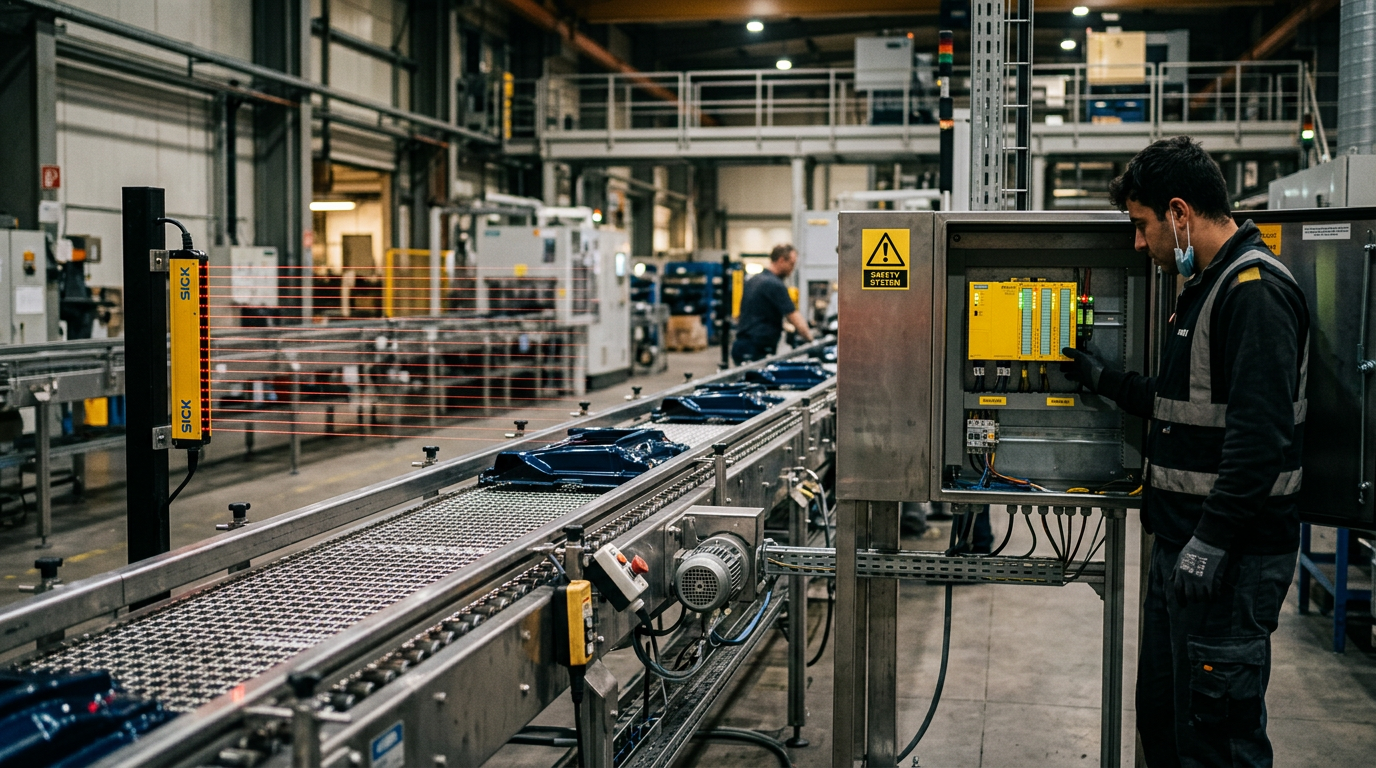
Implementing safety PLCs, light curtains, and SIL ratings on conveyor lines requires adhering to the IEC 61508 and IEC 62061 standards, ensuring that Safety Integrity Level (SIL) requirements match the identified risk level, typically ranging from SIL 1 to SIL 3 for industrial material handling. A properly integrated safety system reduces the Probability of Failure on Demand (PFD) by up to 10,000x compared to standard control systems, effectively bridging the gap between operational efficiency and personnel protection.
The Architecture of Conveyor Safety Systems
Modern conveyor systems have evolved from simple "stop-start" machines to complex, multi-axis automated environments. In these settings, traditional hard-wired safety relays are often insufficient. The transition to a decentralized, programmable approach allows for more granular control over safety zones without shutting down an entire facility during a minor breach.
The core of this architecture is the Safety PLC. Unlike a standard Programmable Logic Controller, a safety PLC utilizes redundancy (dual-processor architecture) and self-diagnostics to ensure that a failure within the controller itself results in a safe state. According to IEC 61508, these devices must be able to detect internal hardware faults and ensure that the safety function is performed even if a component fails.
Understanding SIL Ratings in Material Handling
Safety Integrity Level (SIL) is a relative level of risk-reduction provided by a safety function. In the context of conveyor automation:
- SIL 1: Low risk; minor injuries possible. Often managed by basic relays.
- SIL 2: Moderate risk; serious reversible injuries possible. Common in standard packaging lines.
- SIL 3: High risk; irreversible injury or death possible. Required for high-speed sortation or heavy palletizing zones.
Engineering teams must conduct a Risk Assessment (ISO 12100) to determine the required SIL for each conveyor segment. Over-specifying a system leads to unnecessary costs, while under-specifying leads to legal and physical hazards.
| Feature | Standard PLC | Safety PLC (SIL 2/3) |
|---|---|---|
| Processor Architecture | Single Channel | 1oo2 or 2oo2 Redundancy |
| Diagnostics | Basic | Extensive Self-Checking |
| Error Handling | May fail to "On" | Guaranteed Fail-Safe "Off" |
| Certifications | CE / UL | IEC 61508 / IEC 62061 |
| Cost Tier | Low | Premium |
Optical Protection: The Role of Light Curtains
Light curtains (Opto-electronic protective devices) serve as the "eyes" of the safety system. They are typically used in areas where frequent access is required, such as at the entrance of a palletizer or a manual pick station.
Resolution and Blanking
The effectiveness of a light curtain is determined by its resolution—the distance between individual infrared beams. For finger detection, a resolution of 14mm is standard, while hand detection usually requires 30mm. In conveyor applications, muting and blanking are critical features.
Muting allows the conveyor to transport a product through the light curtain without triggering a stop, provided the safety PLC receives a specific sequence of signals from auxiliary sensors. This ensures that the system can distinguish between a pallet of goods and a human limb.
Integrating Safety with Modular Hardware
When designing a line, the mechanical components must support the electronic safety measures. For instance, using high-quality aluminum profiles and standard modules from Easy Conveyors allows for the seamless mounting of light curtain brackets and emergency stop buttons. Modular systems simplify the routing of safety-rated bus cables (like PROFIsafe or CIP Safety), which carry both standard control data and safety signals over a single Ethernet cable.
Emergency Stop (E-Stop) Integration
E-stops are the most fundamental safety component. Under ISO 13850, an E-stop must be a "fail-safe" device. In a modern safety PLC environment, E-stops are no longer just cutting power to a motor starter; they initiate a controlled "Safe Torque Off" (STO) via the Variable Frequency Drive (VFD). This prevents the motor from generating torque while keeping the electronics powered, allowing for a faster restart once the hazard is cleared.
Easy Conveyors stocks the industrial automation discussed here — ready to ship across Europe.
Software Logic and Functional Safety
The transition from hard-wired logic to software-based safety requires rigorous validation. Safety PLCs use "Safety Function Blocks"—pre-certified pieces of code for functions like "E-Stop Monitoring," "Two-Hand Control," or "Muting."
- Redundant I/O: Safety inputs (like light curtains) provide dual-channel signals. The PLC compares these; if they don't match within a few milliseconds (discrepancy monitoring), the system faults.
- Safety Fieldbuses: Protocols like PROFIsafe add a "safety layer" to standard industrial Ethernet. This layer includes a CRC check, a time-stamp, and a unique ID for every safety message to ensure that data packets are not corrupted, lost, or delayed.
- Reaction Time: The total safety reaction time is the sum of the sensor detection time, PLC processing time, and the actuator (brake/motor) stopping time. This total time dictates the Safety Distance—the minimum distance a light curtain must be placed from the hazard.
Common Pitfalls in Conveyor Safety Selection
A frequent mistake is neglecting the "Safety Lifecycle." Safety is not a one-time installation but a continuous process.
- Inadequate Muting Sensors: Using only two sensors for muting can lead to "nuisance trips" or, worse, "defeatability" where an operator can trick the system. Four-sensor cross-muting is generally preferred for high-speed lines.
- Standard VFDs in Safety Circuits: Using a standard VFD without an STO (Safe Torque Off) input for a SIL 3 application requires two redundant contactors to drop the main power. This adds wear to the contactors and increases downtime. Modern SEW-Eurodrive or Siemens drives often include integrated safety functions that eliminate the need for these contactors.
- Ignoring Reset Procedures: A safety system should never automatically restart a conveyor when a light curtain is cleared. A manual reset, positioned where the operator has a full view of the hazard zone, is a requirement under OSHA 1910.212.
Future Trends: Collaborative Safety and AI
We are moving toward "Safe Speed Monitoring" (SLS - Safely Limited Speed). Instead of stopping a conveyor entirely when a light curtain is breached, the safety PLC can command the drives to slow down to a crawl speed. This allows the operator to perform adjustments without a total production halt, significantly improving OEE (Overall Equipment Effectiveness).
Furthermore, 3D safety cameras are beginning to replace traditional light curtains in complex workspaces. These sensors create "safety volumes" in 3D space, allowing for more flexible interaction between robots, conveyors, and human workers in "cobot" applications. Regardless of the technology used, the foundational principles of SIL ratings and redundant logic remain the bedrock of industrial safety.
Frequently Asked Questions
What is the difference between SIL 2 and SIL 3 in conveyor systems?
SIL (Safety Integrity Level) refers to the reliability and risk-reduction capability of a safety function. SIL 3 is the highest common level in industrial automation, requiring redundant processors and 99% diagnostic coverage to ensure a fail-safe state.
How do muting and blanking differ in light curtain applications?
Muting temporarily disables a safety function (like a light curtain) during the non-hazardous part of a machine cycle, such as when a pallet passes through. Blanking ignores specific static objects within the light curtain's field while maintaining protection for other areas.
Can I use a standard PLC for safety functions if I use redundant code?
Safety PLCs utilize redundant processors, dedicated safety-rated I/O, and certified firmware. They perform internal self-tests to ensure that a hardware failure results in a safe shutdown, whereas a standard PLC might fail with an output 'stuck on.'
How is the safety distance for a light curtain calculated?
The safety distance is calculated using the formula S = (K x T) + C, where K is the approach speed, T is the total system stopping time, and C is the additional distance based on the light curtain's resolution. This ensures the machine stops before a person can reach the hazard.