Advanced Safety Systems: Integrating PLCs and Light Curtains on Conveyors
Master conveyor safety with SIL 3 ratings, light curtains, and safety PLCs. Learn how to calculate safety distances and implement AOPDs for maximum uptime and protection.
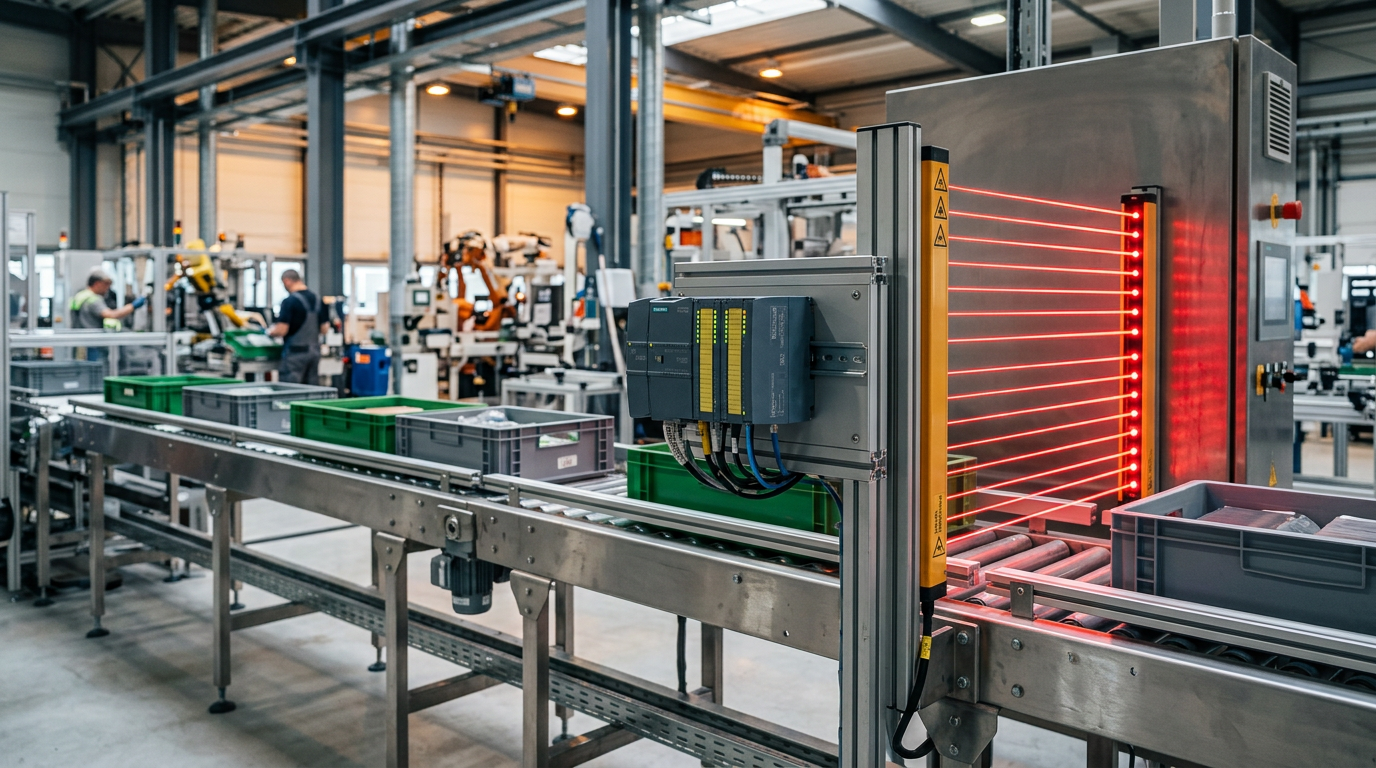
Implementing a functional safety system on modern conveyor lines requires adhering to EN ISO 13849-1 or IEC 62061 standards, where safety PLCs and light curtains must typically achieve a Safety Integrity Level (SIL) of 2 or 3 to mitigate risks of crushing or entanglement. By integrating decentralized safety logic with optical barriers, facilities can reduce emergency stop reaction times to under 100 milliseconds while maintaining high operational throughput.
The Hierarchy of Conveyor Safety
In high-speed sortation and heavy-duty manufacturing, the "safety by design" principle is mandated by international standards. Unlike standard control systems, functional safety systems are designed to detect internal failures and fail into a "safe state."
The core of this architecture is the Safety PLC. Unlike a standard PLC, a safety-rated controller uses redundancy (1oo2 or 2oo2 architectures) and diverse processing to ensure that a single hardware failure does not lead to a loss of safety functions. When designing these systems, engineers often look to Easy Conveyors for modular hardware that integrates seamlessly with standardized safety mounting brackets and sensor arrays, ensuring physical guards and electronic measures work in tandem.
Understanding SIL and PL Ratings
To select the right components, you must understand the two primary rating scales: Safety Integrity Level (SIL) and Performance Level (PL).
| Feature | SIL (IEC 62061) | PL (ISO 13849-1) | Application Severity |
|---|---|---|---|
| Low Risk | SIL 1 | PL b / c | Minor bruising, easily reversible |
| Medium Risk | SIL 2 | PL d | Severe injury, irreversible, single limb |
| High Risk | SIL 3 | PL e | Fatality or permanent total disability |
| Architecture | Defined by PFD/PFH | Defined by Categories (B, 1-4) | High-speed palletizing & robotics |
For most industrial conveyor applications involving robotic interfaces or high-torque drives, a rating of SIL 3 / PL e is the gold standard. This level implies a Probability of Failure per Hour (PFH) of less than $10^{-7}$, as defined by the IEC 62061 standard.
Light Curtains: The Invisible Barrier
Light curtains (AOPDs - Active Opto-electronic Protective Devices) are essential where frequent access to the conveyor is required, such as at in-feed or out-feed stations.
- Resolution: The distance between light beams determines what the curtain can detect. A 14mm resolution is standard for finger detection, while 30mm is sufficient for hand detection.
- Muting and Blanking: In conveyor automation, "muting" allows the safety PLC to temporarily bypass the light curtain when a pallet passes through, identified by specific sensors (e.g., inductive or photo-eye pairs). This prevents the system from tripping during normal material flow while maintaining protection against human entry.
- Safety Distance: The curtain must be placed far enough from the hazard so that the conveyor stops before a person can reach the danger zone. This is calculated using the formula $S = (K \times T) + C$, where $K$ is the approach speed and $T$ is the total system stop time.
Integrating the Safety PLC
The Safety PLC acts as the "brain" of the operation. It monitors inputs from E-stops, light curtains, and interlocks. Modern safety PLCs utilize safety-rated fieldbus p
Easy Conveyors stocks the industrial automation discussed here — ready to ship across Europe.
rotocols like PROFIsafe or CIP Safety to communicate with VFD soft-start tuning modules and servo drives.
One of the primary advantages of a dedicated safety controller over hard-wired safety relays is diagnostics. When a light curtain is tripped, the PLC can provide the exact timestamp and beam location to an HMI, drastically reducing downtime. Furthermore, localized safety zones allow one section of a conveyor to stop for maintenance while the rest of the line continues to run, optimizing "VFD soft-start tuning" profiles for the restarted sections to avoid mechanical shock.
Safe Motion Control
Safety on a conveyor line isn't just about cutting power. Modern hygienic wash-down design and high-speed lines often require "Safe Motion" functions integrated into the drive electronics:
- Safe Torque Off (STO): The most basic function, ensuring no power can reach the motor to generate torque.
- Safe Stop 1 (SS1): The motor is brought to a controlled stop before power is removed, preventing heavy loads from coasting dangerously.
- Safely Limited Speed (SLS): Allows the conveyor to move at a reduced, non-hazardous speed for clearing jams or cleaning.
Common Failure Modes and Maintenance
Even the best SIL 3 components can fail if improperly installed. Common issues include:
- Optical Misalignment: Vibrations from heavy pallet conveyors can knock light curtains out of alignment, leading to nuisance trips.
- Cross-Talk: If two light curtains are placed close together without different frequency settings, they may interfere with one another.
- Accumulation of Debris: In food environments, dust or moisture can obscure lenses. Selecting components with high IP ratings (IP67/IP69K) is critical for longevity.
Proper drum motor selection also plays a role in safety; enclosed motors eliminate external moving parts like chains and sprockets, inherently reducing the number of nip points that need guarding by light curtains in the first place.
The Role of Decentralized Safety
Distributed I/O modules allow engineers to place safety inputs closer to the conveyor modules. This reduces the amount of copper cabling required and simplifies the validation of the safety loop. By using pre-certified function blocks within the safety PLC software, engineers can ensure that the logic for "E-stop Restart" or "Muting" adheres to ISO 13849-1 requirements without writing complex, error-prone custom code.
Ultimately, the goal of integrating safety PLCs and light curtains is to create a system where human error cannot lead to catastrophe. By following a rigorous risk assessment and selecting components that meet the required SIL ratings, manufacturers protect their most valuable asset—their workforce—while maximizing the uptime of their automated systems.",category_slug:"automation",citations:[{name:"ISO 13849-1:2023 Safety of machinery",publisher:"ISO",url:"https://www.iso.org/standard/69883.html"},{name:"IEC 62061:2021 Safety of machinery",publisher:"IEC",url:"https://www.iec.ch/dyn/www/f?p=103:7:0::::FSP_ORG_ID,FSP_LANG_ID:1293,25"},{name:"Safety Related Controllers and Functional Safety",publisher:"Siemens",url:"https://www.siemens.com/global/en/products/automation/topic-areas/safety-integrated/factory-automation.html"},{name:"Guardmaster Safety Relays and PLCs",publisher:"Rockwell Automation",url:"https://www.rockwellautomation.com/en-us/products/hardware/safety-products.html"}],excerpt:
Frequently Asked Questions
What is the difference between SIL and PL ratings?
SIL (Safety Integrity Level) is defined by IEC 62061 and focuses on the probability of failure, while PL (Performance Level) is defined by ISO 13849-1 and focuses on the system architecture and diagnostic coverage. They are functionally equivalent at higher levels (e.g., SIL 3 is equivalent to PL e).
How does light curtain muting work on a conveyor?
Muting is a temporary, automatic suspension of a safety function (like a light curtain) during a specific part of the operation, such as a pallet passing through. It is triggered by specific sensors that confirm a load, not a person, is entering the zone.
What is STO in conveyor drive systems?
Safe Torque Off (STO) is a functional safety feature that ensures no power is applied to the motor, preventing it from generating torque. It is the most common safety function used to prevent unexpected startups during maintenance or after an E-stop.
How do I determine the mounting distance for a light curtain?
Safety distance is calculated based on the system's total response time and the speed at which a human limb can move (typically 1,600 mm/s or 2,000 mm/s per ISO 13855). You must ensure the conveyor stops before the person can reach the hazard.