Maximizing Uptime: Predictive Maintenance with Vibration Sensors on Conveyor Drives
Learn how vibration sensors and ISO 20816 analysis transform conveyor drive maintenance, reducing unplanned downtime by 35% through early fault detection.
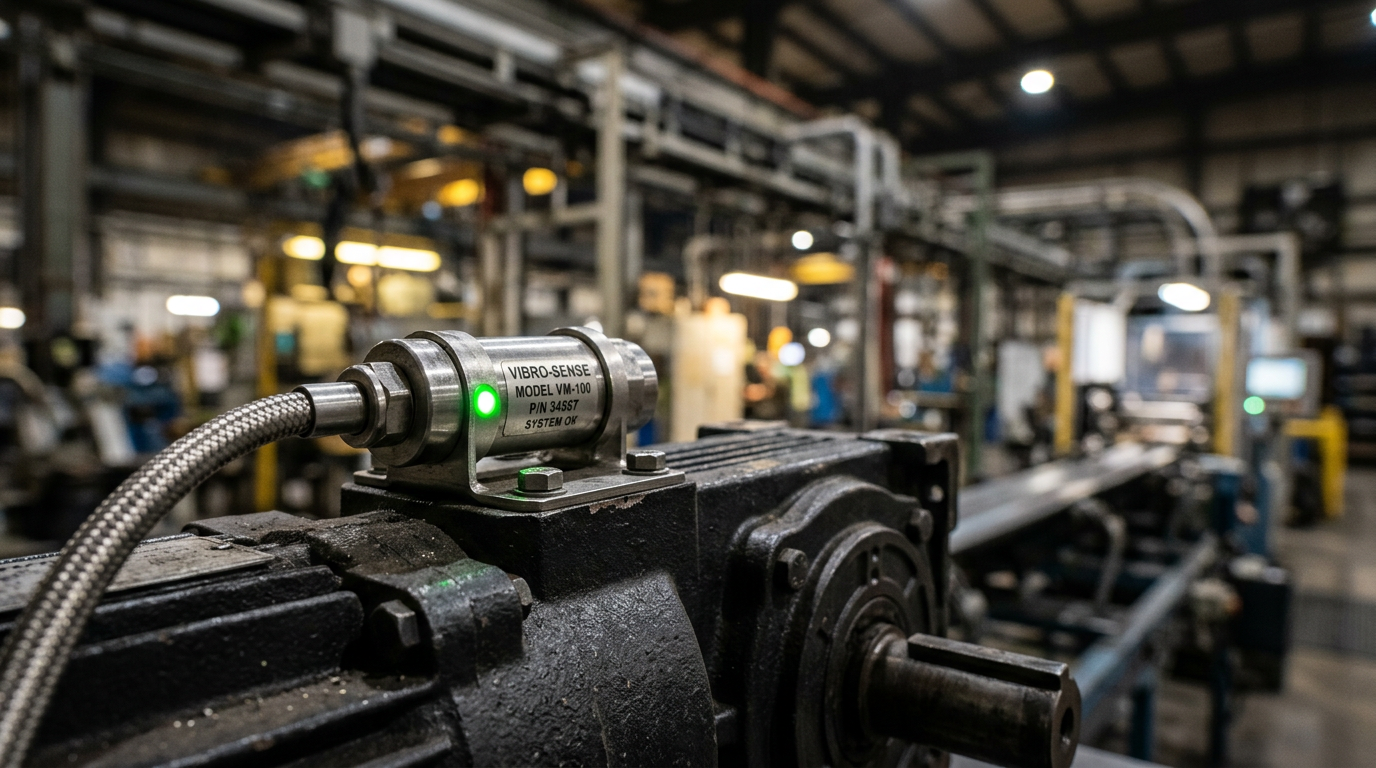
Predictive maintenance for conveyor drives utilizes vibration sensors to detect early-stage bearing wear, gear misalignment, and motor unbalance by monitoring frequency shifts in the 10 Hz to 10 kHz range. By implementing ISO 20816 standards for mechanical vibration, facilities can transition from reactive repairs to planned interventions, typically reducing unplanned downtime by up to 35% and extending component service life by 20%.
The Physics of Vibration Monitoring in Conveyor Drives
In a modern automated facility, the conveyor drive—consisting of the motor, gearbox, and drive pulley—is the primary point of failure. Traditional maintenance relies on fixed intervals (preventive) or "run-to-fail" (reactive) strategies. However, predictive maintenance (PdM) leverages the fact that mechanical components emit specific vibration signatures long before a functional failure occurs.
Vibration sensors, typically MEMS-based accelerometers or piezoelectric transducers, measure the velocity (mm/s) and acceleration (g) of the drive housing. According to ISO 20816-1, these measurements are categorized into zones (A through D), providing an objective scale for machine health.
Key Frequency Ranges to Monitor
- Low Frequency (1x - 3x RPM): Often indicates structural looseness or shaft misalignment.
- Medium Frequency (Gear Mesh): Reveals tooth wear or lubrication failure within the gearbox.
- High Frequency (Bearing Defects): Detects early pitting in the inner or outer races of rolling-element bearings (BPEO/BPII).
Selecting Sensors for Modular Conveyor Systems
When integrating sensors into modular systems, engineers must choose between wired (IO-Link) and wireless (LoRaWAN/Bluetooth) architectures. For high-speed sortation or heavy-pallet handling, wired IO-Link sensors are preferred for their real-time data streaming and integration with PLC environments like Siemens TIA Portal or Rockwell Studio 5000.
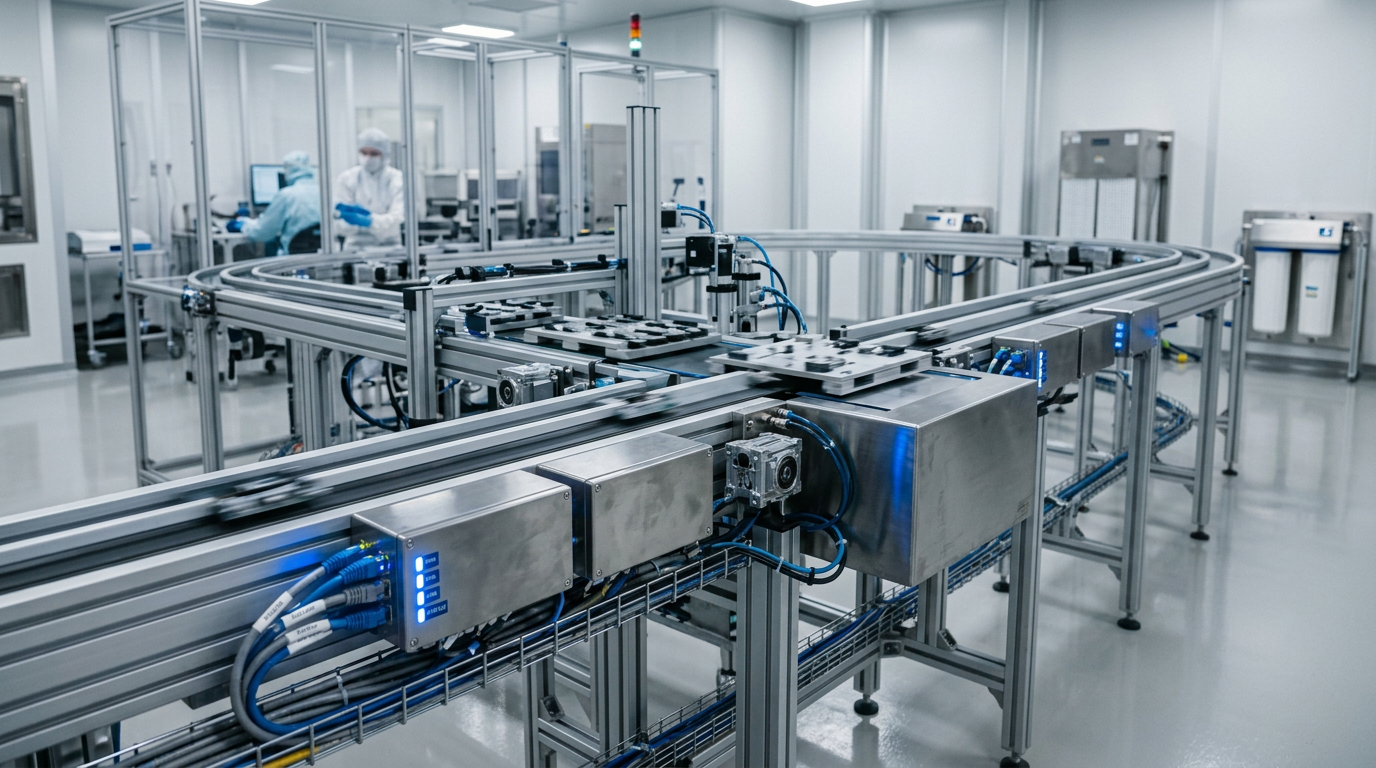
In complex layouts involving hundreds of meters of track, Easy Conveyors provides modular frameworks that allow for the easy mounting of standardized sensor brackets on drive units. This modularity ensures that vibration monitoring can be scaled without redesigning the primary conveyor structure.
Comparison: Sensor Architectures for Drive Monitoring
| Feature | Wired (IO-Link) | Wireless (IIoT) | Handheld / Route-Based |
|---|---|---|---|
| Data Frequency | Continuous / Real-time | Periodic (e.g., every 15 min) | Monthly / Quarterly |
| Latency | Low (< 5ms) | High (Seconds) | N/A |
| Installation Cost | High (Cabling required) | Low (Battery-powered) | Manual labor intensive |
| Best For | Critical Sortation Drives | General Transport | Non-critical auxiliary units |
| Integration | Direct to PLC | Gateway to Cloud | Offline Database |
Deployment Strategy: The FFT Analysis
The core of predictive maintenance is the Fast Fourier Transform (FFT). This mathematical process converts time-domain signals (the raw vibration) into a frequency-domain "spectrum." By analyzing this spectrum, a maintenance engineer can pinpoint exactly which component is failing. For instance, a spike at the "Ball Pass Frequency" indicates a specific bearing issue, whereas a spike at the motor's electrical frequency might suggest a rotor bar problem (IEC 60034-1).
Fault Detection Thresholds
Modern "smart" sensors often include edge computing capabilities that calculate the RMS (Root Mean Square) velocity. For most industrial conveyor drives, an RMS velocity exceeding 4.5 mm/s (Severity Zone C) serves as a common alert threshold to schedule inspection during the next shift change.
Easy Conveyors stocks the industrial automation discussed here — ready to ship across Europe.
Synergy with Motor Control and VFDs
Vibration sensors should not operate in a vacuum. Integrating vibration data with VFD soft-start tuning and current monitoring provides a holistic view. If a vibration spike correlates with a sudden increase in motor amperage, the likelihood of a mechanical bind or gearbox jam is high. Similarly, correlating vibration with drum motor selection parameters—such as oil temperature and load cycles—allows for highly accurate "Remaining Useful Life" (RUL) predictions.
Impact on Maintenance Operations
The shift to PdM changes the fundamental workflow of the maintenance department. Instead of "checking" motors, technicians are dispatched based on automated work orders triggered by the sensor's digital twin.
- Reduced Spare Parts Inventory: By knowing 4–6 weeks in advance that a bearing will fail, procurement leads can order parts JIT (Just-In-Time).
- Energy Efficiency: A misaligned drive or one with worn gears consumes significantly more energy. Maintaining machines in "Zone A" (Newly commissioned state) ensures compliance with IE3/IE4 motor efficiency classes (IEC 60034-30-1).
- Hygienic Safety: In food-grade environments, high vibration can lead to micro-cracks in stainless steel housings, creating harborages for bacteria. Predictive monitoring supports EHEDG standards by ensuring the mechanical integrity of wash-down zones.
Common Failure Modes and Vibration Signatures
- Imbalance: A heavy spot on a pulley or motor fan produces a strong 1x RPM peak.
- Misalignment: Characterized by high axial vibration and a strong 2x RPM peak in the spectrum.
- Gear Wear: Manifests as high-frequency "sidebands" around the gear mesh frequency.
- Bearing Failure: Distinctive high-frequency peaks that increase in amplitude and "carpet" noise as the failure progresses.
By implementing specialized monitoring on critical conveyor drives, manufacturers achieve a level of operational resilience that manual inspections cannot match. The combination of high-precision sensors, standardized vibration analysis, and modular hardware creates a future-proof material handling system.
Frequently Asked Questions
Can vibration sensors detect all conveyor drive failures?
While vibration sensors are excellent for detecting 80% of mechanical faults, some localized overheating or electrical winding failures are better caught by thermography or MCT (Motor Current Trace) analysis. A combined approach is best for critical drives.
What is a 'normal' vibration level for a conveyor motor?
For most standard conveyors, a velocity range of 0.7 mm/s to 4.5 mm/s is considered acceptable (Zone A/B), while anything over 7.1 mm/s (Zone D) requires immediate shutdown to prevent catastrophic damage.
Can I integrate vibration sensors into my existing PLC system?
Yes. IO-Link sensors can stream data directly into existing PLC architectures, allowing maintenance alerts to be displayed on HMIs without needing a separate cloud-based IIoT platform.
Where is the best place to mount a sensor on a conveyor drive?
Sensors should be mounted as close to the bearing housing as possible, ideally on a flat, rigid, unpainted surface. For conveyor drives, monitoring both the motor housing and the gearbox output shaft provides the most comprehensive data.