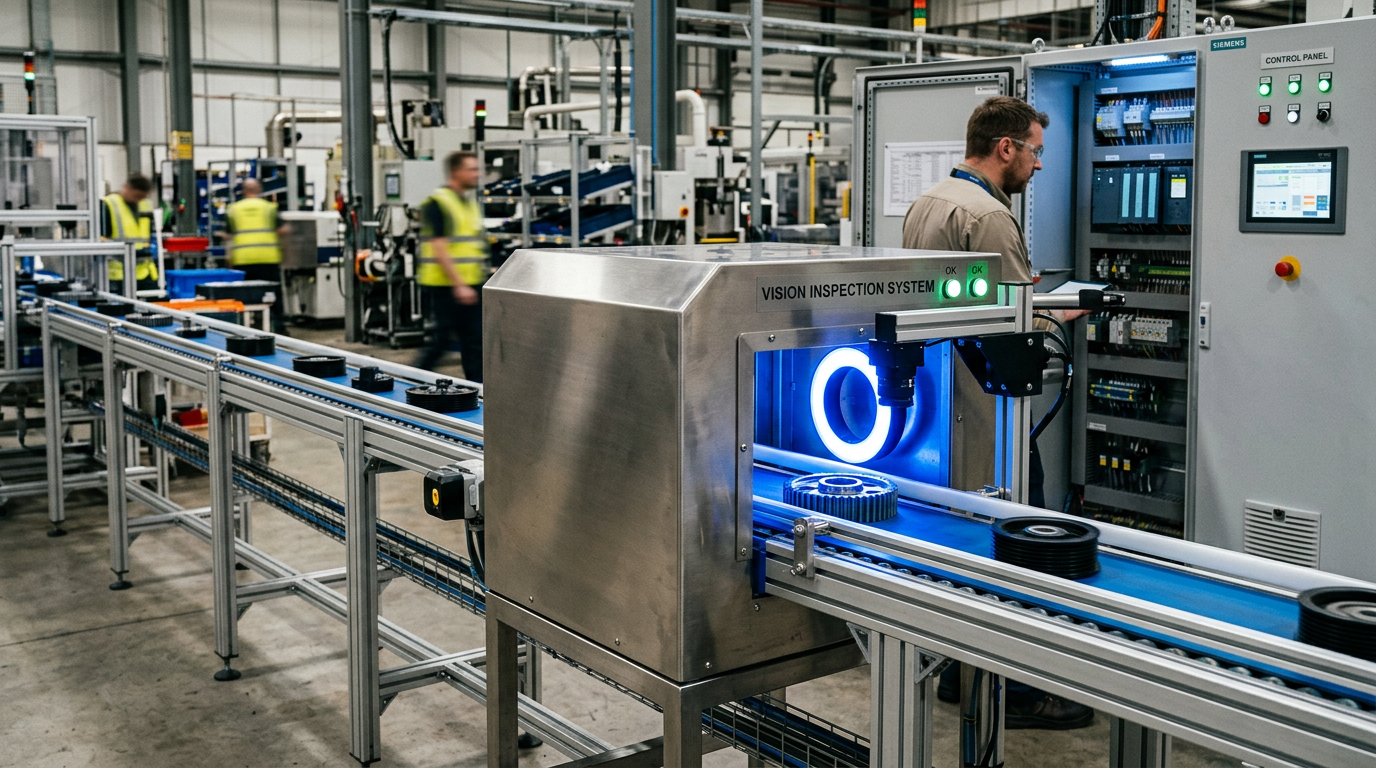
Predictive Maintenance with Vibration Sensors on Conveyor Drives
Learn how vibration sensors on conveyor drives predict failures before they happen, reducing downtime by up to 50% using ISO 20816 standards and FFT analysis.
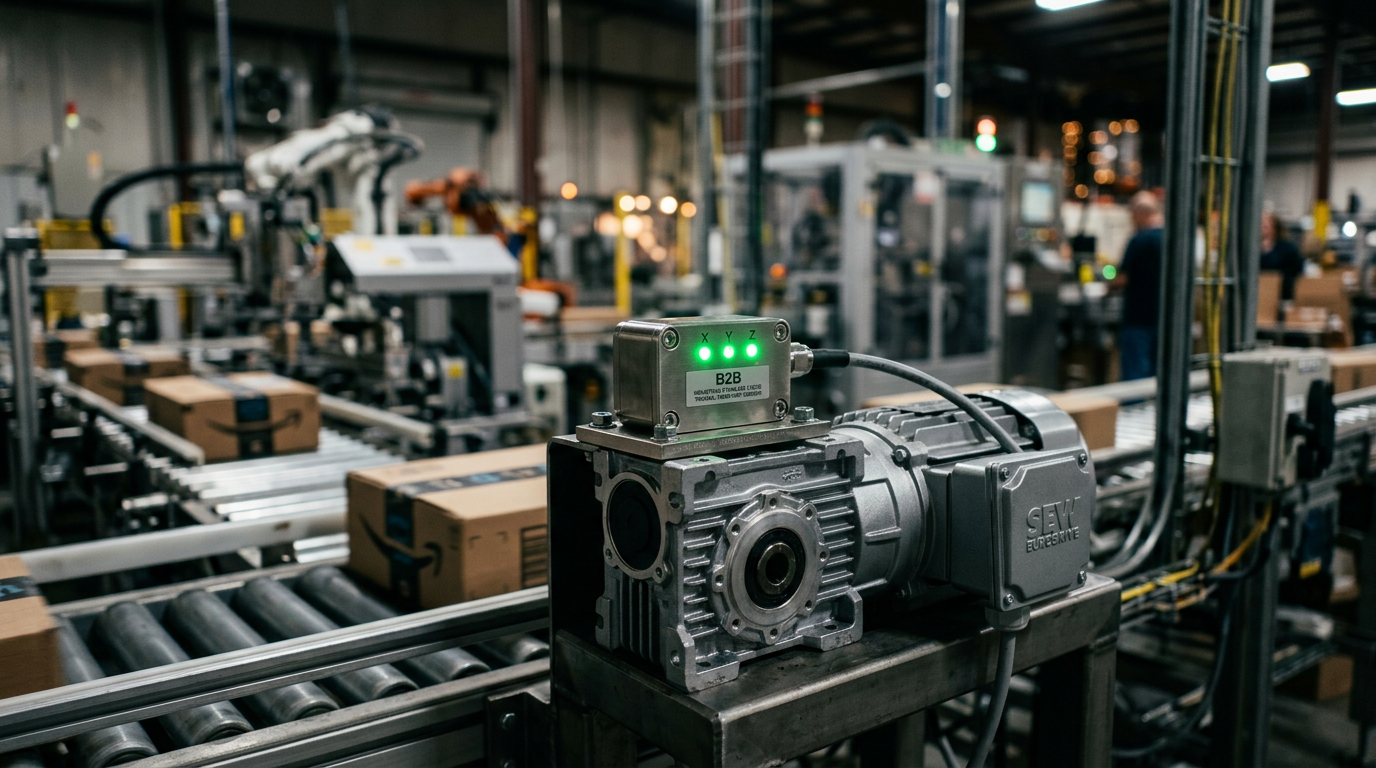
Predictive maintenance using vibration sensors on conveyor drives reduces unplanned downtime by 35-50% by identifying bearing fatigue and gear mesh misalignments up to 90 days before structural failure occurs. By monitoring Velocity (mm/s RMS) and Acceleration (g) against established standards such as ISO 20816-1, maintenance teams can transition from reactive "run-to-fail" models to data-driven intervention schedules.
The Shift from Preventive to Predictive Maintenance
Traditional maintenance for conveyor systems often relies on periodic inspections and time-based lubrication schedules. However, this "preventive" approach frequently results in unnecessary part replacements or, conversely, fails to catch sudden component failures between scheduled checks. In high-throughput environments like e-commerce sortation or food processing, a single motor failure can stop an entire production line, costing thousands of Euros per hour.
Predictive maintenance (PdM) leverages Industrial IoT (IIoT) sensors to monitor the health of the drive unit in real-time. By mounting triaxial vibration sensors directly onto the motor housing and gearbox, engineers can detect subtle changes in the "signature" of the drive. As gear teeth wear or lubricant viscosity breaks down, the vibration frequencies shift. This allows for a surgical approach to maintenance: you only stop the line when the data confirms it is necessary.
Key Vibration Metrics and ISO Standards
To implement predictive maintenance effectively, you must understand the two primary metrics measured by industrial vibration sensors:
- Velocity (RMS): Typically measured in mm/s, this indicates the overall "energy" of the vibration. It is the best indicator of general mechanical health, including unbalance and misalignment.
- Acceleration (Peak/RMS): Measured in g, acceleration is highly sensitive to high-frequency impacts. This is the primary metric for detecting early-stage bearing defects, where the rolling elements strike pits or cracks in the races.
The industry benchmark for these measurements is the ISO 20816 series. For most modular conveyor drives (typically falling under Class I or II machines), the following vibration severity guide applies:
| Vibration Velocity (mm/s RMS) | Machine Condition | Action Required |
|---|---|---|
| 0.28 - 1.12 | Good | No action; documented baseline. |
| 1.12 - 2.80 | Satisfactory | Normal operation; continue monitoring. |
| 2.80 - 7.10 | Unsatisfactory | Schedule inspection within 30 days. |
| > 7.10 | Unacceptable | Immediate shutdown to prevent catastrophic failure. |
Failure Modes Detected by Vibration Analysis
Vibration sensors do more than just tell you a motor is "shaking." Through Fast Fourier Transform (FFT) analysis—a process that converts time-domain signals into a frequency spectrum—automation systems can pinpoint the exact cause of the distress.
1. Bearing Fatigue
Bearings follow a predictable failure curve. Early-stage wear (Stage 1) produces ultrasonic frequencies invisible to the human ear or touch. By Stage 3, the vibration becomes evident in the velocity spectrum. Advanced sensors can detect Ball Pass Frequencies, allowing for replacement during a scheduled weekend shift rather than a Monday morning emergency.
2. Gearbox Misalignment
In modular systems using external gearmotors, slight shifts in the mounting bracket can lead to angular or offset misalignment. This manifests as a high-amplitude vibration at the 1x or 2x shaft rotation frequency. Left unchecked, this puts excessive radial load on the motor shaft, leading to premature drum motor vs gearmotor replacement.
3. Structural Resonance
Sometimes the vibration isn't coming from the drive itself, but from the conveyor frame. If the motor's operating frequency (controlled by a VFD) matches the natural frequency of the conveyor support structure, resonance occurs. Vibration sensors identify these "critical speeds," allowing automation engineers to program "skip frequencies" into the VFD software.
Easy Conveyors stocks the industrial automation discussed here — ready to ship across Europe.
Integration with Modular Conveyor Systems
Modern modular designs, like those optimized by Easy Conveyors, prioritize accessibility for these sensors. When designing a system, providing flat, machined surfaces on the drive end-track allows for more accurate sensor mounting.
For large-scale facilities, these sensors are often integrated into a centralized dashboard. This is where "VFD soft-start tuning" plays a role; by analyzing the vibration during start-up cycles, engineers can refine the acceleration ramps to minimize mechanical shock, further extending the life of the drivetrain.
Wireless vs. Wired Sensors
When retrofitting existing lines, the choice between wired and wireless sensors is critical:
- Wired Sensors (IEPE/4-20mA): Best for permanent monitoring in critical "bottleneck" conveyors. They provide continuous data streams and are immune to EMI.
- Wireless Sensors (LoRaWAN/Bluetooth): Ideal for large warehouses where cabling would be cost-prohibitive. They typically "wake up" every hour to send a burst of data, which is sufficient for detecting gradual wear.
Data Processing: Edge vs. Cloud
The volume of data generated by a triaxial sensor sampling at 10kHz is immense. Standard practice now involves "Edge Computing," where the sensor or a local gateway performs the FFT analysis and only sends the "health score" or specific alarm triggers to the cloud. This reduces bandwidth and ensures that hygienic wash-down design integrity isn't compromised by excessive cabling in food-grade environments.
Systems utilizing IE3 efficiency class motors benefit significantly from this. Because IE3 motors operate with tighter internal tolerances and higher magnetic flux, even minor shaft imbalances can lead to heat buildup and efficiency losses that vibration sensors pick up long before a thermal overload trip occurs.
Implementation Steps for Maintenance Teams
To move toward a predictive model, begin with a critical asset analysis. Identify the 20% of conveyor drives that account for 80% of your downtime risk. Install sensors on these units first to establish a "baseline" of healthy operation.
Once the baseline is established, set your "Warning" and "Critical" thresholds based on NEMA MG-1 standards or ISO 20816. Remember that a motor mounted on a lightweight aluminum frame will naturally have a higher vibration baseline than one mounted on a heavy steel mezzanine. Context is everything.
Conclusion
Predictive maintenance with vibration sensors transforms the conveyor drive from a "black box" into a transparent, manageable asset. By understanding the frequency signatures of failure, operations managers can ensure that material handling automation remains continuous, efficient, and cost-effective. As the industry moves toward Industry 4.0, the question is no longer if a drive will fail, but when—and vibration sensors provide the answer months in advance.
Frequently Asked Questions
What is the acceptable vibration level for a conveyor motor?
For most industrial conveyor drives, a vibration velocity exceeding 7.1 mm/s RMS is considered critical and requires immediate inspection. Satisfactory levels are typically below 2.8 mm/s RMS.
Should I monitor vibration velocity or acceleration?
Velocity (mm/s) is best for detecting mechanical issues like unbalance or misalignment, while Acceleration (g) is superior for detecting early-stage bearing wear and high-frequency gear mesh faults.
Where is the best place to mount a vibration sensor on a gearmotor?
Sensors should be mounted as close to the bearings as possible, ideally on a flat, rigid part of the motor or gearbox housing in the radial direction (perpendicular to the shaft).
Can vibration monitoring improve energy efficiency?
Yes. By detecting mechanical friction, misalignment, and bearing drag early, vibration sensors allow for repairs that return the motor to its peak IE3/IE4 efficiency rating, reducing energy waste.