Advanced PLC and Machine Vision Integration on Packaging Conveyor Lines
Learn how to integrate PLC logic with machine vision systems on packaging conveyors to achieve 100% inspection rates and sub-20ms response times for high-speed lines.
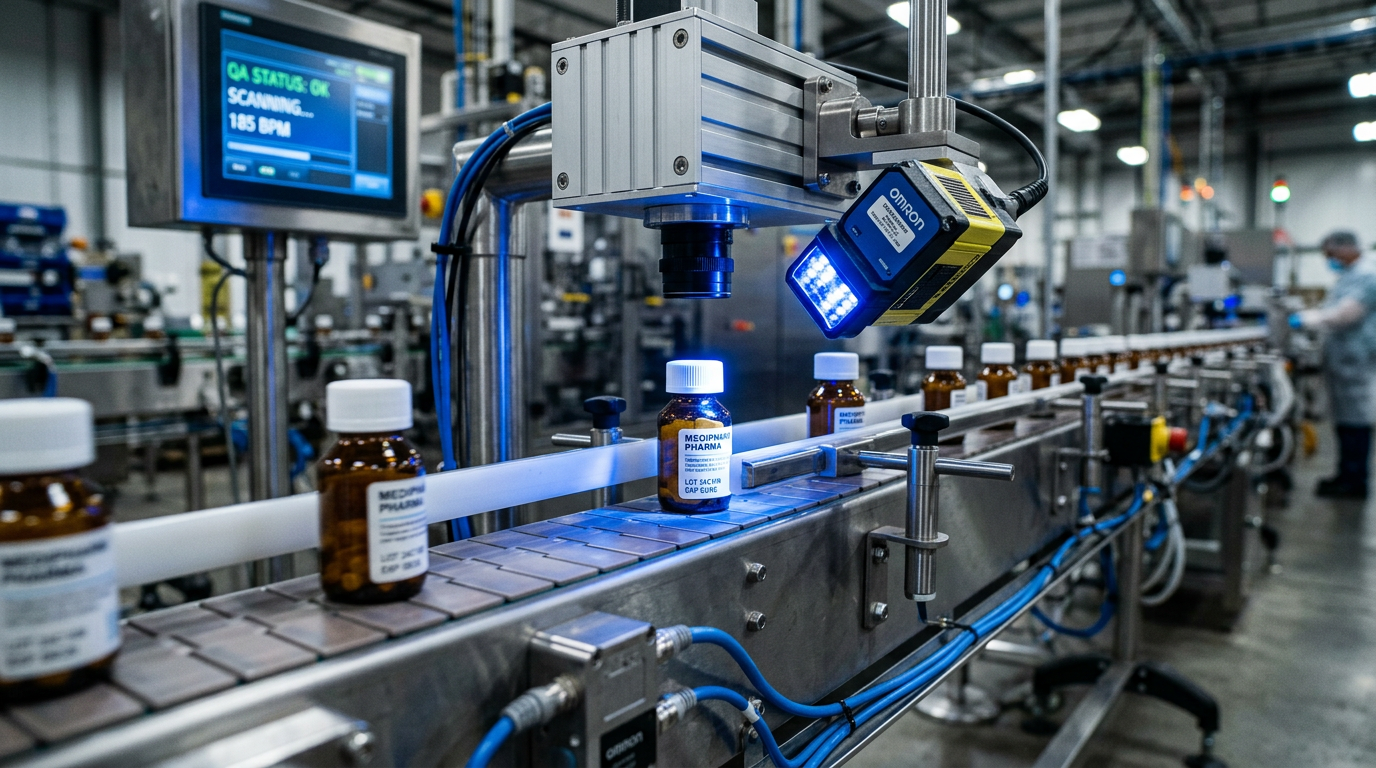
PLC and machine vision integration on packaging conveyor lines relies on a high-speed communication backbone, typically utilizing Industrial Ethernet protocols like PROFINET or EtherNet/IP to achieve trigger-to-response latencies under 20 milliseconds. By synchronizing the Programmable Logic Controller (PLC) with high-resolution smart cameras or PC-based vision systems, manufacturers can achieve 100% inspection rates at line speeds exceeding 60 meters per minute while maintaining a false-reject rate (FRR) of less than 0.1%.
Modern packaging environments demand more than just simple presence detection. As consumer goods companies transition toward mass customization and high-mix, low-volume production, the integration between the "brain" (PLC) and the "eyes" (Machine Vision) must be seamless to handle complex tasks like label verification, 3D volume measurement, and AI-driven defect detection.
The Architecture of Integration: Hardware and Protocols
The foundation of a successful vision-PLC integration is the physical and logical communication layer. Traditionally, vision sensors communicated via discrete I/O—a single wire for "Pass," another for "Fail." While fast, this method lacks the data depth required for Industry 4.0.
Today, integrated systems use Industrial Ethernet to exchange rich data packets. This allows the PLC to not only receive a pass/fail signal but also specific coordinate data for robotic pick-and-place, barcode strings for track-and-trace, and diagnostic data regarding the camera's health.
Communication Standards
- PROFINET/EtherNet/IP: These protocols allow for cyclic data exchange. The PLC acts as the "Master" or "Scanner," and the vision system acts as the "Device" or "Adapter." According to standards established by PI (Profibus & Profinet International), these protocols ensure real-time determinism.
- OPC UA: Often used for vertical integration, sending vision metadata to a SCADA system or the cloud for long-term quality analytics.
- TCP/IP (Raw Ethernet): Used for transferring large image files or custom string formats that don't fit into standard cyclic buffers.
Designing the Physical Inspection Point
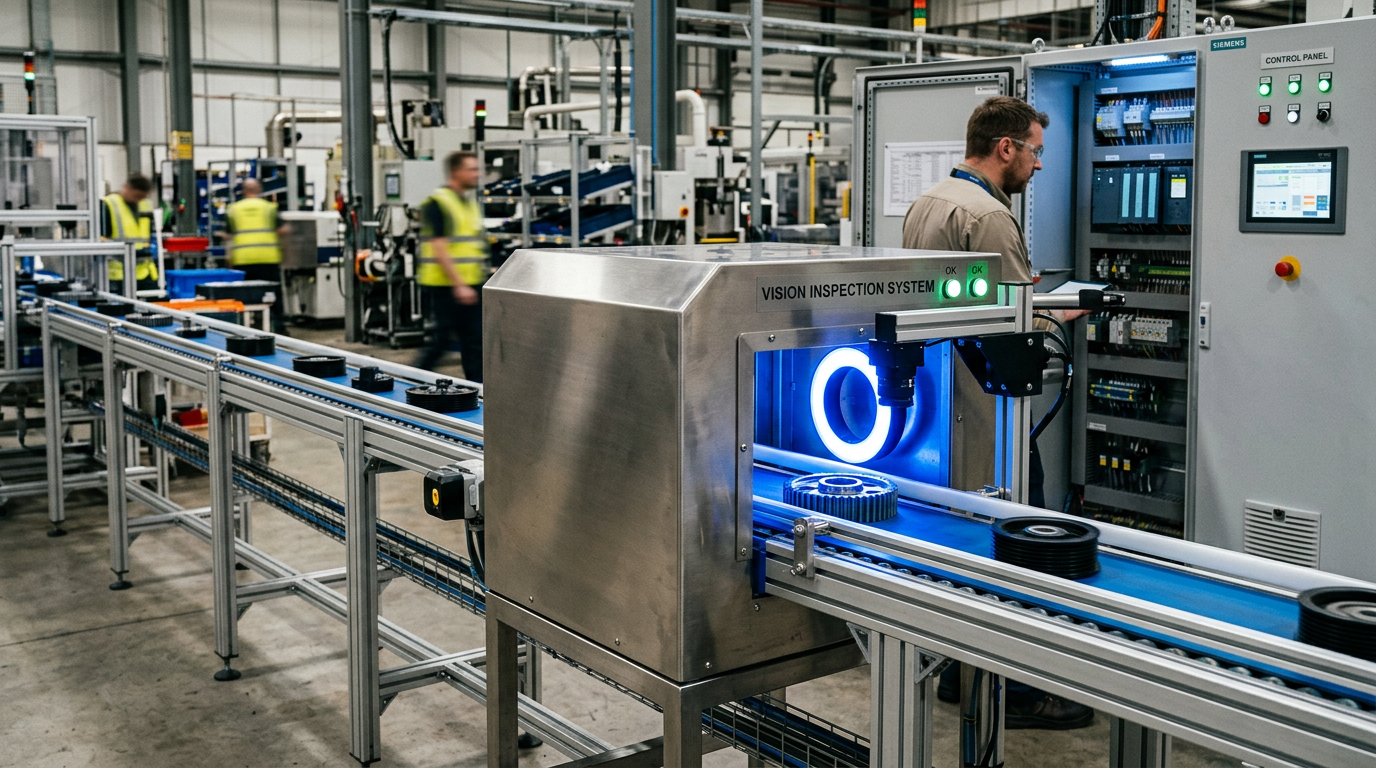
For machine vision to work accurately, the mechanical environment must be controlled. This is where the conveyor system's stability becomes critical. Vibration or inconsistent belt speeds can lead to motion blur, even with global shutter sensors.
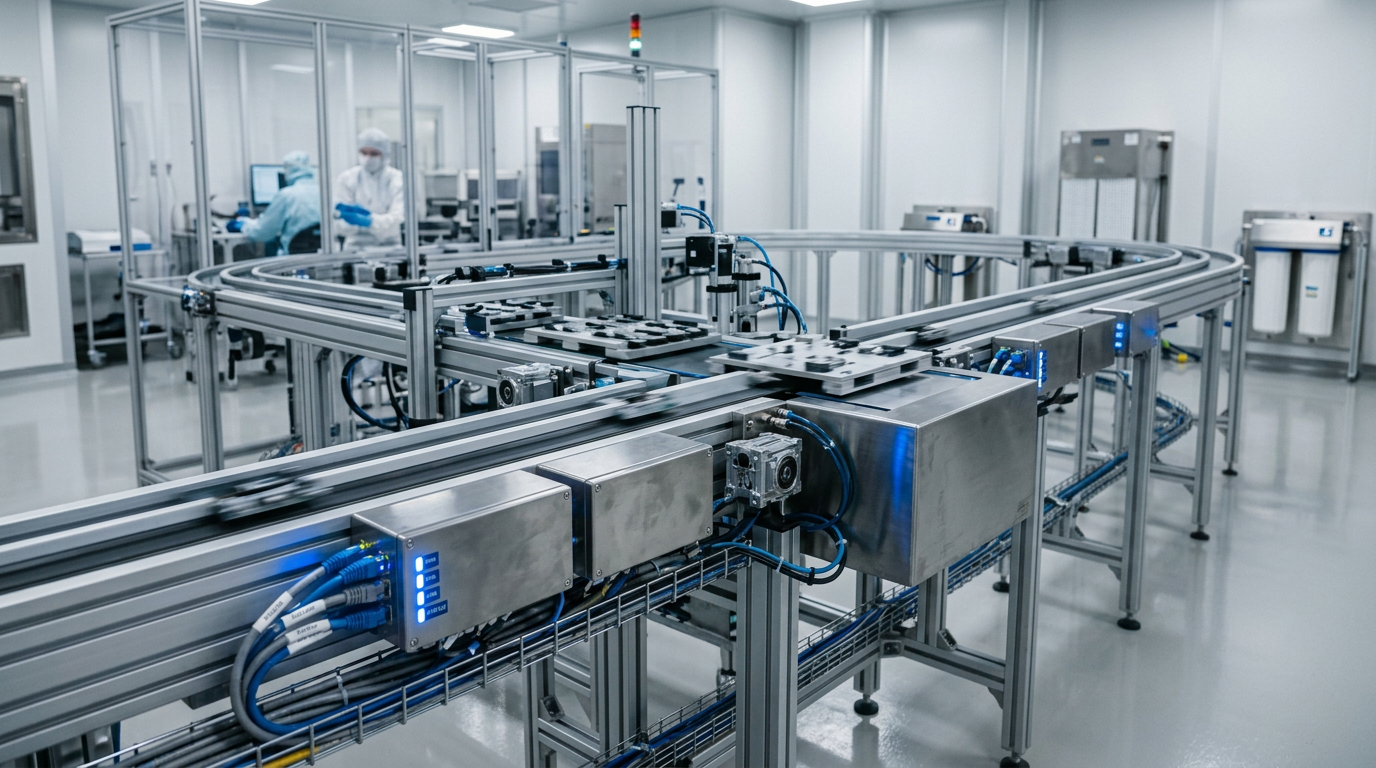
When designing these lines, engineers often turn to Easy Conveyors to provide the modular, high-stability frameworks required for precision optics. The use of aluminum profiles or stainless steel frames ensures that camera mounts remain rigid over millions of cycles.
Key Mechanical Considerations
- Encoder Integration: For lines with variable speeds, a rotary encoder must be linked to the PLC. The PLC then issues a "trigger" to the camera based on the exact position of the product, rather than a fixed time interval.
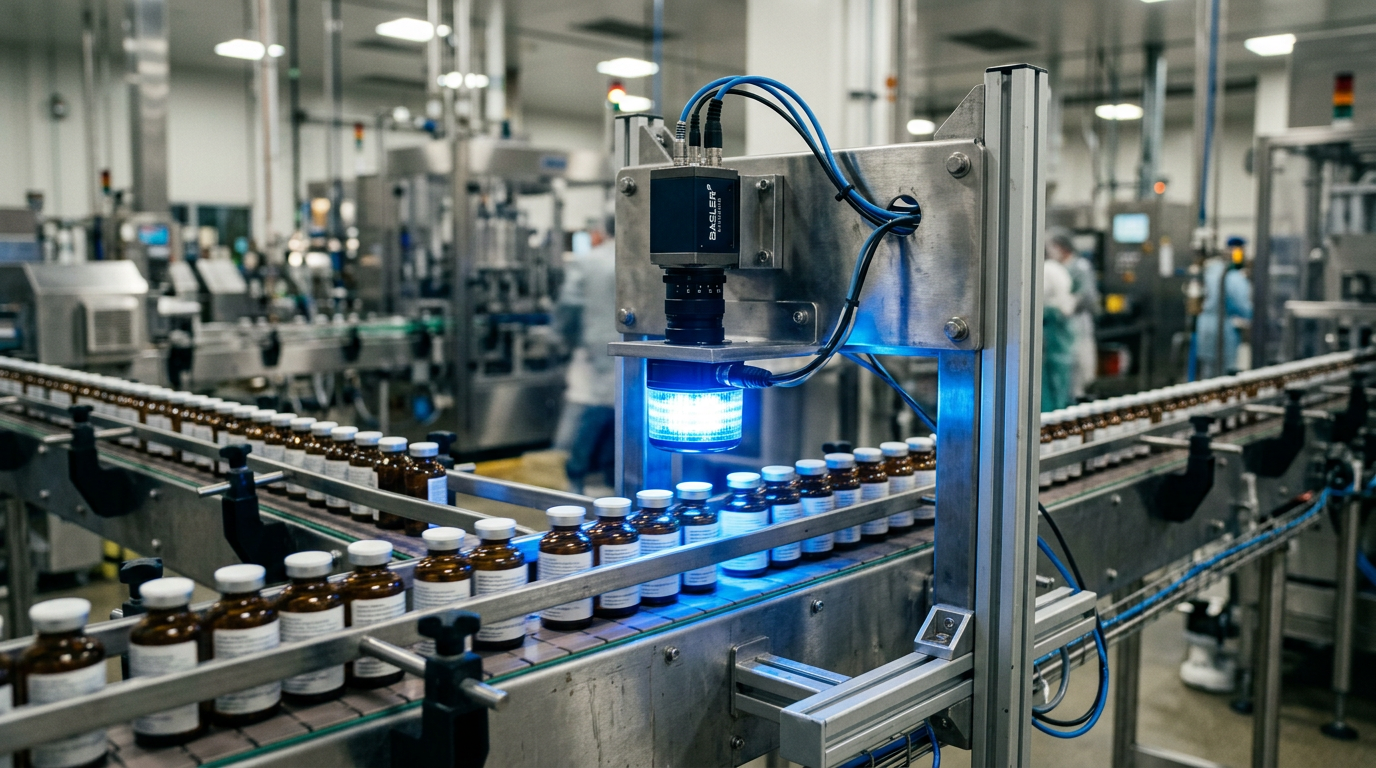
- Lighting Control: The PLC often manages the strobe timing of LED illuminators to coincide with the camera exposure, extending the life of the lighting hardware and preventing ambient light interference.
- Reject Stations: The conveyor must have a designated area for failed products. The PLC calculates the "encoder counts to reject" to ensure the pneumatic pusher or air blast removes the correct item without stopping the line.
Software Integration Strategies
Integrating a vision system into the PLC environment has become significantly easier with the advent of Add-On Instructions (AOIs) and Function Blocks (FBs). Leading automation providers like Rockwell Automation and Siemens provide pre-validated libraries for major vision brands.
The Handshake Sequence
The typical logic flow for a vision-conveyor operation follows a strict handshake:
- Product Detected: A photo-eye or encoder count signals the PLC that a product is approaching the inspection zone.
- Trigger Issued: The PLC sends a bit to the vision system to capture an image.
- Processing: The vision system analyzes the image (e.g., checking a best-before date or seal integrity).
- Result Sent: The vision system sets a "Result Valid" bit and populates a data register with the pass/fail code.
- Acknowledge: The PLC reads the data and clears the trigger bit, readying the system for the next cycle.
| Feature | Discrete I/O Integration | Fieldbus Integration (PROFINET/EIP) |
|---|---|---|
| Data Depth | 1-bit (Pass/Fail) | High (Strings, Coordinates, Scores) |
| Setup Speed | Manual wiring for every signal | Software-based configuration |
| Diagnostics | Minimal | High (Internal temp, focus, exposure) |
| Latency | < 1ms | 2ms - 10ms (Deterministic) |
| Cabling | Multi-conductor per camera | Single Shielded Cat6e |
Easy Conveyors stocks the industrial automation discussed here — ready to ship across Europe.
Overcoming Common Integration Challenges
Handling High-Speed Motion Blur
In high-speed packaging, products can move at several meters per second. If the camera's exposure time is too long, the image will smear. To solve this, engineers must synchronize the PLC trigger with a high-intensity strobe. According to IEC 62471, industrial lighting safety must also be considered when using high-powered strobes in occupied areas.
Data Management and Buffering
When a conveyor line processes 600 parts per minute, the PLC can quickly become overwhelmed with data. It is essential to use a "FIFO" (First-In, First-Out) buffer in the PLC logic. This ensures that the result from "Product A" is matched with the reject station's action for "Product A," even if "Product B" and "Product C" have already been inspected by the time the first product reaches the reject arm.
Hygienic and Environmental Protection
In food and pharmaceutical packaging, wash-down requirements are standard. Vision systems and their PLC control cabinets must meet IP69K ratings to withstand high-pressure, high-temperature cleaning. This involves specialized camera enclosures with hydrophobic windows to prevent water droplets from interfering with the optical path.
Future Trends: AI and Edge Integration
The next frontier in PLC and machine vision integration is the inclusion of Deep Learning. Unlike traditional rule-based vision, AI can identify "organic" defects—such as a bruised fruit or a slightly misaligned flexible pouch—that are difficult to program manually.
New PLC modules now feature integrated AI processing cores, allowing the vision system to pass raw image data directly to the PLC's backplane for inference. This reduces the need for a separate industrial PC (IPC), simplifying the control architecture and reducing the attack surface for cybersecurity threats.
When selecting components, engineers should evaluate the "drum motor selection" for the conveyor to ensure smooth, jitter-free motion, and consider "VFD soft-start tuning" to prevent jerky movements that could displace products before they reach the vision inspection tunnel. These mechanical nuances are just as vital as the communication code for achieving a high OEE (Overall Equipment Effectiveness).
Conclusion
The integration of PLCs and machine vision is no longer a luxury but a requirement for modern packaging lines. By moving away from simple discrete signals toward robust Industrial Ethernet communication, and by ensuring the mechanical conveyor platform is stable and synchronized via encoders, manufacturers can achieve unprecedented levels of quality and throughput. Whether you are implementing a simple barcode check or a complex 3D inspection system, the synergy between logic and vision remains the heartbeat of the automated factory.
Frequently Asked Questions
What is the best communication protocol for PLC-vision integration?
Industrial Ethernet protocols like PROFINET and EtherNet/IP are preferred because they allow for the exchange of complex data (like coordinates and strings) and offer built-in diagnostics that discrete wiring lacks.
Why do I need an encoder for vision integration?
An encoder provides the PLC with the exact position of the conveyor belt. This allows the PLC to trigger the camera at the precise moment a product passes, regardless of speed fluctuations, ensuring the 'Pass/Fail' result is applied to the correct item.
How do you handle latency between the camera and the PLC?
Latency is managed by using high-speed 'interrupt' inputs on the PLC and ensuring the network load is optimized. Modern systems aim for a total loop time (trigger-to-result) of under 20-30 milliseconds.
What are the requirements for vision systems in food packaging?
In wash-down environments (food/pharma), you must use IP69K-rated enclosures for both the camera and the PLC peripherals, along with specialized lighting that can withstand high-pressure cleaning.