Optimizing PLC and Machine Vision Integration on Packaging Conveyor Lines
Integrate PLC systems and machine vision on packaging lines using industrial Ethernet. Learn about object tracking, encoder synchronization, and high-speed sortation logic.
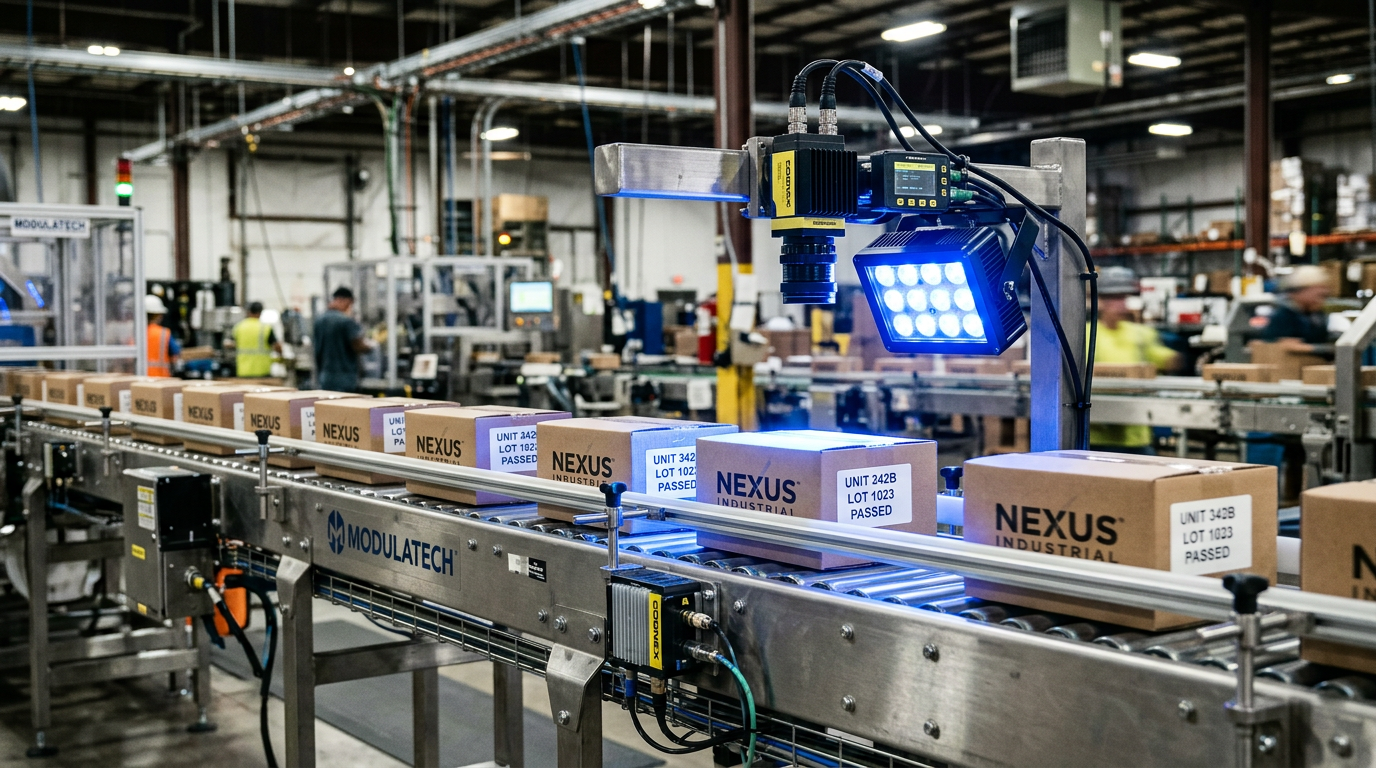
Integrating PLC systems with machine vision on packaging conveyor lines requires a high-speed industrial communication protocol—typically Profinet or EtherNet/IP—to achieve end-to-end latency of less than 20 milliseconds for accurate product rejection or diversion. By synchronizing the Programmable Logic Controller (PLC) with smart cameras, manufacturers can automate quality inspection, label verification, and high-speed sortation with 99.9% accuracy at throughputs exceeding 300 units per minute.
Connectivity and Protocols: The Backbone of Integration
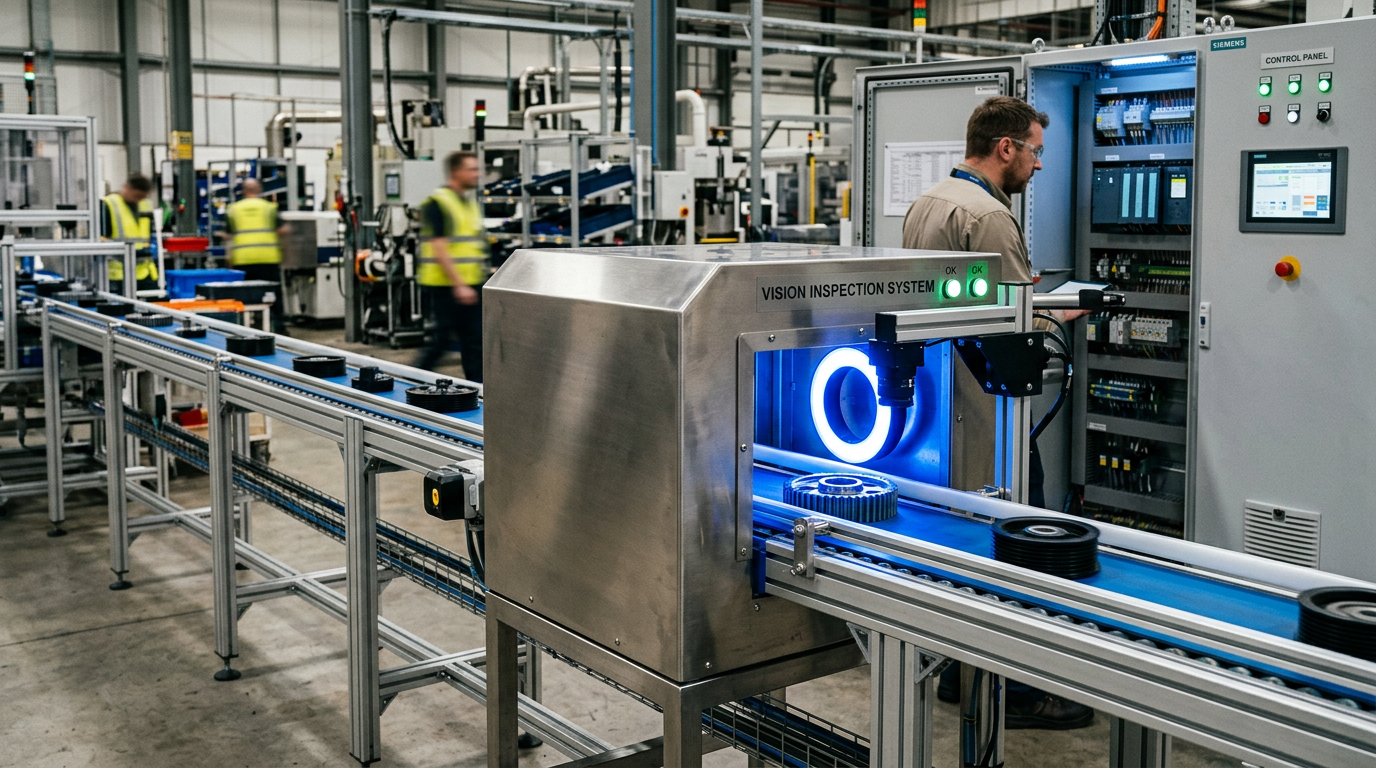
The successful marriage of a PLC and machine vision system starts at the hardware layer. In modern packaging environments, the vision sensor is no longer an isolated peripheral; it is a critical node on the automation network.
To ensure precise timing, engineers utilize industrial Ethernet protocols. According to IEC 61158 standards, these fieldbuses allow for deterministic communication. Profinet (common in Siemens environments) and EtherNet/IP (preferred in Rockwell Automation setups) are the industry standards.
- Deterministic Timing: The PLC must know exactly when an image was captured relative to the encoder position of the conveyor.
- Data Exchange: The vision system sends more than just a "Pass/Fail" bit. It transmits X-Y coordinates for robotic pick-and-place, QR code strings for tracking, and inspection scores for statistical process control (SPC).
- Control Loops: High-speed packaging lines often require "trigger-over-Ethernet" to reduce wiring complexity, though a physical 24V DC discrete trigger is still preferred for sub-millisecond precision in ultra-fast applications.
High-Speed Triggering and Encoder Synchronization
On a moving conveyor, the relative position of the product is dynamic. Integrating machine vision requires the PLC to manage "Object Tracking."
When the product passes a photoelectric sensor, the PLC records the current value of the conveyor's incremental encoder. If the vision system is located 500mm downstream, the PLC calculates the encoder counts required for the product to reach the camera's field of view. This ensures the camera triggers at the exact moment the product is centered.
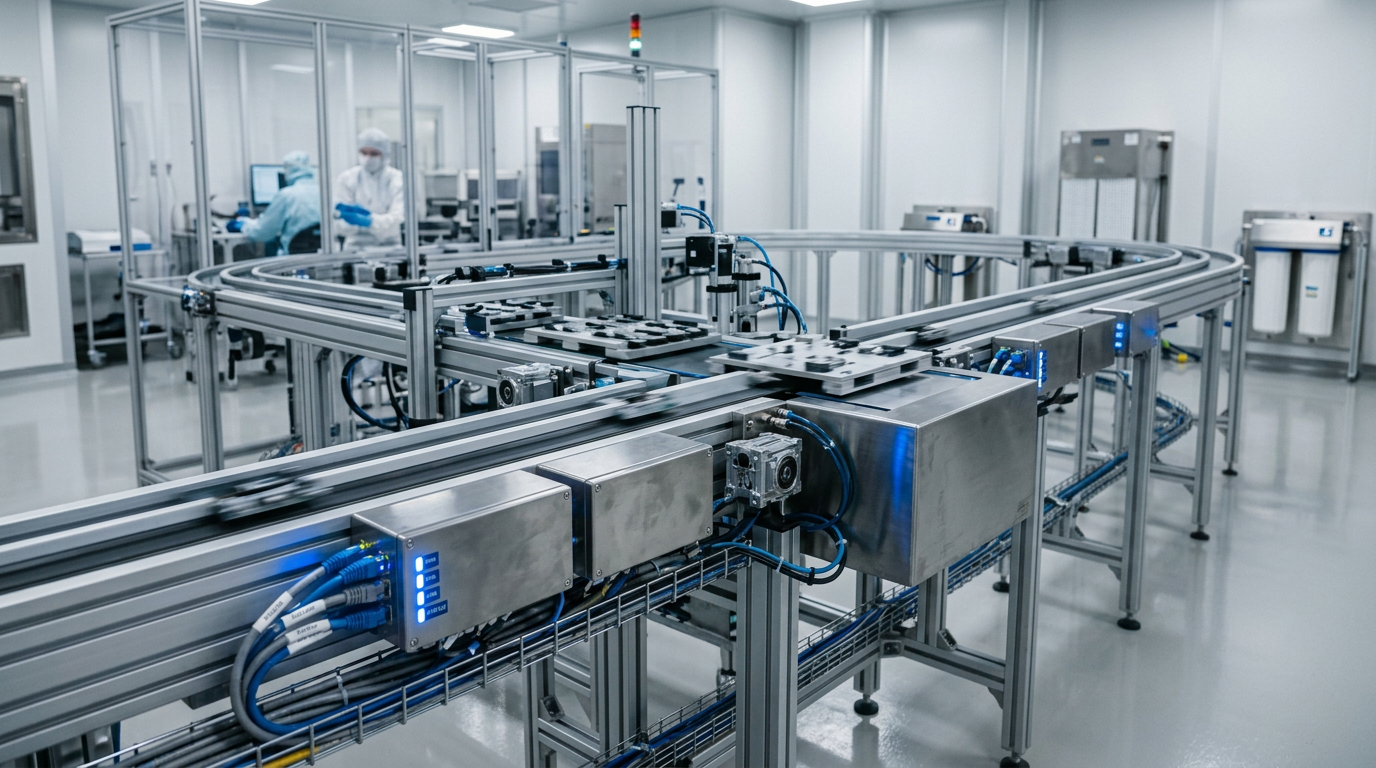
For modular systems used in complex layouts, Easy Conveyors provides the structural stability and precise chain movement necessary to minimize vibration, which is a primary cause of motion blur in machine vision applications.
Comparison: Integrated Smart Cameras vs. PC-Based Vision
Deciding between a self-contained smart camera and a PC-based vision system depends on the complexity of the packaging task.
| Feature | Smart Camera (Edge) | PC-Based Vision |
|---|---|---|
| Processing Power | Moderate | High (Multi-core CPU/GPU) |
| PLC Integration | Native Fieldbus (EDS/GSDML) | Requires Software Bridge |
| Number of Cameras | 1 per unit | Up to 8+ per PC |
| Environmental Rating | IP67 / IP69K | Often requires IP-rated enclosure |
| Cost per Point | High | Low (above 3 cameras) |
| Latency | Extremely Low | Variable (OS dependent) |
Easy Conveyors stocks the industrial automation discussed here — ready to ship across Europe.
The Role of VFDs and Motor Control in Vision Accuracy
Variable Frequency Drives (VFDs) impact vision performance more than many engineers realize. A "hunting" motor or inconsistent belt tension leads to variable product spacing, which can cause the vision system to miss triggers.
Utilizing VFD soft-start tuning ensures that the conveyor reaches a stable velocity before inspection begins. Furthermore, high-efficiency motors, such as those meeting the IEC 60034-30-1 IE3/IE4 classes, provide the consistent torque required to maintain a steady line speed even under varying loads. If the line requires frequent washdowns, specialized hygienic wash-down design for both the conveyor frame and the camera housing is mandatory to prevent lens fogging or equipment failure.
Advanced Logic: Sorting and Rejection
Once the vision system processes an image, it returns a result to the PLC. The PLC then manages the "Shift Register" or "FIFO" (First-In, First-Out) buffer.
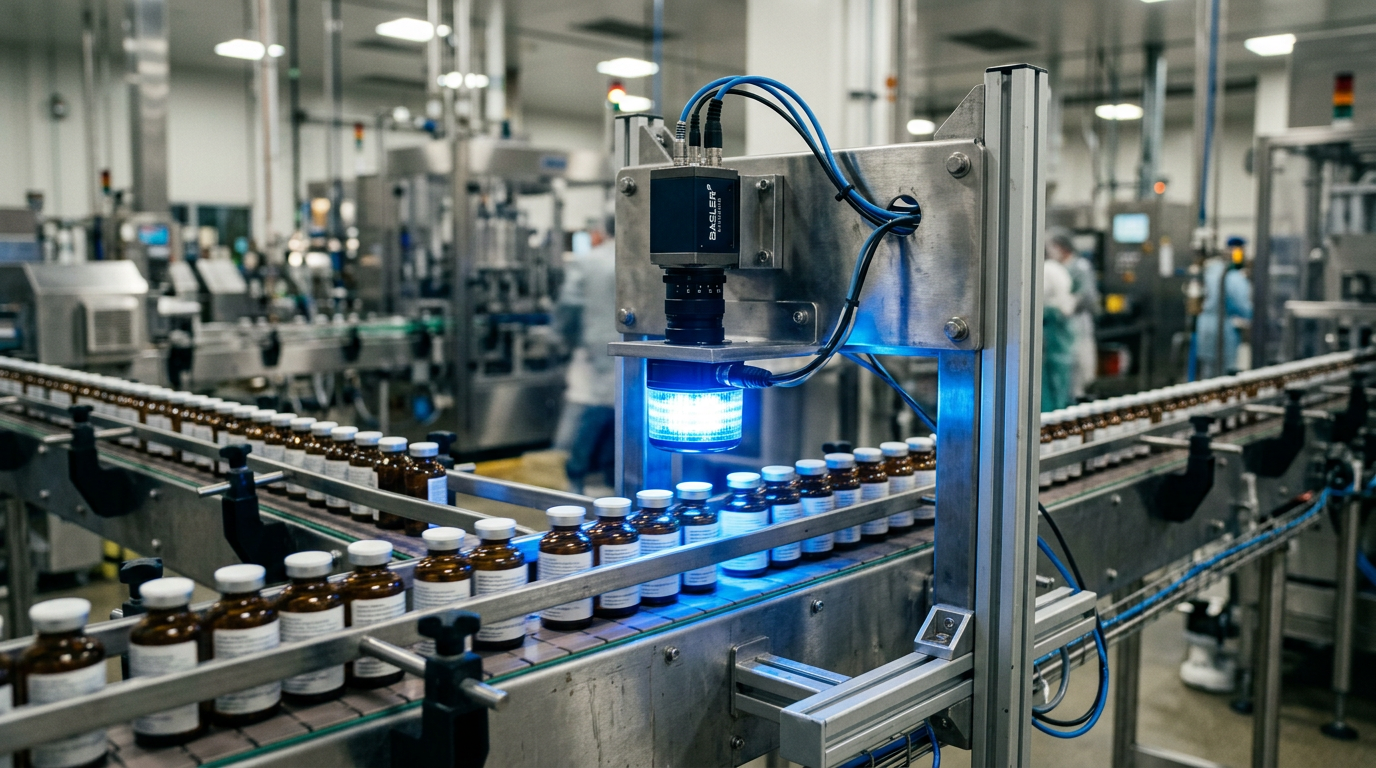
- Inspection State: The camera identifies a misaligned label on a pharmaceutical bottle.
- Logic Update: The PLC marks a specific bit in its tracking array as "Bad Product" at a specific encoder count.
- Execution: As that bottle reaches the pneumatic pusher or air-blast nozzle 2 meters later, the PLC fires the output at the exact millisecond required to eject the bottle without disturbing neighboring "Good" products.
This logic is often paired with drum motor selection strategies that favor high-torque, low-inertia motors to allow for rapid indexing if the line requires stop-and-go inspection rather than continuous flow.
Managing Lighting and Environmental Factors
The PLC integration often includes controlling the illumination. To extend the life of high-intensity LED strobes and prevent operator eye fatigue, the PLC can pulse the lighting only when a trigger is active.
- Backlighting: Ideal for checking fill levels in translucent containers.
- Ring Lighting: Best for label presence and OCR (Optical Character Recognition).
- Coaxial Lighting: Used for highly reflective surfaces like aluminum cans or foil packaging.
Ensuring the vision system is mounted on a vibration-isolated segment of the conveyor—standard practice in high-quality modular systems—is essential for maintaining the focus of the lens (typically 12mm to 25mm focal lengths in packaging).
Failure Modes and Troubleshooting
System designers must account for "fail-safe" logic. If the vision system loses communication, the PLC must decide whether to stop the line or divert all products to a "rework" bin.
Common integration failures include:
- Jitter: Unstable network traffic causing the trigger to arrive after the product has passed. Use VLANs to isolate vision traffic.
- Saturation: Too much data being sent to the PLC, exceeding its cycle time (Scan Time).
- Ambient Light Pollution: Changes in factory skylights affecting image contrast. Use enclosures or polarizing filters.
By following NEMA enclosure standards and ensuring proper grounding of Ethernet shielding, engineers can mitigate most electromagnetic interference (EMI) that plagues integrated automation lines.
Frequently Asked Questions
What is the best communication protocol for PLC-vision integration?
Most modern systems use Profinet, EtherNet/IP, or EtherCAT to handle the high data throughput and deterministic timing required for real-time inspection.
How does a PLC handle product tracking on a moving belt?
The PLC uses an incremental encoder on the conveyor to track the exact position of a product after a sensor trigger, ensuring the camera fires at the precise millisecond.
Can vision data slow down my PLC scan time?
Use an industrial router or managed switch to create a VLAN for vision traffic, preventing large image files from slowing down the PLC's critical control logic.
Can machine vision be used in hygienic washdown environments?
Yes, smart cameras often come with IP67 or IP69K ratings, making them suitable for food and beverage packaging lines requiring washdown procedures.