High-Speed PLC and Machine Vision Integration on Packaging Conveyor Lines
Learn how PLC and machine vision integration optimizes packaging conveyor lines. Covers high-speed Ethernet protocols, encoder tracking, and rejection logic for zero-defect manufacturing.
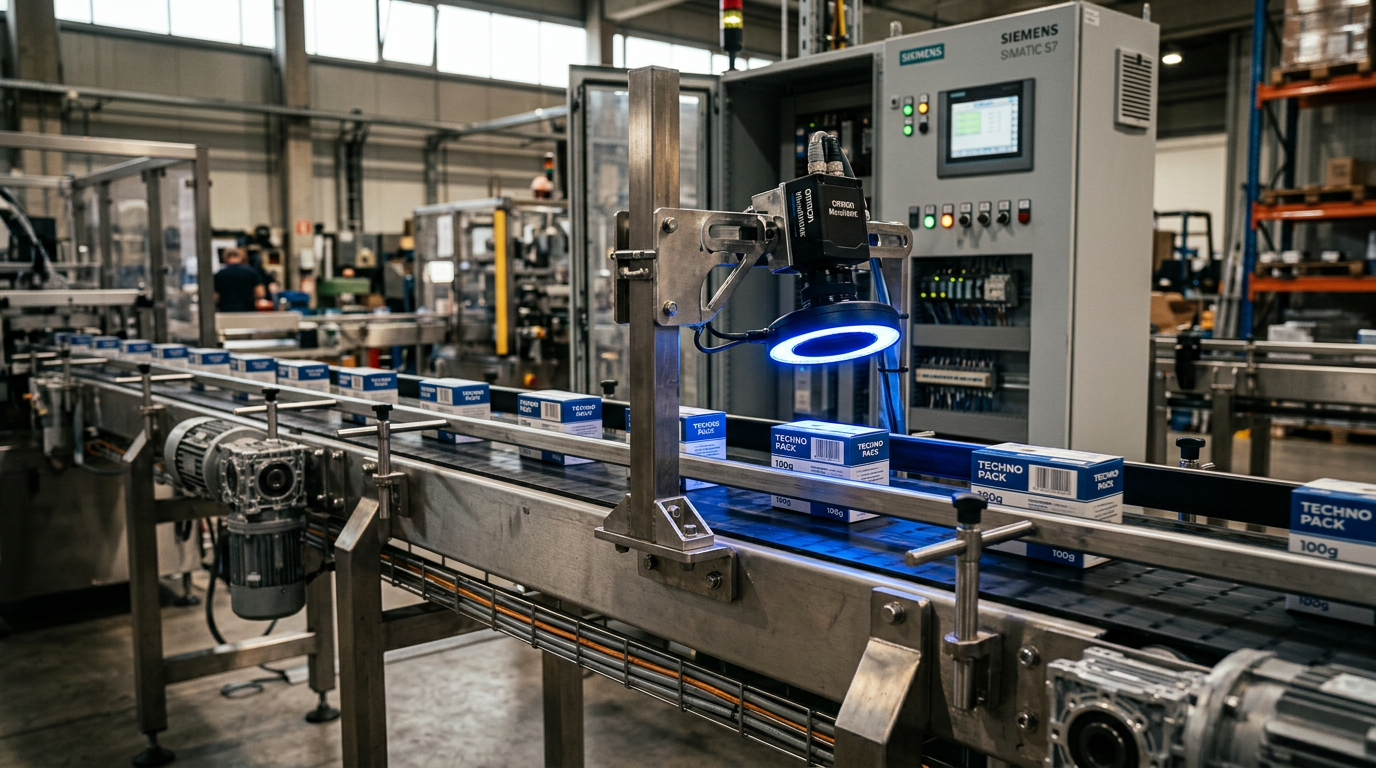
The integration of Programmable Logic Controllers (PLC) and machine vision systems on packaging conveyor lines relies on high-speed industrial Ethernet protocols to achieve a synchronization latency of less than 10 milliseconds, which is critical for accurate product rejection and sorting at belt speeds exceeding 2.0 m/s. Successful implementation requires the vision system to function as an "intelligent sensor" that feeds discrete data packets (Pass/Fail, Coordinate Offsets, or Barcode Strings) into the PLC’s process image via protocols such as PROFINET or EtherNet/IP.
The Architecture of Visual Inspection
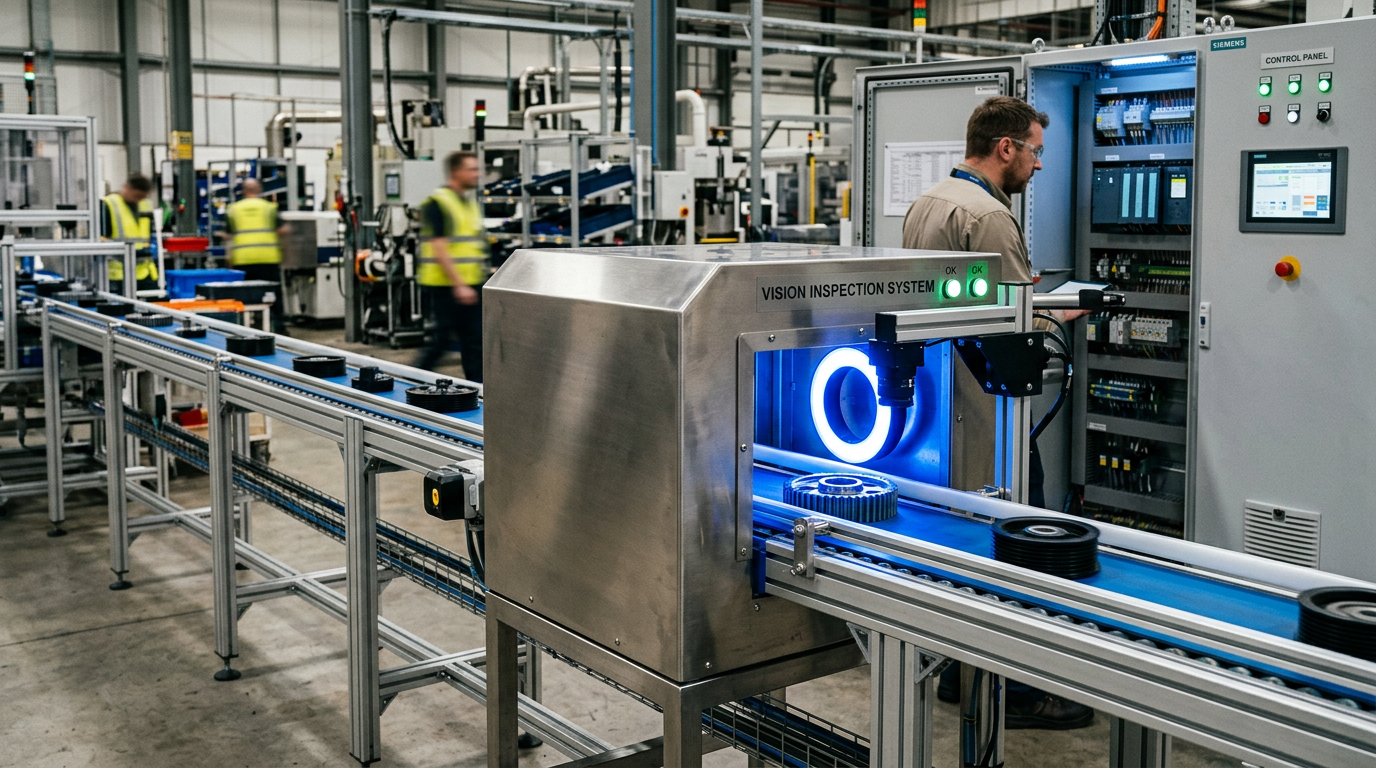
In modern packaging environments, the synergy between the PLC (the "brain") and the machine vision system (the "eyes") is what enables high-speed quality assurance. The PLC manages the conveyor's motion control, sensor timing, and actuator firing, while the machine vision system analyzes pixel data to make qualitative decisions.
To ensure seamless operation, systems typically follow a "Trigger-Process-Action" cycle. A photoelectric sensor detects the product's leading edge and signals the PLC. The PLC then calculates the precise moment to trigger the vision camera, accounting for the "trigger-to-exposure" lag. This timing is often managed using high-speed counter modules or encoder-based tracking within the PLC program.
Data Exchange Protocols
The physical layer of this integration is almost exclusively dominated by Industrial Ethernet. According to IEC 61158 standards, these protocols allow for deterministic communication:
- PROFINET: Preferred in Siemens-heavy European markets, offering Gbit/s speeds and "Isochronous Real-Time" (IRT) capabilities for sub-millisecond precision.
- EtherNet/IP: Common in North American Rockwell/Allen-Bradley environments, utilizing the Common Industrial Protocol (CIP).
- EtherCAT: Known for the lowest jitter, often used when the vision system must guide high-speed delta robots for pick-and-place packaging.
Critical Design Parameters for Packaging Lines
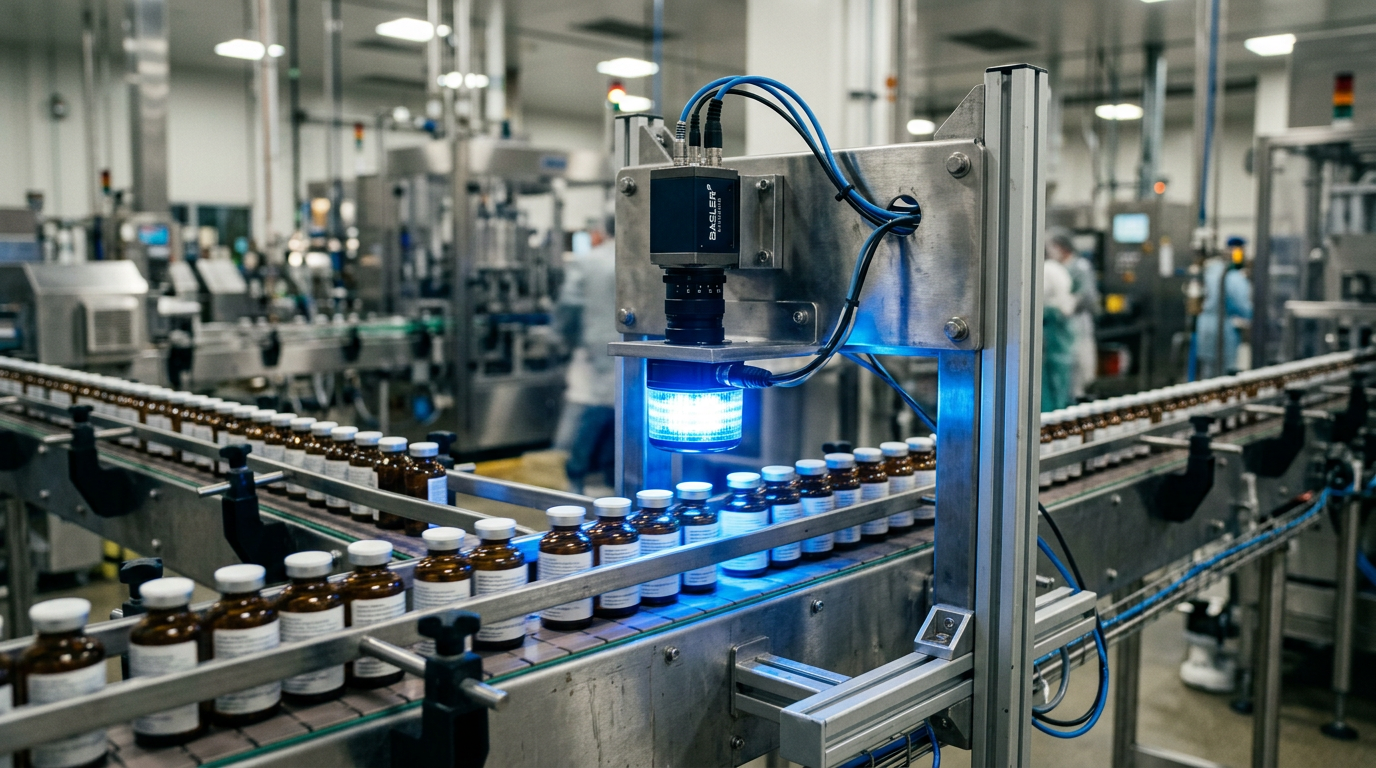
When designing a conveyor line for vision integration, the mechanical stability of the modular system is as important as the code itself. Vibrations or inconsistent belt speeds can lead to motion blur or "smearing" in the captured image, rendering the AI inspection algorithms useless.
| Parameter | Specification Requirement | Rationale |
|---|---|---|
| Belt Vibration | < 0.05 mm Amplitude | Prevents focus shift and image distortion. |
| Speed Consistency | ±0.5% Variance | Vital for encoder-based tracking and trigger timing. |
| Illumination | > 5000 Lux (Strobed) | Overpowers ambient factory lighting to maintain contrast. |
| Latency | < 15ms (End-to-End) | Essential for rejecting defective items at high RPM. |
| IP Rating | IP67 or IP69K | Necessary for hygienic wash-down design in food/pharma. |
Role of the Modular Conveyor
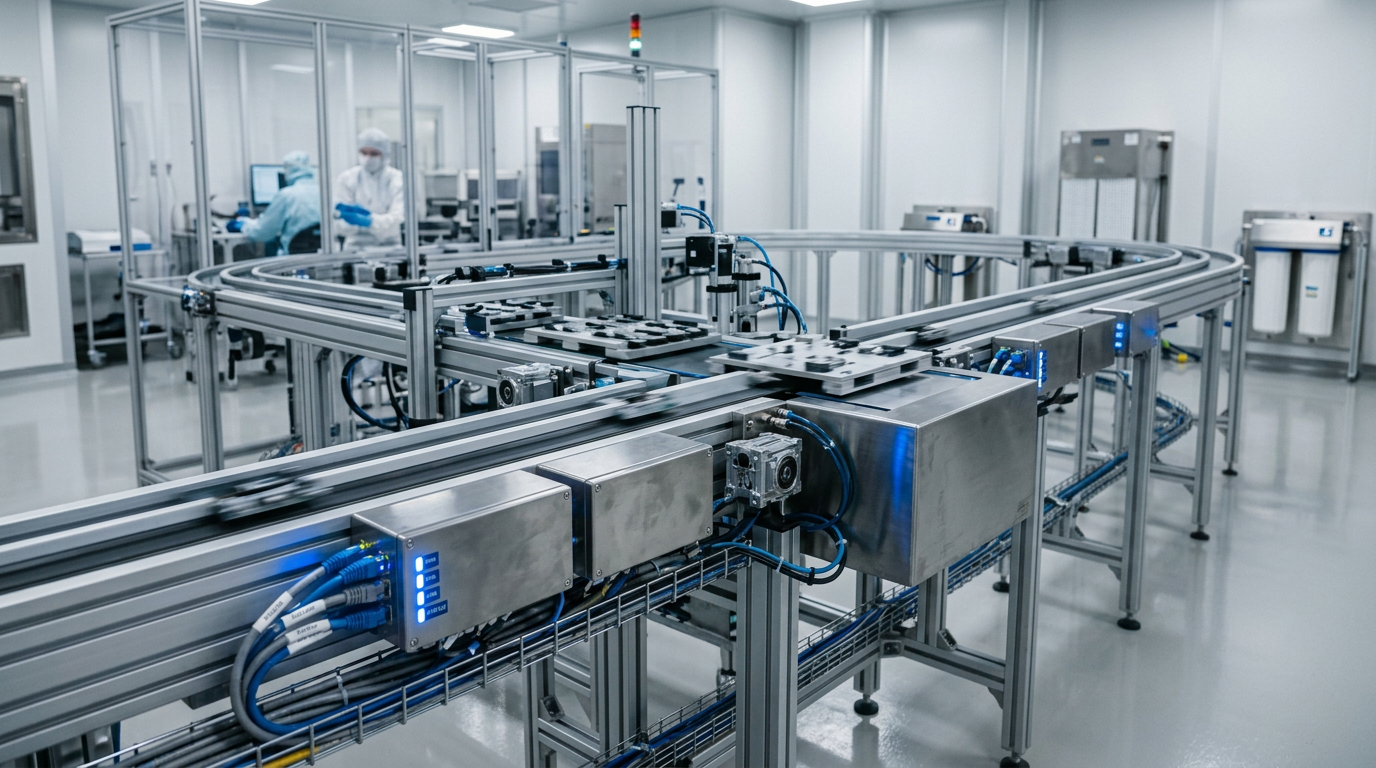
The choice of conveyor platform significantly impacts vision accuracy. For instance, Easy Conveyors provides modular aluminum and stainless steel chain systems that offer the structural rigidity required to mount high-resolution cameras without the risk of parallax errors caused by frame flexing.
Furthermore, integrating "gap-forming" conveyors—where the speed of successive modules is increased—allows for consistent product spacing. This spacing is a prerequisite for machine vision systems to distinguish between individual packages and to allow rejection gates or air blasts enough time to cycle between products.
Easy Conveyors stocks the industrial automation discussed here — ready to ship across Europe.
Synchronization and Encoder Tracking
On high-speed packaging lines, "Time-of-Flight" triggering is often insufficient. Instead, engineers use Encoder Tracking.
- The PLC receives a pulse train from an incremental encoder mounted on the conveyor drive shaft (complying with IEC 60034 motor standards).
- When a product is detected, the PLC records the current encoder count ($C_1$).
- The camera is triggered at $C_1 + \Delta_{trigger}$.
- If the vision system returns a "Fail" result, the PLC executes the reject command at $C_1 + \Delta_{reject}$.
This method ensures that even if the belt speeds up, slows down, or stops entirely, the "Bad" product is never lost in the buffer. This logic is a staple in "VFD soft-start tuning," where the acceleration ramps must be communicated to the vision processor to adjust exposure times dynamically.
Handling Rejection and Fail-Safe Logic
A common failure mode in PLC-Vision integration is the "Missed Trigger." If the PLC expects a vision result but doesn't receive one within a defined timeout window, the system must default to a "Fail-Safe" state. On a high-speed line, this usually means rejecting the item as if it were defective or halting the line to prevent uninspected goods from reaching the palletizer.
Advanced systems now utilize OPC UA for "Vertical Integration." While the PLC handles the real-time rejection, the vision system sends rich metadata (images of the failure, statistical distributions of tolerances) to a SCADA or MES system for long-term quality tracking. This level of traceability is often a regulatory requirement in pharmaceutical packaging (FDA 21 CFR Part 11).
Machine Learning at the Edge
The newest generation of vision sensors incorporates "Edge AI." Unlike traditional rule-based tools (measuring pixel contrast), these systems use neural networks to identify complex defects like torn shrink-wrap or misaligned labels. Integrating these with a PLC requires broader data registers. Instead of a single bit for "Pass/Fail," the PLC might read a "Confidence Score" (0-100%). Engineers can then program the PLC to divert "low confidence" items to a manual inspection station rather than the scrap bin, reducing Total Cost of Ownership (TCO).
Optimizing these systems also involves "drum motor selection" to ensure low-inertia starts and stops, reducing the mechanical stress on the vision mounts during emergency stop events. By combining rigid modular hardware with deterministic PLC logic and AI-driven vision, manufacturers can achieve near-zero defect rates at throughputs exceeding 1,000 parts per minute.
Frequently Asked Questions
What is the best communication protocol for PLC-Vision integration?
Industrial Ethernet protocols like PROFINET or EtherNet/IP are preferred for their high speed, determinism, and ability to handle both discrete signals and large data packets required by vision systems.
How much latency is acceptable for a rejection system?
A latency of less than 15ms is standard for high-speed packaging. If the latency is too high, the reject mechanism may miss the defective product, especially at belt speeds over 1.5 m/s.
Why is encoder tracking better than time-based triggering?
Encoder tracking allows the PLC to monitor the product's position based on physical belt movement rather than time. This ensures accuracy even if the conveyor speed fluctuates or stops.
What happens if the vision system fails to trigger?
A 'fail-safe' logic ensures that if the vision system fails to send a signal or loses power, the PLC automatically rejects all uninspected products to prevent quality leakage.
Does the type of conveyor impact vision accuracy?
Modular conveyors, such as those from Easy Conveyors, are designed for high rigidity. This prevents camera vibration and ensures the product remains in a fixed focal plane, which is critical for high-resolution inspection.