Optimizing Pharmaceutical Track-and-Trace Conveyor Line Layouts
Optimize pharmaceutical track-and-trace conveyor layouts for 99.9% read rates. Learn about vibration dampening, indexing accuracy, and global serialization standards.
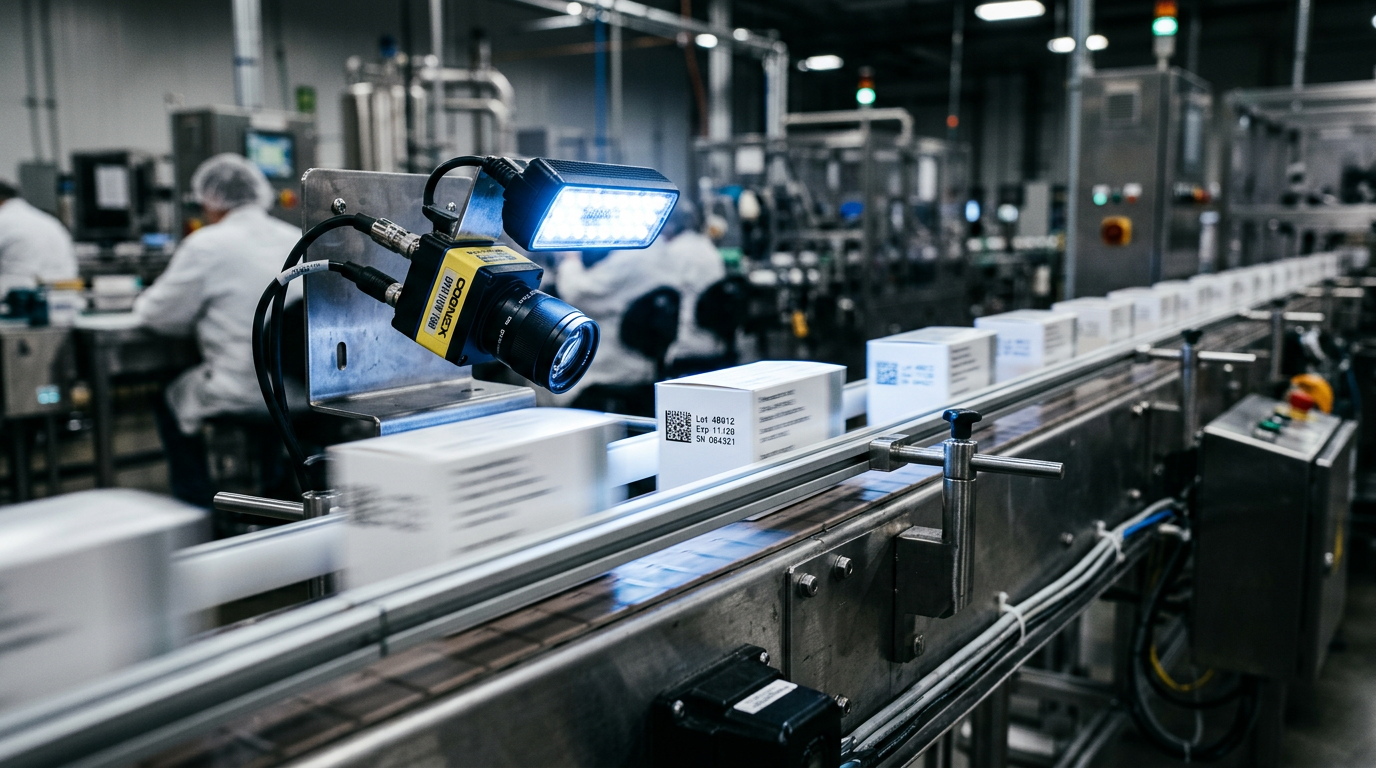
Implementing pharmaceutical track-and-trace conveyor line layouts requires a minimum of 300mm to 500mm of stabilized, vibration-free travel distance per inspection station to ensure 99.9% read rates at speeds exceeding 60 meters per minute. According to ISO 11607 and global serialization mandates, layout design must prioritize precise product orientation and lighting consistency to support the high-resolution imaging required for GS1 DataMatrix ECC200 codes.
The Engineering Foundation of Serialization Layouts
Track-and-trace (T&T) in pharmaceutical manufacturing is no longer just a compliance requirement; it is a high-speed data acquisition challenge. As global regulations like the EU Falsified Medicines Directive (EU FMD) and the US Drug Supply Chain Security Act (DSCSA) tighten, the conveyor system becomes the literal backbone of the digital thread.
A successful layout is dictated by the physics of optics. For a camera to capture a 2D barcode on a folding carton or vial, the product must be perfectly stable. Any lateral vibration or vertical "bounce" can result in motion blur, leading to rejected products and decreased Overall Equipment Effectiveness (OEE).
Key Design Parameters for Track-and-Trace Lines
- Pitch Control: Products must be spaced precisely. This is often achieved using timed screw feeders or high-friction "indexing" belts.
- Vibration Dampening: The conveyor frame must be decoupled from heavy vibratory equipment like checkweighers or case packers.
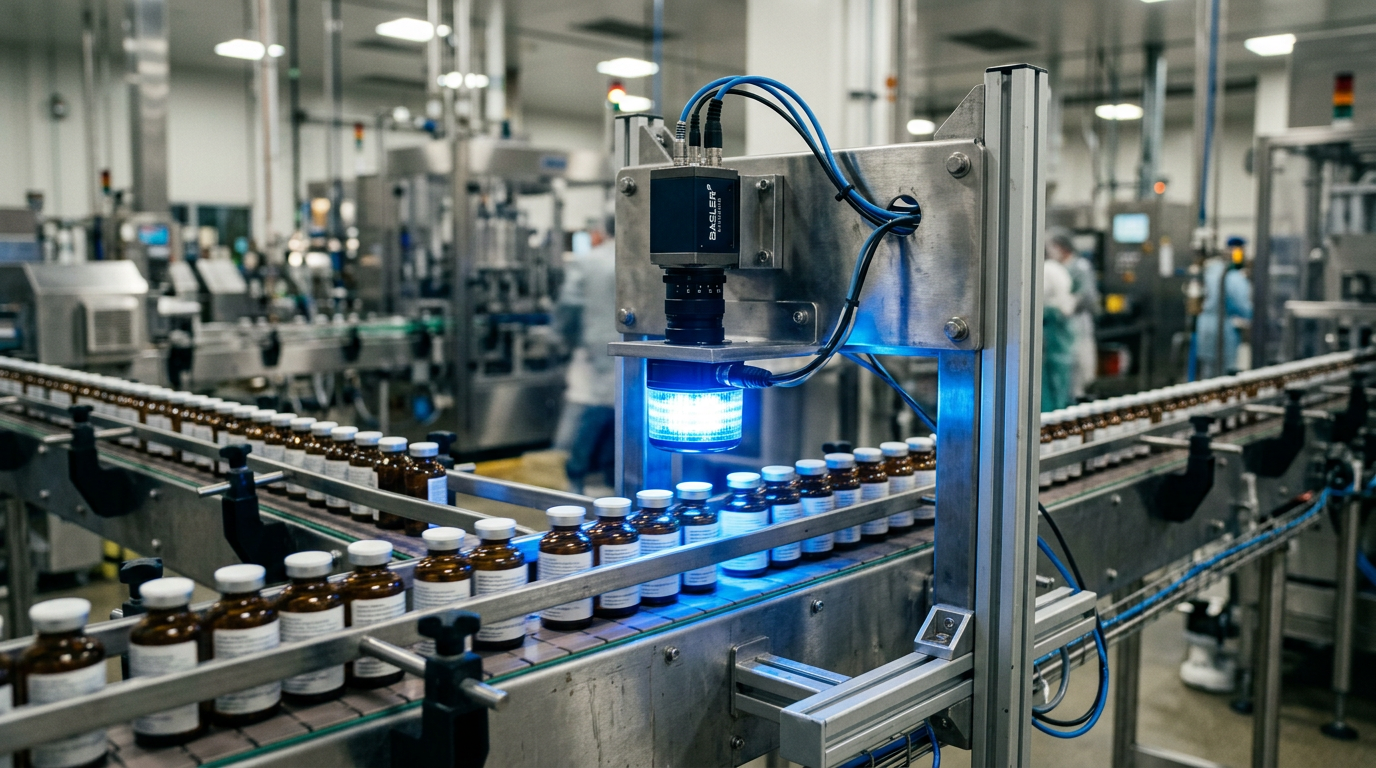
- Lighting Integration: Layouts must provide 360-degree access for multi-camera arrays or integrated strobe lighting without casting shadows from the conveyor side rails.
Layout Configuration Types
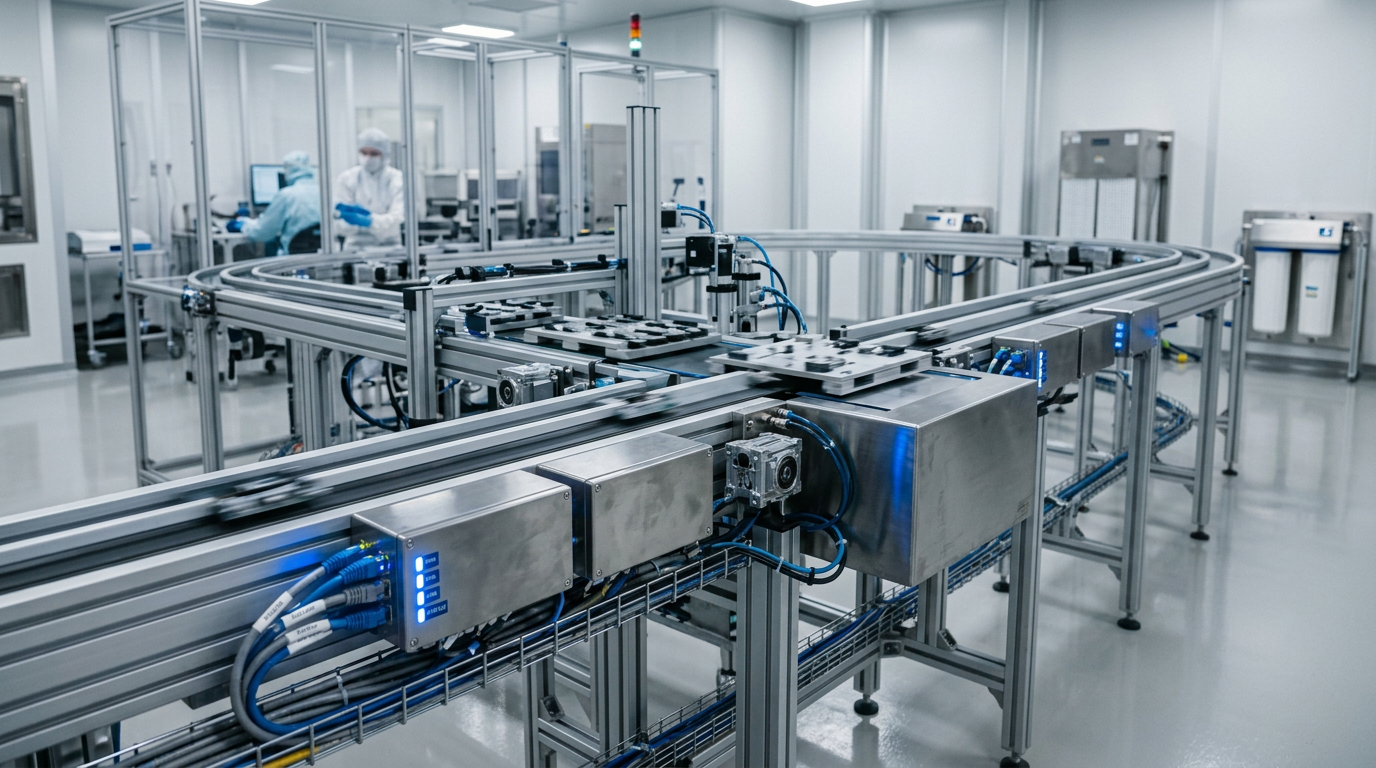
The choice of conveyor layout depends on the packaging format (cartons, vials, or bottles) and the available floor space. In modern facilities, modularity is the primary driver of layout flexibility.
1. The Inline Serialization Cell
This is the most common layout for folding cartons. It typically features a narrow-profile conveyor with high-grip belts. Because the inkjet or laser coder needs a flat surface, the conveyor often includes a "top-stabilizer" belt to hold the carton firmly against the transport surface during the printing and curing phase.
2. The Bottom-Coding Layout
For cylindrical containers like vials or bottles, codes are often applied to the bottom. This requires a "gap transfer" layout where two side-grip conveyors (often using soft POM or rubber-coated chains) suspend the product by its sides, leaving the bottom exposed for a bottom-up camera and coder. Easy Conveyors specializes in these high-precision modular links that allow for such narrow-profile side-gripping applications.
3. The 90-Degree Transfer Layout
When space is limited, track-and-trace lines often utilize a 90-degree turn. However, traditional radius turns can cause products to shift or rotate. Engineers prefer "pop-up" transfer modules or right-angle pushers to maintain the orientation of the barcode relative to the next inspection station.
Technical Specifications for T&T Conveyors
| Feature | Specification | Standard/Reference |
|---|---|---|
| Belt Material | Anti-static POM or PET | FDA 21 CFR |
| Motor Type | Servo or IE4 Synchronous | IEC 60034-30-1 |
| Speed Stability | < 0.5% Variation | Required for Coder Sync |
| IP Rating | IP66 (Washdown) | IEC 60529 |
| Code Grade | Grade B or higher | ISO/IEC 15415 |
Easy Conveyors stocks the industrial automation discussed here — ready to ship across Europe.
Overcoming Common Failure Modes
Motion Blur and Jitter
Even the highest resolution 5MP cameras will fail if the conveyor "stutters." This is often caused by incorrect VFD soft-start tuning or mechanical resonance in the conveyor frame. Using high-efficiency motors, such as those meeting IE4 or IE5 standards, ensures smoother torque delivery at low speeds.
Glare and Optical Interference
In pharmaceutical environments, stainless steel surfaces are common. However, highly reflective conveyor side guides can cause "hot spots" in the camera’s field of view. Layout designers should use matte-finish anodized aluminum or black POM guides in the "inspection zone" to mitigate this.
Reject Handling
A track-and-trace line is only as good as its reject mechanism. The layout must include a "fail-safe" reject station. If a code is unreadable, the system must physically remove the item and, more importantly, confirm the removal via a "reject-verification" sensor. If the sensor does not detect the rejected item falling into the bin, the entire line must execute an E-stop to prevent an unverified product from reaching the palletizer.
Integration with Automation Ecosystems
Modern track-and-trace conveyors are rarely standalone units. They are nodes in an Industrial Ethernet network (Profinet or EtherNet/IP). The conveyor controller must communicate with the serialization software (L1/L2 layers) to associate a specific serial number with a specific position on the belt.
This requires advanced modular conveyor systems that support "encoder feedback." By mounting a high-resolution encoder on the drive shaft, the system knows exactly how many millimeters a product has traveled since it passed the "trigger" sensor. This allows the camera to fire at the precise millisecond the product enters the focal point.
For facilities looking to scale, adopting a "standardized module" approach—where the inspection, printing, and rejection modules share a common mechanical and electrical interface—is essential. This reduces the engineering time required for hygienic wash-down design and simplifies the validation process (IQ/OQ/PQ) required by regulatory bodies.
Future Trends: AI and 3D Inspection
We are seeing a shift toward 3D layout analysis. Future track-and-trace lines will use 3D profiling sensors to detect not just the code, but also the physical integrity of the package (e.g., a crushed corner or a partially open flap). These sensors require even more stable conveyor platforms, as 3D reconstruction is highly sensitive to belt speed fluctuations.
Incorporating "smart" conveyor technology, where the rollers themselves can detect weight or friction changes, will allow for predictive maintenance. This ensures that a bearing failure never causes a "jitter" that results in a thousand rejected (and potentially destroyed) pharmaceutical doses.
Frequently Asked Questions
What is the required speed stability for serialization conveyors?
A pharmaceutical T&T conveyor requires a speed stability of +/- 0.5% to ensure the inkjet or laser coder applies the DataMatrix code without distortion. This usually requires high-quality VFDs and servo-driven motors.
How does conveyor vibration affect track-and-trace accuracy?
Vibration is the primary cause of 'No Reads' in T&T. Layouts should use heavy-duty, reinforced frames and keep the inspection zone physically separated from high-vibration equipment like reciprocating case packers.
Are there specific material requirements for pharmaceutical conveyor belts?
Yes, FDA 21 CFR and EHEDG guidelines often apply, especially in secondary packaging where hygiene is critical. Belts should be made of non-porous materials like POM or PET that do not shed particles.
What is a side-grip conveyor in pharmaceutical packaging?
Side-grip conveyors use two parallel belts to hold the container by its sides, leaving the bottom free for coding. This is essential for vials and bottles where the only available real estate for a barcode is the base.
What are the requirements for a fail-safe reject mechanism?
A fail-safe reject station must include 'Reject Confirmation.' A sensor must detect the product entering the reject bin. If it fails to detect this, the system must trigger a line stop to prevent 'orphan' products.