Optimizing Pallet Handling Conveyors for End-of-Line Automation
Optimize end-of-line automation with heavy-duty pallet handling conveyors. Learn about roller vs. chain technology, IE3 efficiency, and ISO safety standards.
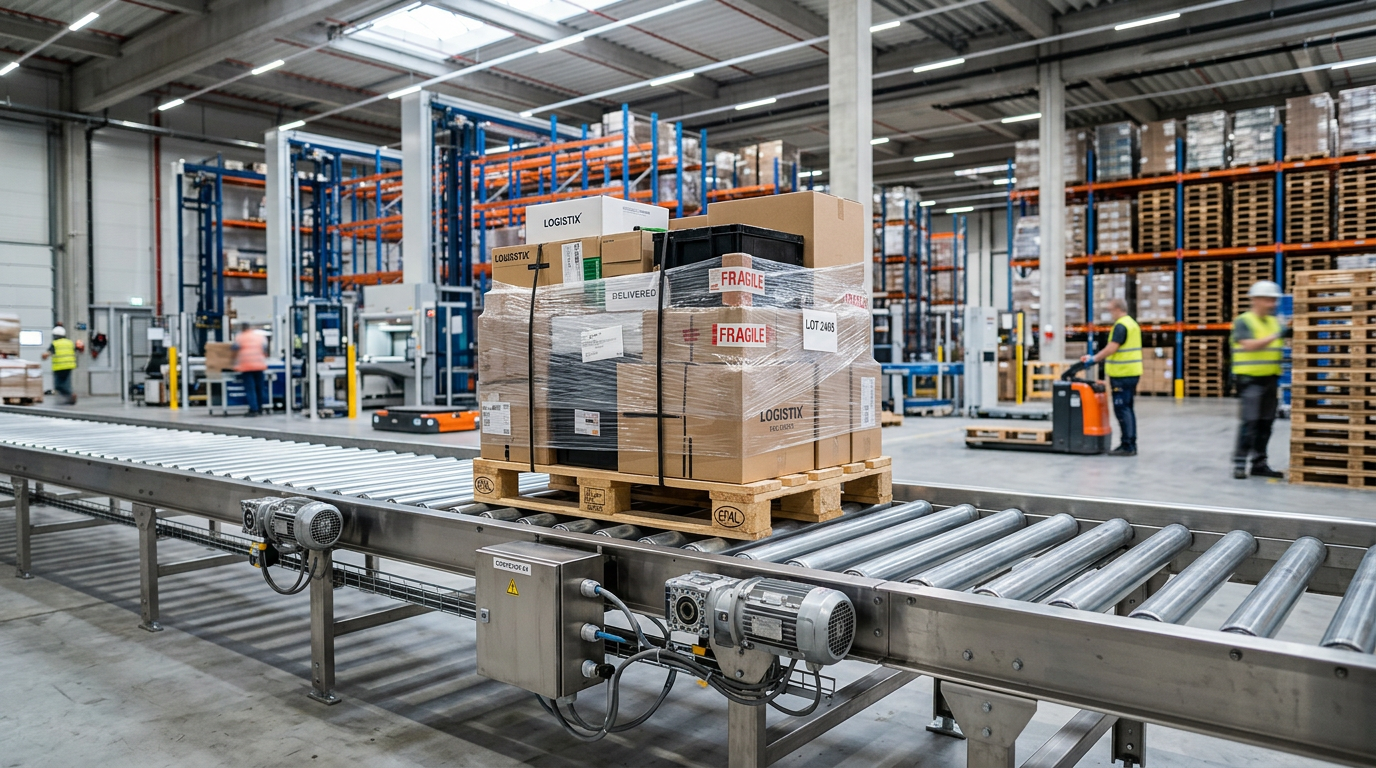
Modern end-of-line pallet handling systems improve throughput by up to 30% compared to manual forklift operations while reducing workplace injury risks by nearly 40%. Pallet conveyors serve as the critical bridge between primary packaging, robotic palletizing, and the automated storage and retrieval systems (ASRS) or shipping docks.
The Role of Pallet Conveyors in End-of-Line Automation
In high-volume manufacturing environments, the transition from individual unit packaging to bulk transport units—pallets—represents the final stage of internal logistics. End-of-line (EOL) automation aims to stabilize, label, and transport these heavy loads (typically ranging from 500 kg to 1,500 kg) with minimal human intervention.
Standardized pallet dimensions, such as the Euro-pallet (1200 x 800 mm) or the ISO Industrial Pallet (1200 x 1000 mm), dictate the design of the transport system. Compliance with ISO 6780 ensures that conveyor rollers, chains, and transfer units are correctly spaced to support the pallet's bottom deck boards, preventing sagging or structural failure during transit.
Core Technologies in Pallet Handling
Choosing the right transport medium depends on the pallet type, load weight, and environmental conditions.
1. Roller Conveyors (Driven)
Roller conveyors are the workhorse of EOL automation. They utilize heavy-duty steel rollers, often 60mm to 89mm in diameter, driven by chains or high-torque motor-driven rollers (MDR).
- Best for: Longitudinal transport of Euro-pallets where the deck boards are perpendicular to the rollers.
- Key Advantage: Ability to implement "Zero Pressure Accumulation" (ZPA), which prevents pallets from touching each other, reducing product damage.
2. Chain Conveyors
Chain conveyors typically utilize two or three strands of heavy-duty roller chain. These are essential when the pallet orientation requires the deck boards to run parallel to the direction of travel.
- Best for: Cross-wise transport or heavy loads exceeding 1,200 kg.
- Key Advantage: Extremely robust and less sensitive to debris or pallet damage than roller systems.
3. Modular Belt Pallet Conveyors
A hybrid solution using wide plastic modular belts. These provide a continuous flat surface, making them ideal for handling pallets of varying qualities or non-standard plastic pallets. Easy Conveyors offers versatile modular components that simplify the integration of these systems into existing packaging lines, allowing for rapid reconfiguration as production needs evolve.
Technical Specification Comparison
| Feature | Powered Roller (CDLR) | Chain Conveyor | Modular Belt Pallet |
|---|---|---|---|
| Typical Load Capacity | 500 – 1,500 kg | 1,000 – 2,500 kg | 500 – 1,200 kg |
| Max Speed | 12–20 m/min | 10–15 m/min | 15–25 m/min |
| Efficiency Class | IE3 / IE4 | IE3 | IE3 / IE4 |
| Maintenance Need | Moderate (Chain tension) | High (Lubrication) | Low (Self-lubricating) |
| Pallet Compatibility | Standard Euro/ISO | Best for 2-way entry | Universal / Plastic |
Automation Components and Safety Standards
Pallet handling is not merely about movement; it is about controlled positioning.
- Motor Selection: To meet European energy requirements, motors must comply with IEC 60034-30-1 efficiency classes. Most modern EOL systems utilize IE3 premium efficiency motors or IE4 permanent magnet motors to reduce operational costs.
- Sensors and Positioning: High-performance photoelectric sensors (e.g., from [
Easy Conveyors stocks the material handling discussed here — ready to ship across Europe.
Rockwell Automation](https://www.rockwellautomation.com/en-us/products/hardware/sensors-and-switches.html)) are used to detect pallet presence, gaps, and overhangs. In robotic palletizing cells, precision is paramount; conveyors often utilize VFDs (Variable Frequency Drives) to perform soft-starts and controlled ramps to a stop, ensuring the pallet is positioned within ±2mm.
- Safety Requirements: Systems must adhere to ISO 13849-1 for safety-related parts of control systems. This includes the integration of light curtains at entry/exit points and emergency stop circuits that safely de-energize the drive motors without losing the load's stability.
Design Considerations for EOL Integration
When designing a pallet conveyor layout for end-of-line automation, engineers must account for several critical factors:
Transfer Points and Directional Changes
Standard modules include Right-Angle Transfers (RAT) and Turntables. A turntable is often preferred for maintaining pallet orientation, whereas a chain-to-roller transfer is more cost-effective for 90-degree changes where orientation isn't critical.
Accumulation Logic
In EOL systems, the conveyor acts as a buffer between the palletizer and the forklift pick-up station. Implementing "Slug Accumulation" or "ZPA" (Zero Pressure Accumulation) ensures that if the downstream process stops, the upstream production can continue until the buffer is full.
Environmental Durability
In industries such as cold storage or food processing, components must withstand temperatures down to -30°C or high-pressure washdowns. Utilizing stainless steel frames and IP69K-rated motors (as defined by ISO 20653) prevents premature failure due to corrosion or moisture ingress.
Common Failure Modes and Maintenance
Despite their robust appearance, pallet conveyors are subject to extreme mechanical stress.
- Chain Elongation: In chain-driven roller conveyors, the drive chains will stretch over time. Automatic tensioners and regular lubrication schedules are vital to prevent jumping teeth.
- Bearing Fatigue: Rollers under constant 1,000 kg loads experience significant radial forces. Using precision-housed bearings with labyrinth seals extends the lifecycle.
- Sensor Misalignment: EOL areas are high-traffic zones. Forklift impacts are common. Protecting sensors with heavy-duty steel guards reduces downtime caused by "ghost" pallet detections or lost signals.
Scaling for the Future: ASRS and AGVs
The trend in end-of-line automation is the integration of conveyors with Automated Guided Vehicles (AGVs) and Autonomous Mobile Robots (AMRs). Modern pallet conveyors now feature "handshake" protocols (typically via PROFINET or EtherNet/IP) to coordinate pallet transfers to mobile robots. This eliminates the need for fixed guarding in certain zones, creating a more flexible and floor-space-efficient production environment.
When selecting a partner for these complex integrations, focusing on modularity is key. Systems that utilize standardized mechanical interfaces allow for easier "drum motor selection" and "VFD soft-start tuning," which are essential for long-term operational flexibility. Selecting a system that accommodates "hygienic wash-down design" even in non-food areas can also improve the overall longevity of the facility by making cleaning cycles more efficient.
By prioritizing standardized modules, high-efficiency motors, and robust safety protocols, manufacturers can ensure their end-of-line automation is a reliable asset rather than a bottleneck.
Frequently Asked Questions
When should I choose a chain conveyor over a roller conveyor for pallets?
While roller conveyors (CDLR) are standard, chain conveyors are superior when the pallet deck boards run parallel to the direction of travel or when loads exceed 1,500 kg. Roller conveyors are preferred for Zero Pressure Accumulation (ZPA) to prevent product damage.
What is Zero Pressure Accumulation (ZPA) in pallet handling?
ZPA is a control logic that ensures pallets never touch during accumulation. This is achieved by dividing the conveyor into zones, each with its own sensor and motor control, preventing the 'domino effect' of heavy pallets crashing into one another.
What are the critical safety requirements for pallet conveyors?
Pallet handling is hazardous due to high inertia. Systems must include emergency stops (E-stops), light curtains at entry/exit points, and physical guarding to prevent limb entrapment, all compliant with ISO 13849-1 standards.
Can pallet conveyors operate in sub-zero cold storage environments?
Yes, but they require specialized components. For cold storage (down to -30°C), you must use low-temperature lubricants, heaters for control panels, and specialized seals for bearings to prevent freezing and brittleness.