Pallet Handling Conveyors for End-of-Line Automation: A Design Guide
Optimize your end-of-line automation with high-capacity pallet conveyors. Learn about roller vs. chain technology, robotic integration, and Industry 4.0 trends.
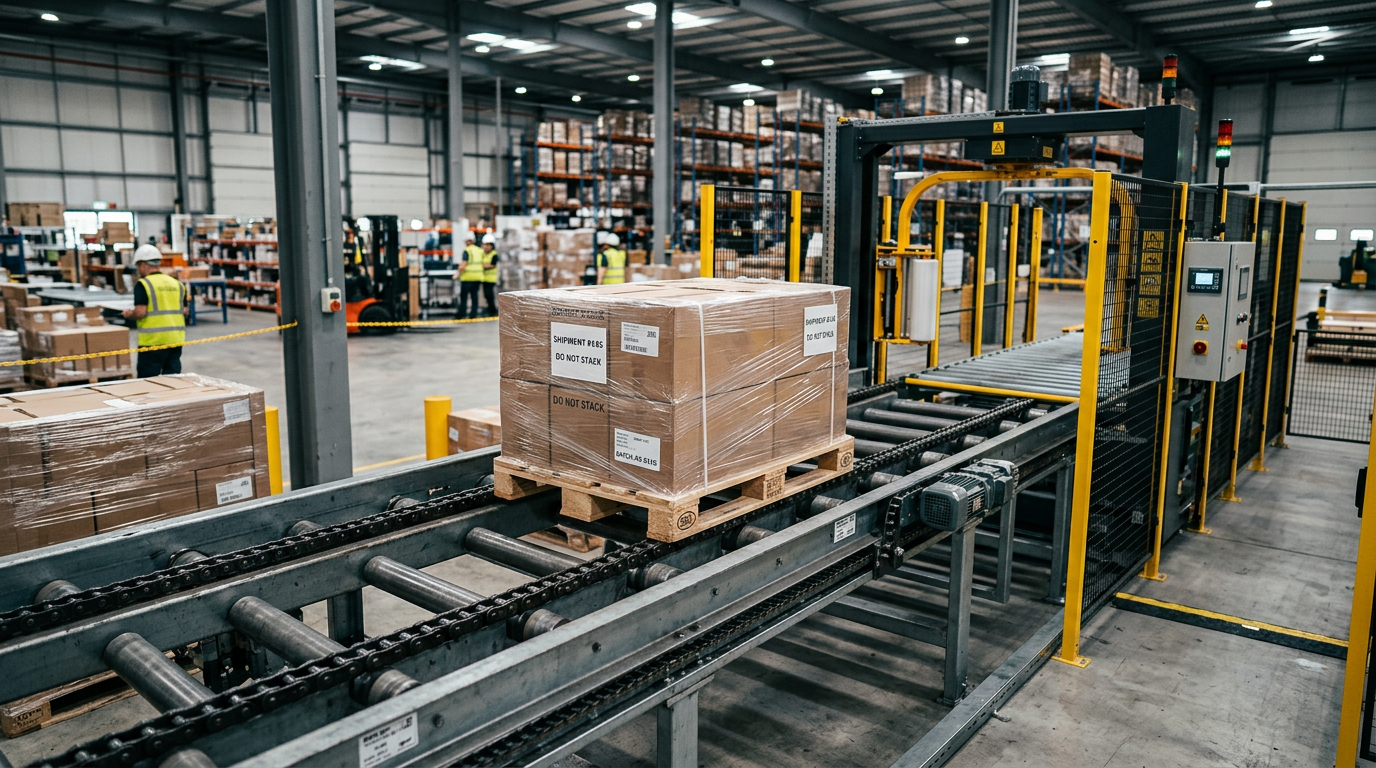
Modern end-of-line automation requires pallet handling conveyors to manage loads typically ranging from 500 kg to 1,500 kg with a positioning accuracy of ±1-2 mm for robotic palletizing. Utilizing heavy-duty modular components like wide-diameter twin-strand chains or heavy-duty rollers ensures high system availability and seamless integration with AS/RS (Automated Storage and Retrieval Systems) and robotic workcells.
The Role of Pallet Handling in End-of-Line Systems
End-of-line (EOL) automation is the bridge between production and distribution. While primary packaging handles the individual product and secondary packaging handles the case, tertiary handling—the pallet—is where the highest physical loads occur. A failure in the pallet conveyor system creates an immediate bottleneck that can shut down entire production halls.
Engineers must transition from light-duty "box" thinking to heavy-duty material handling. This involves selecting systems capable of managing standard pallet sizes (ISO 1, Euro, or Industrial pallets) while maintaining the structural rigidity required for high-speed robotic interaction. In this environment, the choice between chain conveyors and roller conveyors is driven primarily by the pallet's orientation, bottom structure, and the presence of automation peripherals like turntables and transfer units.
Comparing Pallet Conveying Technologies
The selection of a pallet conveyor depends on the orientation of the pallet stringers relative to the direction of travel. If the stringers are perpendicular to the flow, rollers are standard; if they are parallel, multi-strand chain systems are required to prevent sagging or "crabbing."
| Feature | Heavy Duty Roller Conveyor | Multi-Strand Chain Conveyor | Twin-Track Modular Belt |
|---|---|---|---|
| Typical Load Capacity | Up to 2,000 kg/m | Up to 1,500 kg/strand | 500 - 1,200 kg |
| Best For | Roller-ready pallets (Euro) | Non-standard or weak pallets | High-friction requirements |
| Motor Efficiency | IE3 or IE4 gearmotors | IE3 chain drives | Specialized drum motors |
| Positioning Accuracy | Low (±10mm) | Moderate (±5mm) | High (±1-2mm) |
| Maintenance Need | Low (bearing lubrication) | Moderate (chain tensioning) | High (belt tracking) |
Key Components of an Automated Pallet Line
1. Heavy-Duty Roller Conveyors
These are the workhorses of end-of-line automation. For automated environments, rollers are typically driven by a tangential chain or a chain-to-chain drive system. In many modern facilities, Easy Conveyors provides modular roller solutions that allow for rapid reconfiguration as warehouse layouts evolve. Standard roller diameters for pallet handling are 60mm or 80mm, with wall thicknesses exceeding 3mm to withstand the impact of forklift loading.
2. Chain Conveyors (Two or Three Strand)
When pallets must be moved "long-side-leading" or when the bottom of the pallet is irregular (like a plastic skid or a damaged wooden pallet), chain conveyors are used. They provide a stable, flat surface. The use of 3/4-inch or 1-inch pitch chains is common. For robotic cells, these chains are often fitted with specialized accumulation links to prevent backpressure from damaging the load during a backup.
3. Transfer and Rotation Modules
Automated lines rarely run in a straight line. Right-angle transfers (using pop-up chains or rollers) and turntables are critical. Turntables are essential for aligning pallets for stretch-wrapping or for presenting a specific "labels-out" face to a barcode scanner. These modules require high-torque precision motors and often utilize **[VFD](/glossary#vfd-variable-frequency-dr
Easy Conveyors stocks the material handling discussed here — ready to ship across Europe.
ive) soft-start tuning** to prevent "pallet shift"—where the load slides off the pallet due to aggressive acceleration.
Integration with Robotic Palletizers
Robotic palletizing is the standard for end-of-line automation in the food, pharma, and automotive sectors. The conveyor system must provide more than just transport; it must provide data.
- Zero-Pressure Accumulation (ZPA): To prevent pallets from crashing into each other, ZPA logic is essential. Each zone (typically one pallet length) operates independently. When the downstream zone is occupied, the upstream zone stops.
- Precision Centering: Before a robot can pick a layer or place a case, the pallet must be perfectly centered. Pneumatic or electric "squaring" units are integrated into the conveyor frame to push the pallet against a fixed datum point, achieving the necessary ±2mm tolerance.
- Sensor Integration: Inductive sensors detect pallet presence, while photoelectric beams verify height and overhang. If a pallet is "out of profile" (e.g., a loose board or a shifted load), the conveyor must divert it to a manual inspection station before it enters an automated wrapper or warehouse stacker.
Essential Design Standards and Safety
For European and North American markets, pallet handling equipment must adhere to stringent safety and efficiency standards:
- ISO 13849-1: Ensures the safety-related parts of the control system (like E-stops on a 50-meter conveyor run) meet specified Performance Levels (PL).
- IE3/IE4 Motors: With the high energy demands of moving tons of material, high-efficiency motors are mandatory for reducing operational expenditure (OPEX).
- IP65/IP69K Ratings: While standard warehouse lines may only need IP54, end-of-line systems in food and beverage often require higher protection for wash-down hygiene.
Drive Systems and Motor Selection
The choice between a traditional side-mounted gearmotor and a drum motor is a major design trade-off. Gearmotors offer easier maintenance access but take up more floor space—a critical factor in cramped production halls. Drum motor selection for pallet loads requires careful consideration of thermal dissipation; because pallet conveyors often stop and start frequently (cycling), the motor must be rated for high-frequency S3 duty cycles.
Integrating an intelligent control layer, often using IO-Link for sensor data, allows for predictive maintenance. By monitoring the current draw of the motor, maintenance teams can identify a degrading bearing or a stretched chain before it causes a catastrophic failure. This type of "smart" material handling is the hallmark of Industry 4.0 end-of-line systems.
Maintenance and Failure Modes in Heavy Handling
Despite their robust appearance, pallet conveyors are susceptible to specific failure modes:
- Chain Stretch: In chain conveyors, uneven stretch between the two strands will cause the pallet to skew, leading to jams.
- Bearing Contamination: In dusty environments like grain or cement packaging, bearings must be shielded or fitted with automatic lubrication systems.
- Debris Build-up: Wooden pallet splinters can clog logic sensors or jam rollers. Regular "blow-out" schedules and debris trays are essential for hygienic wash-down design in regulated industries.
By focusing on modularity, engineers can ensure that when production needs change—such as moving from Euro pallets to half-pallets—the conveyor system can be modified with minimal downtime. The goal is a seamless, silent, and safe flow of finished goods from the palletizer to the truck.
Frequently Asked Questions
When should I choose chain conveyors over roller conveyors for pallets?
While roller conveyors are cheaper, use chain conveyors if the pallet stringers are parallel to the travel direction, if the pallets are non-standard, or if the load exceeds the contact pressure limits of standard rollers.
What is the standard roller diameter for 1,500kg pallet loads?
Standard pallet loads (up to 1,500kg) typically use 60mm or 80mm diameter rollers with a wall thickness of at least 3mm to prevent deformation under static and dynamic loads.
What does ZPA mean in the context of pallet handling?
Zero-Pressure Accumulation (ZPA) is a control logic where conveyor zones operate independently to ensure pallets never touch each other, preventing product damage and allowing for buffer storage.
How do I achieve high positioning accuracy for robotic palletizing?
For robotic palletizing, conveyors should include pneumatic squaring/centering stations to achieve a positioning accuracy of ±1-2mm.
Can modular belts be used for heavy pallet handling?
Yes, but they require high-friction top surfaces and precise VFD control to manage acceleration ramps (soft-start) to prevent the pallet from sliding.