Mastering Pallet Handling Conveyors for End-of-Line Automation
Discover the technical essentials of pallet handling conveyors for end-of-line automation. Learn about chain, roller, and modular belt systems for heavy industrial loads.
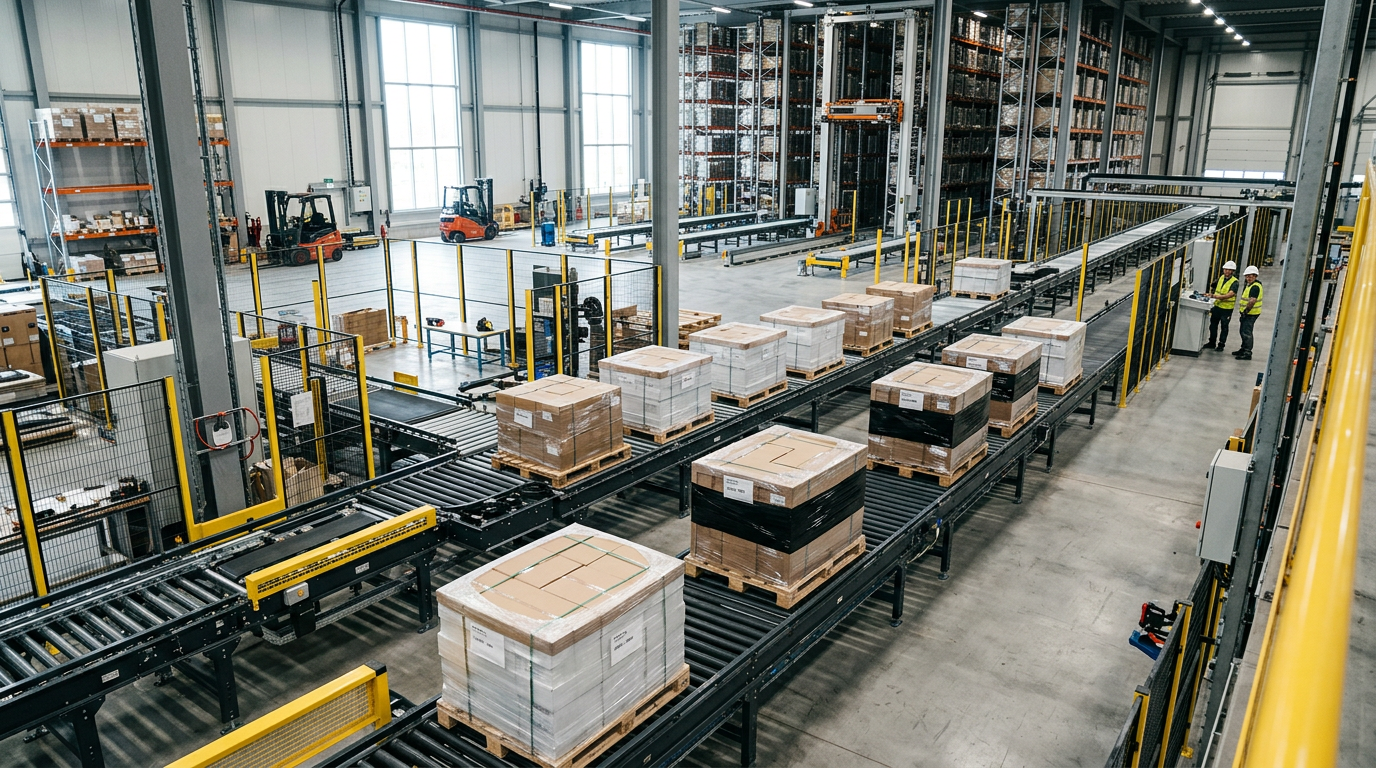
Pallet handling conveyors for end-of-line automation are heavy-duty transport systems designed to move, rotate, stack, and stabilize palletized loads (typically 500kg to 2,000kg) between robotic palletizers, wrapping units, and shipping docks. These modular systems integrate chain, roller, and turntable modules to provide a seamless transition from production to logistics.
Successful end-of-line (EOL) automation relies on the predictable movement of finished goods. As manufacturers move toward Industry 4.0, the "islands of automation"—the standalone palletizer or the individual stretch wrapper—are being bridged by intelligent pallet conveyor networks. These networks do more than move weight; they manage data flow, provide buffering for forklift transitions, and ensure safety in high-traffic zones.
Core Technologies in Pallet Conveying
The selection of a pallet conveyor depends on the pallet type (Euro, CHEP, GMA), the weight of the load, and the hygiene requirements of the facility. Manufacturers typically choose between three primary drive technologies.
1. Multi-Strand Chain Conveyors
Chain conveyors use two or three strands of heavy-duty roller chain to support the pallet. They are the preferred choice for transporting pallets with bottom boards oriented perpendicular to the direction of travel.
- Best for: Rugged environments, heavy loads up to 2,000kg, and pallets with irregular undersides.
- Design Tip: Ensure the chain tracks are precisely aligned to prevent "crabbing" or premature wear on the drive sprockets.
2. Heavy-Duty Roller Conveyors
Driven by precision-engineered chains or tangential belts, roller conveyors provide a smooth surface for pallets with consistent bottom runners. For EOL automation, these are often equipped with zero-pressure accumulation (ZPA) logic to prevent pallets from colliding.
- Best for: Smooth transportation, long straight runs, and integration with weight scales.
- Efficiency: Modern systems utilize IE3 or IE4 efficiency class motors to reduce the carbon footprint of the logistics hall.
3. Modular Plastic Belt Pallet Conveyors
Emerging as a versatile alternative, modular plastic belts offer full-width support. This is critical for fragile loads or half-pallets that might dip between traditional rollers. Easy Conveyors specializes in modular systems that allow for rapid reconfiguration, proving essential for facilities handling diverse SKU footprints.
Technical Comparison of Selection Criteria
| Feature | Chain Conveyor | Roller Conveyor (CDLR) | Modular Belt |
|---|---|---|---|
| Load Capacity | Up to 2,500 kg | Up to 1,500 kg | Up to 1,200 kg |
| Typical Speed | 10–18 m/min | 12–25 m/min | 15–30 m/min |
| Maintenance | Medium (Lubrication) | Low (Sealed Bearings) | Very Low |
| Accumulation | Difficult/Mechanical | High (ZPA Electronic) | Moderate |
| Noise Level | 75–80 dB | 70–75 dB | < 70 dB |
| Standard Pitch | N/A | 130mm / 150mm | N/A |
Integrating End-of-Line Modules
A complete pallet handling circuit is rarely a straight line. To navigate the plant floor, several specialized modules are integrated into the "conveyor vs AGV selection" strategy during the plant design phase.
Turntables and Right-Angle Transfers
When a pallet needs to change orientation or direction in a tight footprint, turntables or pop-up chain transfers are used.
- Turntables: Rotate the entire pallet 90°, 180°, or 270°. These are preferred when the pallet's leading edge must remain the same for entry into a stretch wrapper.
- Chain Transfers: These lift the pallet off rollers using internal chain strands, moving it at a 90° angle without rotating the load. This is faster but changes the "leading edge" of the pallet.
Pallet Dispensers and Stackers
Automated palletizers require a steady stream of empty pallets. Semi-automated "pallet handling safety protocols" often fail when human operators manually feed heavy pallets. Automated dispensers (magazines) can hold 15–20 pallets and release one at a time via pneumatic or electric actuators.
Buffering and Zero-Pressure Accumulation
The most critical role of end-of-line conveyors is buffering. If the stretch wrapper experiences a film break, the robotic palletizer shouldn't have to stop. ZPA logic allows pellets to "queue up" without touching. This prevents product damage and reduces the high-torque restarts associated with moving a solid line of 10 tons of palletized goods.
Easy Conveyors stocks the material handling discussed here — ready to ship across Europe.
Engineering Standards and Safety
Pallet handling involves significant kinetic energy. Designers must adhere to strict safety standards, particularly ISO 13849-1 for safety-related parts of control systems.
- Guarding: Any area where a pallet enters or exits an automated cell requires light curtains or pressure mats.
- Emergency Stops: E-stop pull cords must be accessible along the entire length of the conveyor.
- Braking Systems: For conveyors on an incline (e.g., reaching a mezzanine), mechanical backstops or motor brakes are mandatory to prevent "runaway" loads during power loss.
- IP Ratings: In food or pharma, conveyors must meet IP66 or IP69K wash-down ratings, utilizing stainless steel construction and hygienic motors. For standard dry warehousing, IP54 is typically sufficient.
Common Failure Modes and Troubleshooting
Despite their robust appearance, pallet conveyors are precision machines.
- Chain Stretch: In chain conveyors, uneven loading causes one strand to stretch faster than the others, leading to pallets "walking" off-center.
- Roller Bearing Seizure: Often caused by fork-truck impact or excessive debris. Implementing a "predictive maintenance for conveyors" program using vibration sensors can detect bearing heat before a total failure.
- Sensor Misalignment: End-of-line automation relies on photo-eyes. If reflections from stretch wrap or dust buildup trigger false "blocked" signals, the entire line halts. High-quality polarized sensors are a necessity.
Future Trends: Intelligence and AGV Interfacing
The gap between fixed conveyors and autonomous mobile robots (AMRs) is narrowing. Modern pallet conveyors now include "handshake" stations with precise positioning (±15mm) to allow AMRs or AGVs to dock and transfer loads. These stations utilize inductive power or wireless communication to signal the robot that the conveyor is ready to discharge.
Furthermore, digital twin technology is becoming standard. Engineers can simulate the "palletizer cycle time" against the conveyor's buffering capacity to find bottlenecks before a single piece of steel is cut. By optimizing motor acceleration profiles ("S-curves") via VFDs, facilities are extending the life of their mechanical components by up to 30%.
Ensuring your end-of-line system is modular—meaning modules can be moved or swapped as production needs change—is the best way to future-proof the investment. Modular systems allow for the "standardization of conveyor parts", reducing the spare parts inventory required for large-scale operations.
Frequently Asked Questions
When should I choose a chain conveyor over a roller conveyor?
Chain conveyors are best for pallets with bottom boards perpendicular to travel or for heavy loads up to 2,500kg. Roller conveyors are ideal for smooth travel and high-speed accumulation of standard GMA/Euro pallets.
What is the typical motor power required for a 1-ton pallet?
A standard 1,000kg pallet usually requires a motor between 0.75kW and 1.5kW, depending on the desired speed (standardly 12-18 m/min) and the friction coefficient of the conveyor type.
How does Zero Pressure Accumulation work in pallet handling?
ZPA (Zero Pressure Accumulation) prevents pallets from touching each other during buffering. This is achieved through localized sensors and motor control zones, preventing product damage and motor strain during restarts.
What safety standards apply to automated pallet conveyors?
Key standards include ISO 13849-1 for control safety, EN 619 for continuous handling equipment safety, and local regional standards like OSHA (US) or CE/Machinery Directive (EU).