Case and Tote Conveyors for 3PL Warehouses: Optimizing Throughput and Scalability
Optimize 3PL warehouse throughput with modular case and tote conveyors. Learn why 24V MDR technology and ZPA logic are essential for scalable fulfillment.
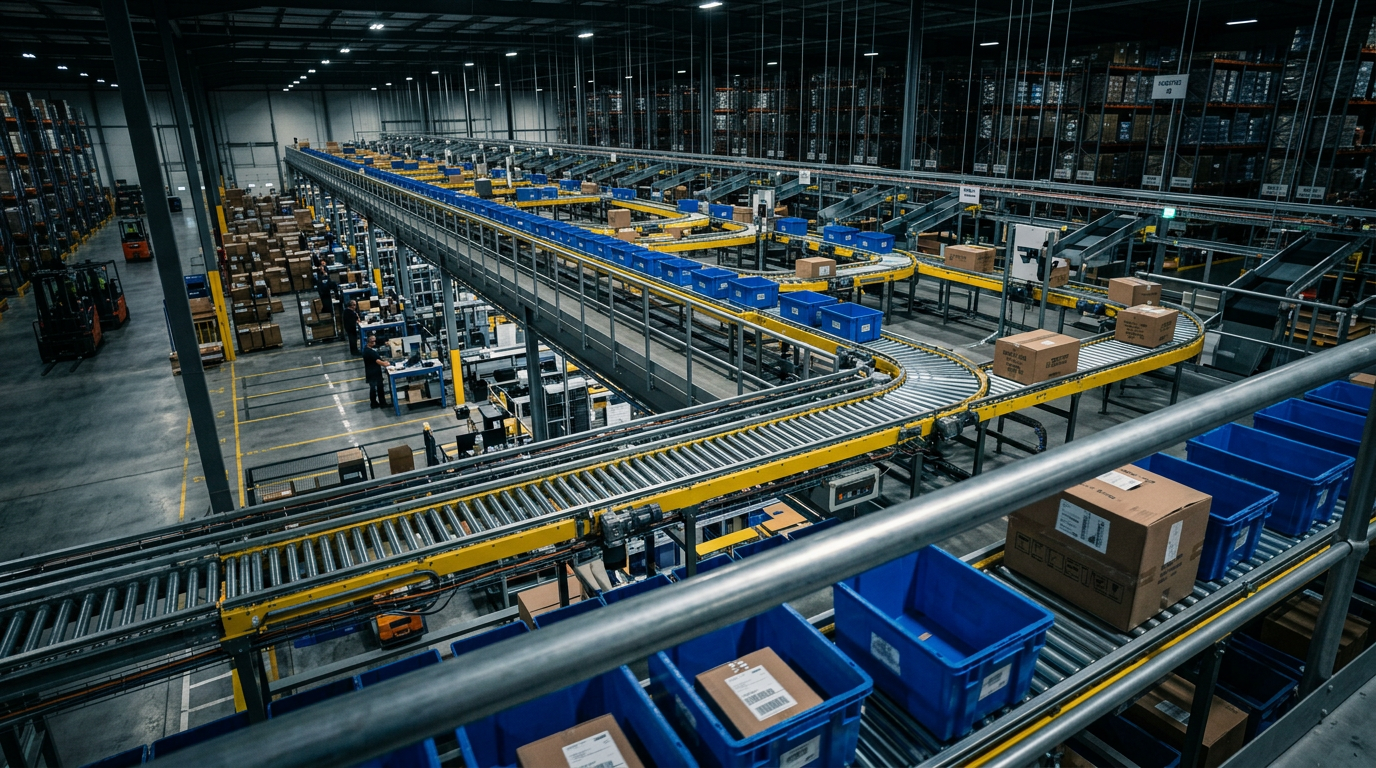
Selecting the optimal case and tote conveyors for 3PL warehouses requires balancing a throughput density of 1,500 to 3,000 units per hour with modular scalability to handle seasonal peaks. In modern high-volume fulfillment, 24V DC Motorized Drive Roller (MDR) technology has become the industry standard for tote handling, offering up to 50% energy savings over traditional AC gearmotors by utilizing "run-on-demand" logic.
The Role of Modular Conveyors in 3PL Scalability
Third-party logistics (3PL) providers operate in a landscape defined by razor-thin margins and volatile contract lengths. Unlike a captive manufacturing facility, a 3PL warehouse must remain "agile." This means the conveyor infrastructure cannot be a rigid, floor-bolted monument. It must be a reconfigurable asset.
Modular case conveyors allow for rapid layout changes. When a new e-commerce client signs a two-year contract requiring specialized kitting, the 3PL must be able to insert new pack stations or divert loops within a weekend. This is where Easy Conveyors excels, providing the modular building blocks—like roller tracks and belt modules—that allow engineers to snap together complex systems without extensive on-site welding or custom fabrication.
Key Technologies: MDR vs. AC Gearmotors
The choice of drive technology dictates the long-term Opex of a fulfillment center. For light-to-medium loads (totes and cases under 35kg), 24V or 48V DC rollers are superior.
| Feature | 24V DC Motorized Roller (MDR) | Standard AC Gearmotor |
|---|---|---|
| Energy Consumption | Low (Run-on-demand) | Medium (Continuous run) |
| Noise Level | < 60 dB | > 75 dB |
| Maintenance | Plug-and-play replacement | Oil changes/alignment required |
| Efficiency Class | IE3/IE4 equivalent | Variable (IE1 to IE3) |
| Safety | Low voltage (Safe touch) | High voltage (400V typical) |
| Control | Integrated ZPA logic | Requires external VFD/PLC |
Zero Pressure Accumulation (ZPA)
In a 3PL environment, totes often queue before a sortation manifold or a print-and-apply labeling station. ZPA is critical here. It prevents products from touching each other, eliminating "back pressure" which can damage fragile goods or cause thin polybags to get pinched between rollers. Modern systems utilize photo-eye sensors at every zone to ensure that a motor only turns on if the zone ahead is clear and a package is present.
Sorting and Diverting Strategies
Efficiency in a 3PL warehouse is often won or lost at the shipping sorter. When handling a mix of cardboard cases, plastic totes, and padded mailers, the diverting mechanism must be versatile.
- Right-Angle Transfers (RAT): Ideal for tight footprints. These use small pop-up rollers or belts to move the tote 90 degrees.
- Swivel Wheel Diverts: High-speed sorters capable of handling up to 100 cartons per minute. These are essential for 3PLs serving high-volume retail replenish contracts.
- Pusher Diverts: Lower cost but higher impact. Not recommended for fragile electronics or open-top totes.
For 3PLs managing diverse inventory, the friction coefficient of the conveyor surface is a vital design parameter. For instance, plastic totes move differently than recycled corrugated cardboard. Engineers must specify rollers with polyurethane sleeves to increase grip on plastic surfaces, ensuring consistent acceleration and deceleration.
Easy Conveyors stocks the material handling discussed here — ready to ship across Europe.
Integration with Warehouse Management Systems (WMS)
Sophisticated case and tote conveyors are no longer "dumb" hardware. They are the physical extension of the WMS. Through Ethernet/IP or PROFINET interfaces, the conveyor system provides real-time data on:
- Throughput Statistics: Units per hour (UPH) per zone.
- Preventative Maintenance: Monitoring current draw in drum motors to predict bearing failure.
- Volume Dimensioning: Integrated scanners that measure box size to optimize shipping lane assignments.
When designing these systems, adhering to standards like IEC 60034-30-1 for motor efficiency and ISO 13849-1 for safety-related parts of control systems ensures the facility meets global insurance and safety requirements.
Common Failure Modes in 3PL Systems
Despite their robust design, high-duty cycle conveyors fail if mismanaged.
- Sensor Misalignment: The most frequent cause of "ghost" jams. High-vibration areas can loosen photo-eye brackets.
- Debris Accumulation: 3PLs handling apparel often face issues with loose threads or plastic wrap tangling in roller bearings.
- Overloading: Exceeding the rated weight capacity of an MDR zone can lead to thermal shutdown of the internal motor controller.
To mitigate these, 3PL managers should prioritize drum motor selection for areas requiring high ingress protection and VFD soft-start tuning for heavy-duty incline sections where traditional across-the-line starting would cause belt slippage.
Design Rules of Thumb for 3PL Tote Loops
When sizing a new tote handling system, engineers should follow these baseline metrics:
- Pitch: Ensure the roller pitch (distance between centers) is at most 1/3 the length of the smallest item. For a 300mm tote, a 75mm or 100mm pitch is required.
- Incline Limits: Standard friction belts can handle up to 15-18 degrees. For steeper inclines, "rough top" belts or "cleated" modular belts are necessary.
- Clearance: Always allow 50mm of clearance on each side of the widest tote for guardrail safety.
By focusing on modularity and energy-efficient drive technology, 3PL providers can build a material handling backbone that grows with their clients and survives the rigors of peak season demand.
Frequently Asked Questions
Why is 24V MDR technology preferred over traditional AC motors in 3PLs?
MDR systems are significantly more energy-efficient because they use Zero Pressure Accumulation (ZPA) logic, where motors only run when a package is present, unlike traditional AC motors that run continuously. Individuals zones can be powered down during gaps in product flow.
What is the best conveyor surface for plastic totes?
For cardboard cases, standard galvanized rollers are sufficient. For plastic totes, polyurethane-coated rollers or high-friction modular belts are recommended to prevent slipping during acceleration and braking.
What is the standard clearance for tote conveyors?
Current industrial standards and insurance requirements typically necessitate a safety clearance of at least 50mm on either side of the largest transported unit to prevent pinch points.
How does modularity help a 3PL manage seasonal demand?
Modular conveyors use standardized segments (straight, curves, merges) that can be bolted together. This allows a 3PL to reconfigure their warehouse layout in days rather than weeks, making it easier to adapt to new client contracts.